


Syllabus: GS3/Environment
Context
- The Supreme Court accepted the recommendations of a Union Environment Ministry panel on the definition of Aravalli Hills to restrict mining.
About
- The Supreme Court has accepted the committee’s recommendations relating to:
- the uniform definition of the Aravalli Hills and Ranges;
- prohibition of mining in core/ inviolate areas;
- and measures for enabling sustainable mining and preventing illegal mining in the Aravalli Hills and Ranges.
Background
- For decades, the Aravalli hills have been under severe pressure from mining, both legal and illegal, and other development activities such as construction.
- Last year, the SC had asked the government to come up with an uniform definition of the Aravalli.
- While the FSI has been using a 3-degree slope yardstick to define Aravalli Hills since 2010, a technical committee formed for the purpose in 2024 modified the benchmark.
- It defined any landform with a slope of at least 4.57 degrees and a height of at least 30m to identify as Aravalli Hills.
- These yardsticks would effectively cover up to 40% of the Aravallis.
New Definition by Panel
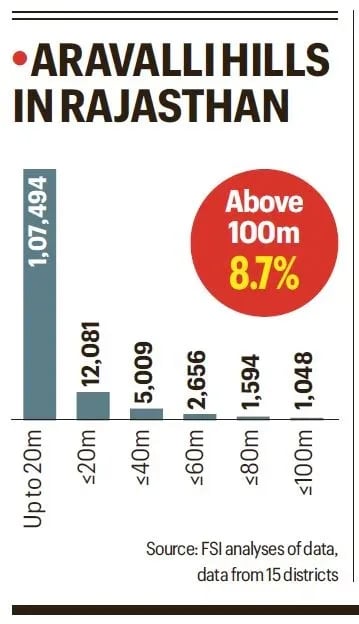
- Any landform that is at an elevation of 100 m or more above the local relief will be considered as part of Aravalli Hills along with its slopes and adjacent land.
- By this definition 90% of the Aravali Hills will not be counted as Aravalli anymore.
- As per an internal assessment by the Forest Survey of India (FSI): Barely 1,048, or just 8.7% spread across 15 districts in Rajasthan, are 100 m or more in height.
- The 20m height cut-off is crucial for a hill’s function as a wind barrier.
The Aravalli Range
- The Aravalli Range, stretching over approximately 692 kilometres (430 miles) in a northeastern direction, traverses the Indian states of Gujarat, Rajasthan, and Haryana before culminating in Delhi, is the oldest mountain range in India.
- Rajasthan accounts for nearly two-thirds of the mountain range.
- The mountain range is characterised by rugged hills, rocky outcrops, and sparse vegetation, and it plays a crucial role in the region’s ecology and hydrology.
- The Aravallis serve as a natural barrier against desertification, and helps regulate the climate, supports diverse ecosystems, and acts as a watershed for several rivers, including the Sabarmati, Luni, and Banas.
- Rich in biodiversity, the Aravallis are home to a variety of flora and fauna, including dry deciduous forests, scrublands, and grasslands, as well as numerous species of mammals, birds, reptiles, and insects.
Concerns with the New Definition
- By this definition, more than 90% of the Aravali Hills will not be counted as Aravalli anymore and be potentially open to mining and construction with severe environmental ramifications, including the quality of air in the NCR.
- Area excluded: The ministry’s list of 34 Aravalli districts across four states left out many districts with an established presence of Aravalli.
Way Ahead
- Accepting the 100-m height definition, the SC has asked the ministry to develop a Management Plan for Sustainable Mining with the help of Indian Council of Forestry Research and Education (ICFRE) for the Aravalli Hills under the new definition.
Source: IE
Previous article
Digital Sovereignty
Next article
News in Short – 27 November, 2025
