


Syllabus:GS3/Economy
In News
- The 2026–27 Union Budget announced an integrated East Coast Industrial Corridor with a key node at Durgapur, creating modern, globally competitive industrial hubs and greenfield investment regions.
- 11 industrial corridors are planned across the country, spanning North–South and East–West belts.
Industrial Corridors
- They are linear development zones that connect major economic centres through an integrated network of roads, railways, ports, and airports.
- Industrial corridors play a fundamental role in metamorphosing regional economies by creating environments where industries can operate efficiently, sustainably, and competitively.
Features
- Promotion of accelerated industrial growth by strengthening the link between industry and core infrastructure.
- Creation of globally comparable infrastructure along a defined pathway, offering a competitive and business-friendly environment.
- Facilitation of economic agglomeration and industrial clustering, helping regions maximise their growth potential.
- Optimal utilisation of regional strengths through focused investments and planned industrial development.
- Development along major transport arteries, particularly rail trunk routes, ensuring strong connectivity for efficient movement of freight and the public.
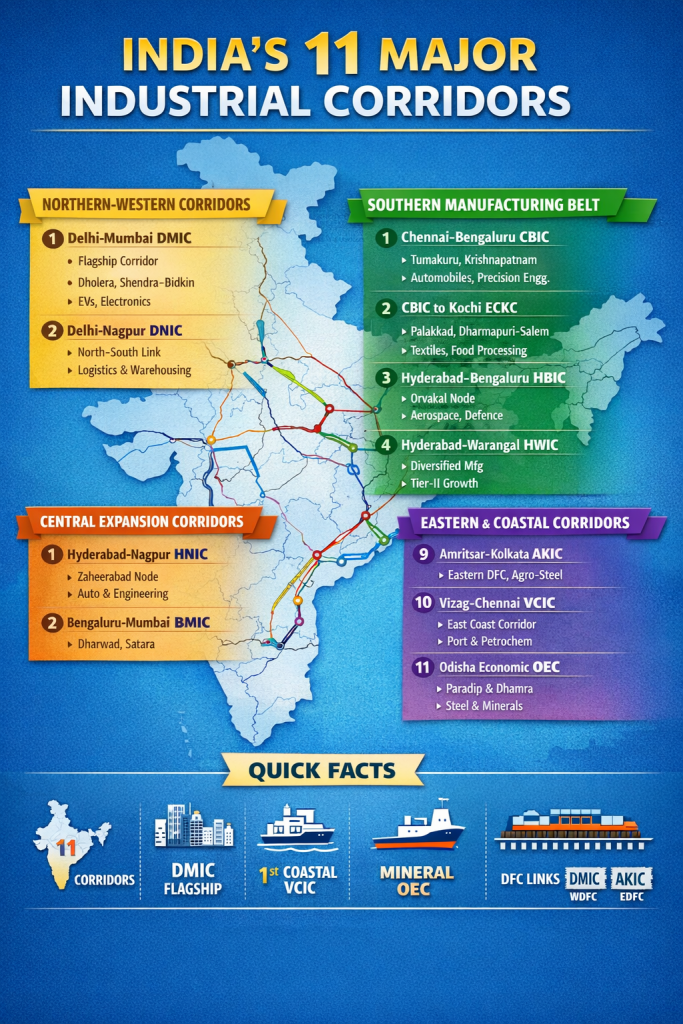
Importance
- Integrated infrastructure strengthens industrial efficiency: Multimodal transport networks, reliable utilities, and ICT-enabled services create a unified ecosystem that supports efficient industrial operations and the movement of goods.
- Plug-and-play ecosystems accelerate business readiness: Ready-to-use facilities, assured utilities, and streamlined approvals reduce setup time, helping industries begin operations quickly and competitively.
- Sustainability initiatives ensure responsible growth: Renewable energy adoption, waste recycling systems, and green building norms help industries expand while limiting environmental impact.
- Skill development initiatives encourage regional employment: Training programmes and partnerships with educational institutions build a skilled workforce, generating jobs and strengthening local economies.
- Special Economic Zones attract investment and promote exports: SEZs offer tax incentives and regulatory advantages that draw foreign investment and enhance India’s position in global value chains.
- Public-Private Partnerships improve development outcomes: Cooperative models between government and industry ensure better planning, efficient resource use, and effective management.
- Walk-to-work planning elevates quality of life and productivity: Reduced commuting, lower pollution, pedestrian-friendly layouts, and green spaces support healthier lifestyles and more productive urban environments, making industrial cities attractive to investors and workers alike.
Governments steps
- The Government of India is developing multiple Industrial Corridor Projects under the National Industrial Corridor Programme (NICDP), guided by the PM GatiShakti framework to ensure coordinated, multimodal connectivity for major economic zones.
- The National Industrial Corridor Development Corporation Limited (NICDC), previously known as Delhi Mumbai Industrial Corridor Development Corporation Limited (DMICDC), was incorporated in January 2008 for the development, coordination, and implementation of the National Industrial Corridor Development Programme (NICDP) by the Government of India.
Source :PIB
Previous article
Attracting Talent Positioned Abroad
Next article
News In Short 27-02-2026
