


Syllabus: GS2/ Polity and Governance
Context
- The Prime Minister inaugurated and laid the foundation stone for multiple development projects in Imphal, Manipur.
Key Highlights of Development Projects
- Infrastructure and Connectivity:
- Launch of the Manipur Urban Roads Project with an investment of over ₹3,600 crore to boost road connectivity and improve urban infrastructure in Imphal.
- The Jiribam-Imphal railway line, worth ₹22,000 crore, will soon connect Imphal to the national rail network.
- Imphal Airport has been expanded with ₹400 crore investment, and helicopter services inaugurated to enhance air connectivity.
- Civil Secretariat building (worth ₹538 crore) and Police Headquarters (₹101 crore) inaugurated to improve governance.
- Digital and IT Initiatives:
- Manipur Infotech Development Project aiming to boost IT and startup ecosystem in the state.
- Women Empowerment:
- Inauguration of four new Ima Markets (women-only markets) reinforcing Manipur’s women-led economy tradition.
- Construction of working women’s hostels at nine locations to empower women and support education and employment.
- Sports and Culture:
- Support for National Sports University and Khelo India initiatives.
- Promotion of polo through the Marjing Polo Complex, which includes the world’s tallest polo statue.
Background
- An ethnic conflict broke out in May 2023, between the Meitei people who dominate the Imphal valley and the Kuki-Zo people who dominate the surrounding hills.
- The violence has claimed above 250 lives and displaced over 60,000 people.
- The conflict originated from the Meitei demand for Scheduled Tribe (ST) status, which the Kukis opposed. By getting ST status, the Meiteis wants to;
- Access to constitutional safeguards such as reservations in jobs, education, and political representation.
- Rights to purchase land in the hill areas, which are currently reserved for tribal communities (mainly Kuki-Zo and Naga groups).
- A political crisis erupted in the State after the resignation of the Chief Minister and the subsequent imposition of President’s Rule.
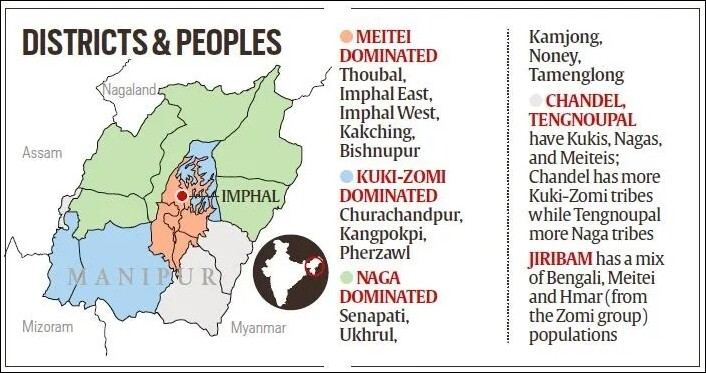
What are the Key Unresolved Issues in Manipur?
- Rehabilitation of Displaced Families: There are more than 280 relief camps in Manipur, sheltering about 57,000 people, many displaced for over two years.
- Restrictions on Movement: During the conflict, “buffer zones” were set up as militarised boundaries separating the valley and hill districts.
- These zones restricted free movement, with Meiteis in the valley cut off from certain services and Kuki-Zo groups unable to access Imphal and other valley-based facilities.
- Border Concerns: The porous international border with Myanmar is an issue. Meitei leaders allege that unchecked migration of Chin people (ethnically related to Kuki-Zo) is worsening tensions.
- The Government scrapped the Free Movement Regime, which allowed border tribes to travel up to 16 km into either country without visa, and plans to fence the border.
- These measures have met opposition from Kuki-Zo and Naga communities, who have cultural, economic ties across the border.
- Political Vacuum: There is a need to ensure good governance and justice in Manipur, creating conditions for stability and development in the State.
- Dialogue Still Missing: Though large-scale violence has reduced since late 2024, there is no sustained dialogue between Meitei and Kuki-Zo communities.
Demand for Separate Administration
- The Kuki-Zo Council has demanded for their hill areas of Manipur to be carved out administratively from the rest of the state, specifically, as a Union Territory (UT) with a legislature under Article 239A of the Indian Constitution.
- Article 239A of the Indian Constitution grants the Parliament the power to create a local legislature or a Council of Ministers, or both, for certain Union Territories.
- This provision was inserted into the constitution by the 14th Amendment Act of 1962.
- However, Meitei organisations like COCOMI strongly oppose the proposal, viewing it as a threat to Manipur’s territorial integrity and a step toward “ethnic partition.”
Need for Development
- Infrastructure and connectivity improvements are critical for trade, mobility, and access to healthcare and education.
- Digital and IT sector growth can provide employment, entrepreneurship opportunities, and integration with the broader economy.
- Women-centric initiatives like Ima Markets help preserve cultural identity while boosting local economies.
- Peace-building efforts and targeted relief for displaced groups are crucial for social cohesion and long-term stability.
- Regional integration through infrastructure aligns with the Act East Policy and fosters economic collaboration with Southeast Asia.
Way Ahead
- A sustainable peace in Manipur requires inclusive dialogue between Meitei and Kuki-Zo groups, backed by neutral mediation.
- The government must prioritise rehabilitation of displaced families with dignity and livelihood support. At the same time, balanced border management and strengthening of local governance institutions can reduce alienation.
- In the long run, a political settlement that safeguards tribal rights while preserving Manipur’s territorial integrity is essential.
Source: TH
Previous article
Pendency in Supreme Court Reaches All-Time High
