


Syllabus: GS2/ International Relation
In News
- The US has released the National Security Strategy (NSS) 2025, marking a decisive departure from post-Cold War American foreign policy frameworks to the “Make America Great Again (MAGA)” agenda at the heart of U.S. global strategy.
How does MAGA shape the new NSS?
- Focused national interest: Only issues directly affecting core US security and prosperity are treated as strategic; the document explicitly criticises earlier “global domination” ambitions.
- Regional Priorities: It puts the Western Hemisphere at the top, announcing a “Trump Corollary” to the Monroe Doctrine to re‑assert US pre‑eminence in the Americas, curb Chinese and other extra‑regional influence.
- The Monroe Doctrine was a foreign policy principle declared by US President James Monroe in 1823, asserting that the Western Hemisphere was closed to future European colonization, the US would oppose any European intervention in independent American states.
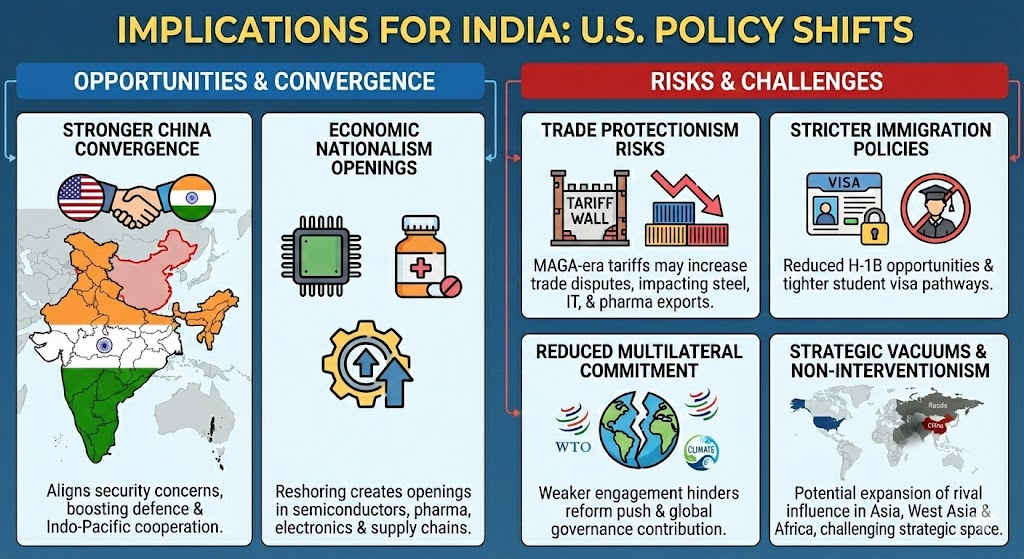
- Primacy of nations and sovereignty: It asserts the nation‑state as the fundamental unit, defends US sovereignty against international institutions and “transnationalism”, and encourages all states to put their own interests first.
- Predisposition to non‑interventionism: It sets a high bar for interventions abroad, criticising “forever wars”, while still insisting the US maintain overwhelming military strength (“peace through strength”).
- Economic nationalism: It elevates reindustrialisation, reshoring, tariffs, balanced trade, and “energy dominance” (including rejection of Net Zero/climate agendas) to central security objectives, aligning directly with MAGA economic themes.
- End of mass migration: It declares that “the era of mass migration is over”, treats border security as the primary element of national security, and links migration, drugs, and crime as core threats—again mirroring MAGA domestic politics in the external strategy.
- Stronger China Convergence: The 2025 US National Security Strategy explicitly positions China as America’s primary strategic challenge, representing a sharpened focus on containment and competition in the Indo-Pacific.
Source: TOI
