


Syllabus: GS2/IR
Context
- India has assumed the chair of the Kimberley Process (KP) for the year 2026.
- The chair oversees the implementation of the Kimberley Process Certification Scheme (KPCS) and operations of the working groups, committees and administration that activate the KP.
Kimberley Process (KP)
- The KP is a multinational mechanism or structure for governing the trade of ‘conflict diamonds’.
- These are rough (or pre-polished) diamonds which are used illegally by rebel or insurgent groups across the world to undermine or threaten legitimate governments.
- The KP was initiated in 2000 when the countries of southern Africa initiated dialogues to prevent the trade in conflict diamonds.
- Negotiations with 37 signatory parties, in 2003, led to the Kimberley Process Certification Scheme (KPCS).
- KPCS is the mechanism the KP uses to prevent the trade of conflict diamonds.
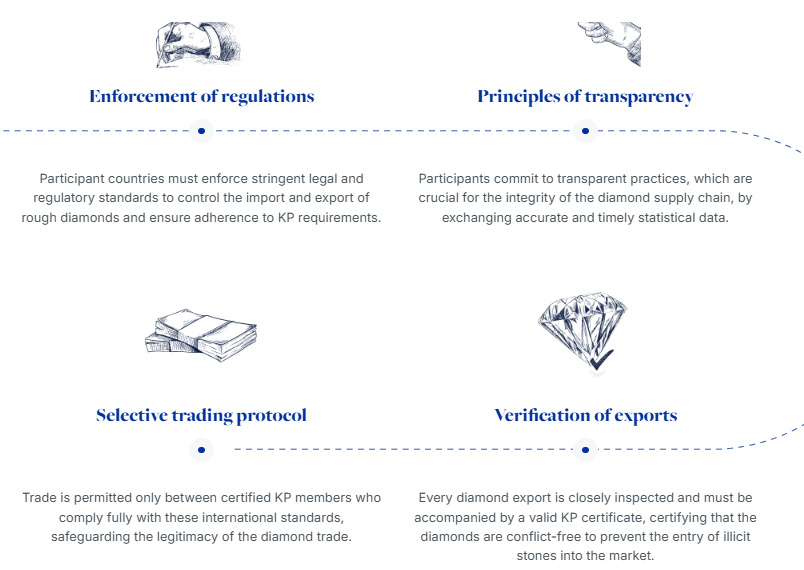
- It is enforced individually by KP Participant countries to ensure that rough diamonds in the legitimate supply chain are KP-compliant.
- The KP has 60 participants, representing 86 countries, and accounts for approximately 99.8% of the global rough diamond production.
Trade in Rough Diamonds
- The trade is permitted only between certified KP members who comply fully with these international standards.
- Obligations for Countries: Participant countries are obliged to share timely and accurate statistical data for diamond production and trade.
- Major Producer: Angola, Botswana, Canada, Congo, Namibia and Russia alone account for more than 85% of the production of rough diamonds, in quantity and value terms.
- Though India is not a producer, it is a major importer of rough diamonds, importing roughly 40% of the total global imports.
- India is a leading cutting and polishing hub, centered in Surat and Mumbai.
- India re-exports polished diamonds to major markets which include China, Hong Kong, Israel, the United Arab Emirates and the United States.
- India’s Relevance to KP: India’s strategic position, at the heart of the global diamond value chain, gives it unique leverage within the KP to steer meaningful reforms in global diamond governance.
Concerns
- Definition of Conflict Diamonds: Its scope is very narrow, capturing only the financial mechanism between rebel groups and governments, while ignoring the illicit use of rough diamonds in state-linked abuses, human rights violations and human trafficking, environmental harm, abuses in artisanal mining, and illicit trade channels.
- Decision Making Process: Consensus-based system allows any participant to exercise a political veto, this weakens enforcement and credibility of KP decisions.
How India can Bring Reforms?
- Agenda Expansion: As KP Chair, India can form a technical working group on violence and human rights risks beyond rebel insurgencies, building evidence and consensus before any redefinition of “conflict diamonds,” without reopening political deadlocks.
- Technology-Led Transparency: India can leverage its digital strengths to introduce tamper-proof, blockchain-based KP certification, with unique, time-stamped shipment records and harmonised customs data exchange to curb fraud and modernise KP operations.
- Capacity Building over Punitive Measures: Establish regional KP technical hubs in central and eastern Africa to provide training, IT support, certification assistance and forensic capacity, making compliance collaborative rather than coercive.
- Institutional Accountability Reforms: Promote independent or third-party audits for selected KP participants and push for full public disclosure of granular KP statistics to enhance credibility and trust.
- From Restriction to Responsibility: Reorient KP’s narrative from merely blocking conflict diamonds to enabling a responsible, inclusive and community-benefiting diamond trade, ensuring revenues support health, education and local infrastructure in mining regions.
Source: TH
Previous article
India and Greece Bilateral Ties
