


Seine River
Syllabus: GS1/ Geography
Context
- After a century-long ban due to pollution, swimming in Paris’s River Seine is now permitted in designated zones.
- The reopening follows a 1.4 billion euro ($1.5 billion) cleanup plan linked to the 2024 Olympics.
About the River
- Origin: The Seine River originates from the Langres Plateau in northeastern France.
- Length: Approximately 777 kilometers long.
- Major Tributaries: Aube, Marne, Yonne, Oise, and Eure rivers.
- Economic Role: Around 20 million tonnes of goods are transported on it every year, making it France’s second-busiest river and reducing road traffic by an estimated 800,000 truck journeys.
- UNESCO Status: The Banks of the Seine in Paris were inscribed as a UNESCO World Heritage Site in 1991.
Source: TOI
Sheesh Mahal (Glass Palace)
Syllabus: GS1/History
In News
- The Sheesh Mahal was restored and officially unveiled by Union Culture and Tourism Minister Gajendra Singh Shekhawat.
| Do you know? – Shalimar Bagh was originally known as Aizzabad Garden, and is believed to have been commissioned by Shah Jahan in memory of Aizzun-Nisha Begum. – The name Shalimar—derived from ‘Shala’ and ‘Mara,’ meaning ‘abode of pleasure’—was reportedly given by the emperor himself. |
Sheesh Mahal
- It is located in Shalimar Bagh, North Delhi .
- It was built in 1653 during Emperor Shah Jahan’s reign.
- The palace and its surrounding gardens—now protected monuments under the Archaeological Survey of India (ASI).
- The Sheesh Mahal also holds historical significance as the site of Aurangzeb’s first coronation in 1658.
Source: IE
Kaladan Multimodal Transit Transport Project (KMTTP)
Syllabus: GS2/ International Relation
In Context
- The Kaladan Multimodal Transit Transport Project (KMTTP) between India and Myanmar would be operational by 2027.
About Kaladan Multimodal Transit Transport Project (KMTTP)
- It is a major infrastructure initiative jointly developed by India and Myanmar to enhance connectivity between India’s eastern seaboard and its landlocked northeastern states, using a combination of sea, river, and road transport.
- The project is entirely funded by India under its Grant in Aid Scheme, with the Inland Waterways Authority of India as the project development consultant
- Components:
- Sea Route: Connects Kolkata Port (India) to Sittwe Port (Rakhine State, Myanmar) across the Bay of Bengal, covering about 539 km.
- River Route: From Sittwe, cargo is transported via the Kaladan River to Paletwa (158 km).
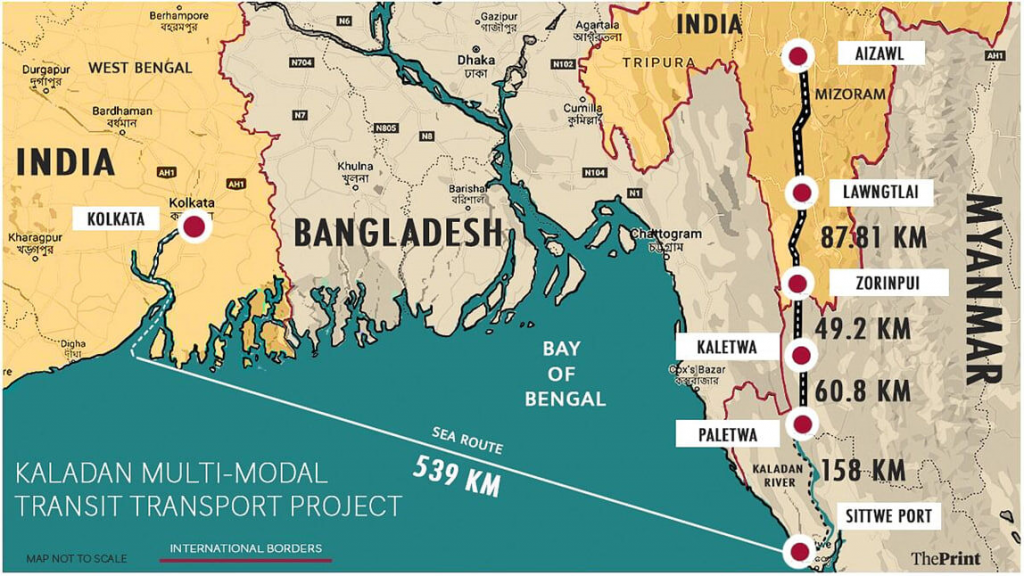
Significance
- Provides a strategic alternative to the narrow and vulnerable Siliguri Corridor (also known as the “Chicken’s Neck”), which is currently the only land route connecting Northeast India to the rest of the country.
- Expected to boost trade and economic integration for India’s northeastern states by providing direct access to the sea and Southeast Asian markets.
- Strengthens India’s ‘Act East’ policy, fostering closer ties with Southeast Asia and reducing dependence on routes vulnerable to geopolitical risks.
- Enhances border trade and offers northeastern states opportunities to access new markets in Myanmar, Thailand, Malaysia, and Singapore.
Source: TOI
2nd Edition of the NER District SDG Index
Syllabus: GS2/ Governance
Context
- The second edition of the North Eastern Region (NER) District Sustainable Development Goals (SDG) Index Report (2023-24) was released by NITI Aayog.
About
- The Index is developed by NITI Aayog and the Ministry of Development of North Eastern Region (MoDoNER), with support from the United Nations Development Programme.
- The Index, builds upon the momentum of the first edition released in 2021, measures the performance of districts across eight North Eastern States on the SDGs.
Key Findings
- Districts are categorised into four categories:
- Achiever: Score equals 100 (achieved the targets set for identified indicators);
- Front Runner: Score between 65 and 99 (excluding 100);
- Performer: Score between 50 and 65 (excluding 65); and
- Aspirant: Score less than 50.
- All districts in Mizoram, Sikkim and Tripura have achieved Front Runner status, with no districts falling in the Aspirant or Achiever categories.
- Mizoram has the highest-scoring district in the entire Northeast region (Hnahthial at 81.43) and Arunachal Pradesh has the lowest-scoring district in the entire region (Longding at 58.71).
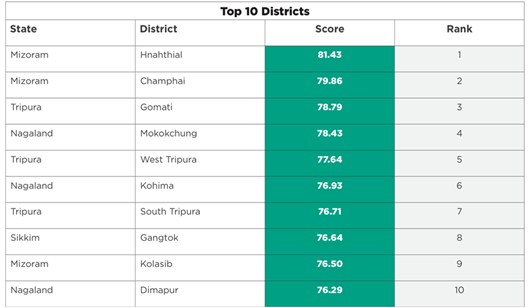
Importance
- The NER District SDG Index 2023-24 serves as a critical policy tool for evidence-based planning, resource allocation, and monitoring of developmental efforts.
- The index report provides detailed district-level analysis and recommendations for accelerating progress towards achieving the SDGs by 2030, ensuring that no district is left behind in the region’s development journey.
| Sustainable Development Goals (SDGs) – Adoption: The United Nations General Assembly, during its 70th Session in 2015, adopted the document titled “Transforming our World: The 2030 Agenda for Sustainable Development.” 1. This document outlines 17 Sustainable Development Goals (SDGs) and 169 associated targets. – The SDGs, also known as the Global Goals, came into force with effect from 1st January 2016. – Aim: The SDGs serve as a comprehensive blueprint aimed at achieving a better and more sustainable future for all. 1. The goals call for action on addressing global challenges such as poverty, inequality, climate change, environmental degradation, peace and justice. – Applicability: The SDGs are universal, applying to all nations—developed, developing and least developed countries. 1. Countries are primarily responsible for following up and reviewing the progress made in implementing the goals and targets at the national level until 2030. – Legality: The SDGs are not legally binding, but they have effectively become international obligations and have the potential to reorient domestic spending priorities in countries. 1. Countries are expected to take ownership and develop a national framework to monitor these goals. |
Source: PIB
Colombia and Uzbekistan Joined New Development Bank (NDB)
Syllabus :GS2/IR
In News
- Colombia and Uzbekistan have officially joined the New Development Bank (NDB), expanding the multilateral lender’s membership to 11 countries.
New Development Bank (NDB)
- Establishment: The NDB was founded in July 2014 at the 6th BRICS Summit in Fortaleza, Brazil, and became operational in July 2015.
- Headquarters: Shanghai, China
- Mandate: The bank’s primary goal is to finance infrastructure and sustainable development projects that contribute to economic growth and development in member countries and beyond.
- Capitalization: The initial authorized capital of the NDB is $100 billion, with each founding member contributing an equal share.
- Members: India, Brazil, Russia, China, South Africa, Bangladesh, UAE, Egypt, and Algeria are members of NDB.
- Governance: The NDB is governed by a Board of Governors and a Board of Directors, with each member country having equal voting rights, reflecting the principle of equality among founding members.
Source :TH
UAE’S Golden Visa Scheme
Syllabus :GS2/IR
In News
- The United Arab Emirates government has introduced a pilot nomination-based golden visa programme for residents of India and Bangladesh.
What are Golden Visas?
- They are immigration schemes that allow individuals to gain residency in a country by making significant financial investments, such as in real estate or government bonds, without meeting traditional requirements like job offers or educational qualifications.
- Some countries also offer golden passports, granting citizenship through investment.
UAE’s Golden Visa Scheme
- The UAE’s golden visa offers long-term residency (5–10 years) without a sponsor, allowing individuals and their families to live, work, and study in the country.
- Under the “new nomination-based visa policy,” Indians can now enjoy lifetime residency in the UAE by paying a fee of AED 1,00,000 (approximately INR 23.30 lakh).
- It is aimed at enhancing business and economic growth.
- There are two main categories of eligibility:
- Investors and Entrepreneurs: Must invest at least AED 2 million in business or real estate (approx ₹4.67 crore), or
- Start a project worth at least AED 500,000 (approx ₹1.17 crore).
- Outstanding Special Talents: Includes doctors, scientists, artists, inventors, executives, athletes, PhD holders in priority fields, and exceptional students.
- Investors and Entrepreneurs: Must invest at least AED 2 million in business or real estate (approx ₹4.67 crore), or
- It will be managed by the Rayad Group and the process includes background checks (criminal records, anti-money laundering, social media activity) to assess the applicant’s potential contribution to sectors like culture, finance, science, and business. Final approval lies with the UAE government, and applicants can apply remotely via OneVASCO centres without visiting Dubai.
- Once granted, the visa allows recipients to relocate with family, employ staff, and engage in business or professional work in the UAE.
Source :IE
Enemy Property Act,1968
Syllabus: GS2/ Governance
In News
- Recently, the Madhya Pradesh High Court has dismissed actor’s plea against the government’s decision to label his ancestral properties worth an estimated Rs 150 billion as enemy property.
What is Enemy Property?
- The concept of “enemy property” originated from the Defence of India Rules, 1962, which allowed the Indian government to take over assets of people who migrated to enemy countries during wartime.
- After the 1965 India-Pakistan war, properties left behind by those who became nationals of Pakistan or China were vested in the Custodian of Enemy Property for India, a government department under the Ministry of Home Affairs.
- The 1966 Tashkent Declaration between India and Pakistan included discussions about returning such properties, but while Pakistan sold off Indian assets, India retained control of these properties under the 1968 Act.
Enemy Property Act, 1968
- The Act empowers the government to appropriate and manage properties in India that belonged to people who took Pakistani or Chinese nationality after the wars.
- All rights, titles, and interests over enemy property are vested in the Custodian, and transfers by the original owners are declared void, even retrospectively.
- The Act was amended several times, most notably by the Enemy Property (Amendment and Validation) Act, 2017, to further strengthen government control and prevent legal challenges or claims of succession by heirs of those who migrated to enemy countries.
Current Status
- As of now, there are approximately 2,000 enemy properties in India, spread across states like West Bengal, Bihar, Uttar Pradesh, Delhi, Andhra Pradesh, and Gujarat.
Source: TOI
India Maize Summit 2025
Syllabus: GS3/ Agriculture
In News
- Union Minister of Agriculture and Farmers Welfare & Rural Development inaugurated the 11th edition of the India Maize Summit.
About Maize & its Production
- Maize, often known as Indian corn, is globally called the queen of cereals due to its highest genetic yield potential.
- In India, it is the third most important food crop after rice and wheat.
- Maize is a rainfed Kharif crop primarily grown in regions with semi-arid conditions (25 – 75 cm rainfall), where rice and wheat production is not feasible.
- In Tamil Nadu, maize is a rabi crop sown before the onset of the winter rainy season in September and October, as rains occur mostly in November and December in eastern Tamil Nadu.
- Maize can be grown in various soils, from loamy sand to clay loam.
- India’s maize production has grown from 10 Mn MT in the 1990s to 42.3 Mn MT in recent years, with a projected target of 86 Mn MT by 2047.
- Maize is cultivated in almost all Indian states, with the major producing states being Karnataka, Madhya Pradesh, Maharashtra, Bihar, and Uttar Pradesh.
Source: AIR
Fugitive Economic Offenders Act
Syllabus: GS3/Economy
Context
- A Delhi special court declared a UK-based arms dealer a Fugitive Economic Offender under the Fugitive Economic Offenders (FEO) Act.
Fugitive Economic Offenders Act
- A Fugitive Economic Offender (FEO) is a person:
- Against whom an arrest warrant has been issued for committing a scheduled economic offence involving ₹100 crore or more, and
- Who has left India to avoid criminal prosecution or refuses to return to face the legal process.
- It is defined under the Fugitive Economic Offenders Act, 2018.
- A director or deputy director (appointed under the Prevention of Money-Laundering Act, 2002) may file an application before a special court (designated under the 2002 Act) to declare a person as a fugitive economic offender.
- The director or deputy director may attach any property mentioned in the application with the permission of a special court.
- Appeals against the orders of the special court will lie before the High Court.
Source: IE
Previous article
India Reaffirms its Bioeconomy Target of $300 Billion by 2030
Next article
India and Brazil Held Bilateral Talks
