


Syllabus: GS3/Economy
Context
- NITI Aayog has released its report “Chemical Industry: Powering India’s Participation in Global Value Chains”.
About
- This report offers an extensive analysis of India’s chemical sector, highlighting both opportunities and challenges, and outlining a pathway for positioning India as a key player in global chemical markets.
- The chemical industry is a vast and diverse sector that encompasses the production, transformation, and distribution of chemical substances.
India’s Chemical Industry
- India is the sixth-largest chemicals producer globally and third in Asia and holds immense potential for expansion.
- Share in Global Chain: India has a 3.5% share in global chemical value chains.
- Market Size: With over $220 billion market size in 2023, it contributed around 7% to India’s GDP and provided vital raw materials to critical sectors such as agriculture, pharmaceuticals, textiles, automotive, and construction.
- Future Projection: The industry is poised to expand to $400–450 billion by 2030 and potentially reach $1 trillion by 2040.
Key Segments by Market Consumption
- Petrochemicals : These chemicals are derived from petroleum and natural gas through a refinement process and are also known as petroleum distillates.
- Petrochemicals form the biggest chemicals segment, with consumption of $65 to $75 billion. The production – consumption gap in these has remained negative over the years.
- Specialty Chemicals: Chemicals with high value but low production volume are considered specialty chemicals, such as paints and coating, dyes, agrochemicals, textile chemicals etc.
- This category constitutes around $40 to $ 45 billion of market consumption and over 50% of India’s chemical exports.
- Inorganic Chemicals: Fundamental to India’s industrial base, these chemicals provide essential materials for applications in construction, water treatment and electronics, among other sectors.
- They encompass a variety of substances such as metals, salts and minerals.
- They make up $15 to 20 billion of the total market consumption.
- Other Non-Core Segments: Other “non-core” chemicals categories include fertilizers, pharmaceutical products and medical devices and personal care consumer products.
- Together, they contribute around $90 billion in market consumption.
Major Constraints
- High Import Dependence: In 2023, India imported chemicals worth $75 billion compared to exports worth $44 billion, accounting for a trade deficit of around $31 billion; major imports were from China (30–35%).
- Low Investment in R&D: India’s low investment in R&D, with only 0.7% of investment against the global average of 2.3%, hampers indigenous innovation in high-value chemicals.
- Infrastructure Deficits: Infrastructure gaps, outdated industrial clusters, and high logistics costs have created a cost disadvantage compared to global peers.
- Regulatory Complexity: Delayed environmental clearances, multiple approvals hampers the growth of the sector.
- Skilled Talent Gap: The sector is hampered by a 30% shortfall in skilled professionals, particularly in emerging areas such as green chemistry, nanotechnology, and process safety.
- Low Diversification: Focus on bulk chemicals over high-value products.
Strategic Vision: Doubling India’s Global Value Chain Share by 2030
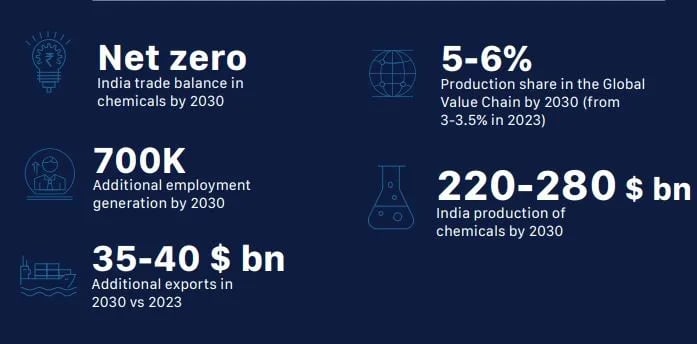
- Growth Drivers:
- Rapid urbanization and consumer demand.
- Supply chain shifts post-COVID and geopolitical tensions.
- India’s potential to serve as a reliable global partner.
Seven Strategic Interventions
- Intervention 1Establish World-Class Chemicals Hubs:
- Establishment of empowered committee at the Central level along with creation of a Chemical Fund under the committee with a budgetary outlay for shared infrastructure development, VGF, etc
- Revitalize existing hubs (Dahej, Paradip, Visakhapatnam, Cuddalore–Nagapattinam).
- Intervention 2 Strengthen Port Infrastructure:
- Establish chemical Committee at major ports.
- Develop 8 high-potential coastal clusters.
- Intervention 3 Introduce a Opex subsidy scheme for chemicals:
- Incentivize incremental production of chemicals based on import bill, export potential, single source country dependence, end-market criticality etc.
- The scheme proposes for incentives on incremental sales to selected participants for a fixed number of years.
- Intervention 4 : Develop and access technologies to enhance self-sufficiency and foster innovation:
- Disbursement of R&D funds to drive innovation with enhanced collaboration between industry and academia through creation of an interface agency in collaboration with DCPC and DST.
- Encourage MNC partnerships for access to global tech.
- Intervention 5 Streamline Environmental Clearances:
- Fast-track approval system with autonomy for EAC.
- “Deemed EC” if the delay exceeds 270 days.
- Clubbing EAC and EIAA for quicker processing.
- Intervention 6 Securing Free Trade Agreements (FTAs) to support Industry growth:
- Targeted negotiations for tariff quotas and critical feedstock exemptions.
- Simplify FTA compliance to widen industry access.
- Intervention 7 Talent and skill upgradation in the chemical industry:
- Expansion of ITIs and specialized training institutes.
- Design industry-aligned curricula in polymer science, petrochemicals, safety.
- Faculty training and PPP-based apprenticeship programs.
| Global Lessons: Case Study of China – China grew its global chemicals share from 6% in 2000 to 33–35% in 2023. – Invested in state-led infrastructure, R&D, and attracted FDI. – Achieved net export status through scale, self-sufficiency goals, and policy consistency. – This transformation over two decades began with a phase of massive overinvestment and oversupply, led by state-owned enterprises (SOEs) and a thrust on establishing small to medium-scale production. – India can adapt similar lessons while tailoring solutions to its federal structure and domestic capabilities. |
Way Ahead: Toward a $1 Trillion Industry
- India’s chemical industry sits at a pivotal juncture. The combination of domestic market strength, favorable policy momentum, and global supply chain realignments present an unprecedented opportunity.
- If the government successfully implements the seven-pronged intervention strategy, India can:
- Transform into a global manufacturing hub.
- Secure strategic autonomy in key chemical segments.
- Lead in green and innovation-driven chemical production.
- Achieving this would not only bolster India’s share in GVCs but significantly contribute to the $5 trillion economy vision.
Source: PIB
Previous article
IOC Asked India To Address the Structural Concerns
Next article
Concerns over IPS appointments in CAPFs
