

Syllabus: GS2/Governance
Context
- A Parliamentary Standing Committee had flagged serious weaknesses in India’s civil aviation safety ecosystem, months before the recent plane crash in Baramati in Maharashtra causing the death of Deputy Chief Minister.
About India’s Civil Aviation Safety Framework
- It is a multi-layered regulatory and oversight system led by the Ministry of Civil Aviation (MoCA) and implemented through specialized statutory bodies such as the Directorate General of Civil Aviation (DGCA), Aircraft Accident Investigation Bureau (AAIB), and Bureau of Civil Aviation Security (BCAS).
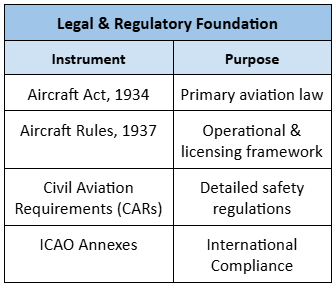
- The framework aligns closely with ICAO Standards and Recommended Practices (SARPs) and focuses on preventive safety, regulatory compliance, accident investigation, and continuous safety improvement through the State Safety Programme (SSP).
Parliamentary Standing Committee Overview
- The Standing Committee on Transport, Tourism and Culture presented its report on ‘Overall Review of Safety in the Civil Aviation Sector’ in August, 2025, assessing systemic safety challenges and proposing reforms across regulation, operations, and infrastructure. These include:
- Air Traffic Management Challenges: A shortage of Air Traffic Controllers (ATCOs) has increased workloads and fatigue-related risks.
- Training capacity has not kept pace with demand.
- The Committee recommended fatigue risk management systems, staffing audits, and expanded training capacity.
- Regulatory Autonomy and Capacity of DGCA: The Committee highlighted severe staffing shortages in the DGCA, with nearly 50% vacancies and limited recruitment autonomy.
- It recommended granting statutory and administrative autonomy, creating specialised recruitment mechanisms, and offering competitive compensation to attract skilled professionals.
- Modernisation of ATC Systems: Existing air traffic control automation systems suffer from performance degradation and lack advanced features like conflict detection and predictive analytics.
- The Committee urged timely modernisation with integration of Artificial Intelligence.
- Strengthening Safety Surveillance and Enforcement: Weak follow-through has led to unresolved concerns, including aircraft fitness while DGCA detects safety issues.
- The Committee recommended time-bound closure mechanisms and stronger enforcement, including financial penalties for non-compliance.
- Safety in Helicopter Operations: Helicopter accidents exposed regulatory gaps, especially in state-managed high-risk operations and lack of terrain-specific pilot training.
- The Committee proposed uniform national frameworks and mandatory terrain-specific training and certification.
- Addressing Recurring Operational Risks: Incidents such as runway incursions in 2024 exceeded safety targets. Persistent issues despite reviews indicate failure in systemic fixes.
- The Committee recommended mandatory root cause analyses and targeted remedial programmes.
- Error Reporting and Whistleblower Protection: Heavy penalties on individual ATCOs discourage voluntary error reporting.
- The Committee advised reviewing penal provisions and establishing clear whistleblower protection frameworks to promote a safety culture.
- Developing Domestic MRO Capabilities: Around 85% of MRO work is outsourced abroad, causing foreign exchange outflow and strategic dependence. Despite tax reductions, domestic MRO struggles to compete.
- The Committee called for a comprehensive policy review and further tax and incentive rationalisation.
- Aligning Airport Development with Fleet Expansion: Aircraft induction is outpacing airport infrastructure, causing capacity constraints at major hubs.
- The Committee recommended a National Capacity Alignment Plan and continued investment in pilot training and certification to meet future demand.
Learning from International Models
- The European Union Aviation Safety Agency (EASA) and US FAA have already embedded real-time crew monitoring and fatigue management systems into their safety protocols.
- EASA mandates a Resource Assurance Certificate before approving airline expansions, a practice India could replicate.
- Similarly, the Civil Aviation Authority of Singapore (CAAS) of Singapore uses predictive oversight models that combine machine learning with safety audits to flag anomalies early.
| Directorate General of Civil Aviation (DGCA) – It is India’s apex regulatory body for civil aviation, operating under the Ministry of Civil Aviation. – It was created in 1927 and became a statutory body in 2020 after amendments to the Aircraft Act. – Organizational Structure: a. Headquarters: Located in New Delhi. b. Regional Offices: Spread across major cities to manage local aviation oversight. Key Functions of the DGCA – Safety Oversight: DGCA is primarily responsible for enforcing civil air regulations, airworthiness standards, and air safety norms across all Indian civil aviation operations. – Licensing and Certification: Issues licenses to pilots, aircraft maintenance engineers, and air traffic controllers. – Certifies aircraft and aviation training organizations. – Regulation of Air Transport Services: Oversees scheduled and non-scheduled air transport services to, from, and within India. – Accident Investigation: Coordinates and monitors investigations into aviation accidents and incidents. – International Coordination: Represents India in the International Civil Aviation Organization (ICAO) and ensures compliance with global aviation standards. Recent Developments – eGCA Platform: A digital initiative to streamline licensing, approvals, and regulatory processes for stakeholders. a. eGCA 2.0, a digital transformation initiative to enhance transparency and reduce paperwork. – Drone Regulations: DGCA oversees the registration and regulation of Unmanned Aircraft Systems (UAS) in India. – Flight Duty Time Limitations (FDTL): Recently updated norms to address pilot fatigue and improve safety, which played a role in the recent IndiGo operational crisis. |
Previous article
India-Saudi Arabia: Deepening Strategic Partnership in Security
Next article
Intellectual Property and Space Activities
