


Syllabus: GS3/Internal Security
In News
- As per a report submitted in the Rajya Sabha, the Enforcement Directorate (ED) has taken up 5,892 cases under the Prevention of Money Laundering Act (PMLA) since 2015 but only 15 have resulted in convictions.
Money Laundering
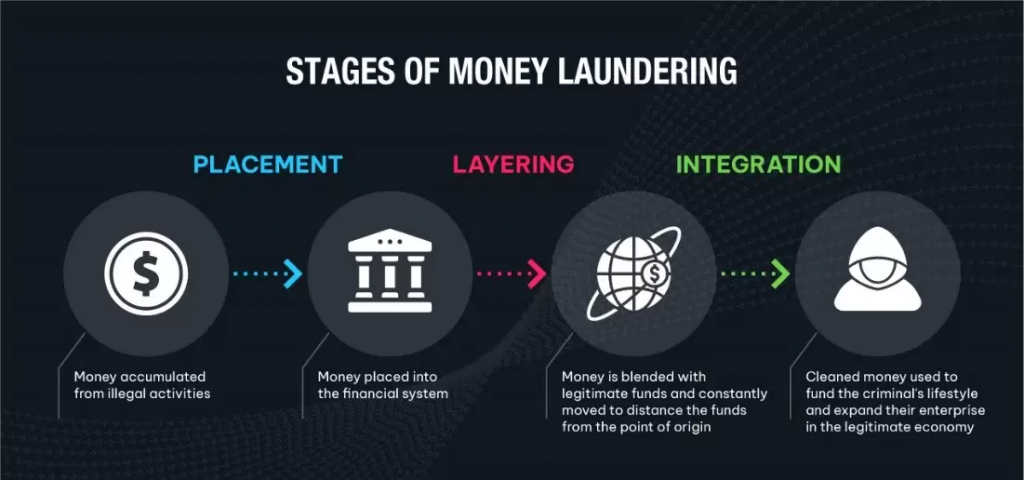
- Money laundering is the process of making illegally obtained money appear legitimate by channeling it through complex financial transactions.
- Under Section 3 of the Prevention of Money Laundering Act (PMLA), 2002, it involves concealing, possessing, acquiring, or using proceeds of crime and projecting them as untainted property.
- It occurs in three stages: placement (introducing illicit money into the system), layering (moving it through transactions), and integration (reintroducing it through assets or businesses).
Consequences Money Laundering
- Money laundering distorts asset prices, undermines fair competition, and destabilizes financial systems.
- For example: Punjab & Maharashtra Cooperative Bank (PMC Bank) crisis in 2019 had linkages to fund misreporting and money laundering.
- Illicit funds can influence elections, policy decisions, and threaten democratic institutions.
- Money laundering is closely linked to terror financing and cross-border criminal networks.
Issues in Tackling Money Laundering in India
- Regulatory Loopholes: Shell companies, informal money channels (like hawala), and real estate still remain underregulated.
- Crypto transactions are a rising blind spot and India lacks a clear legal framework as of 2025.
- Enforcement Challenges: Agencies like Enforcement Directorate (ED) and FIU-IND are often under-staffed and accused of selective action or political targeting (example: frequent ED raids before state elections).
- Judicial Delays: Convictions under PMLA (Prevention of Money Laundering Act) are dismal and highlight concerns about the effectiveness of enforcement and the government’s inability to control such financial crimes.
- Cross-border Complexity: Laundering networks are transnational and Indian agencies struggle with extradition, mutual legal assistance, and information-sharing.
- Panama Papers (2016) and Pandora Papers (2021) exposed several Indians with offshore assets.
Role of Prevention of Money Laundering Act 2002 (PMLA)
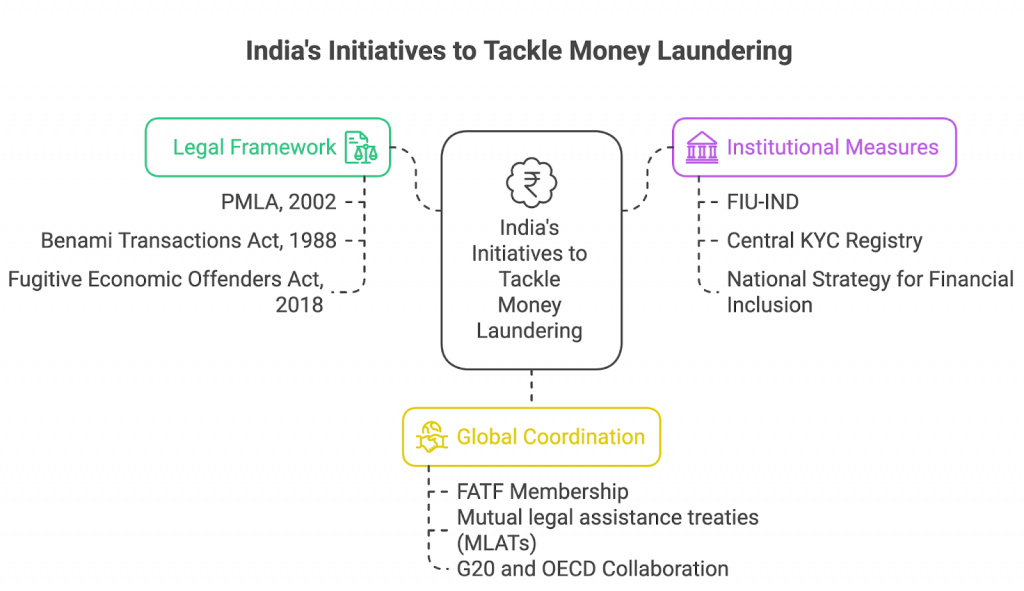
- The Prevention of Money Laundering Act, 2002 (PMLA) is a criminal law aimed at preventing money laundering and confiscating related property.
- It is aligned with the UN Political Declaration and Global Programme of Action adopted by the UN General Assembly in February 1990.
- The Enforcement Directorate (ED) is tasked with investigating, attaching properties, prosecuting offenders, and ensuring confiscation through Special Courts.
- A key aspect of the statute is that the burden of proof lies with the accused.
Supreme Court’s Observations
- The Supreme Court in Vir Bhadra Singh versus ED (2017) reaffirmed that the issuance of an Enforcement Case Information Report (ECIR) is sufficient to initiate proceedings, meaning that an FIR is not required to start action under the Act.
- In Vijay Madanlal Chaudhury vs Union of India (2022), the Supreme Court ruled that while a scheduled offence is required for prosecution under Section 3 of the PMLA, property can be attached under Section 5 without a pre-registered case.
Conclusion and Way Forward
- Money laundering is a socio-political and security threat, not just a financial crime. Despite India’s progress in laws and enforcement, its evolving nature—especially through digital and global channels—requires ongoing vigilance, reforms, and international cooperation.
- Although India has signed DTAAs with around 85 countries to aid information sharing and curb financial crimes, more effective action is still needed.
- To prevent abuse and improve conviction rates, authorities must follow FATF guidelines and handle cases with integrity.
- Use AI/ML algorithms in banking to flag suspicious transaction patterns.
- Ensure independence of ED and FIU while strengthening parliamentary oversight to prevent misuse.
| Do you know? – The term “laundromat” originated from its use by U.S. crime syndicates to conceal illegal activities. – It refers to a financial setup, often by banks or financial firms, that can be misused to launder criminal proceeds, hide asset ownership, embezzle funds, evade taxes, or move money offshore. |
Source :TH
Previous article
US 25% Tariff Likely to Hit Seafood Exports from Andhra Pradesh
Next article
RBI Holds Repo Rate and Lowers Inflation Forecast
