

West Bank
Syllabus: GS1/Places in News
Context
- The UN warned that mass displacement in the West Bank had hit levels not seen since the start of Israel’s occupation of the Palestinian territory nearly 60 years ago.
West Bank
- The West Bank lies to the west of the Jordan River, bordered by Israel to the west, Jordan to the east, and Jerusalem to the south-west.
- Major cities include Ramallah (administrative capital of the Palestinian Authority), Hebron, Nablus, Jenin, and Bethlehem.
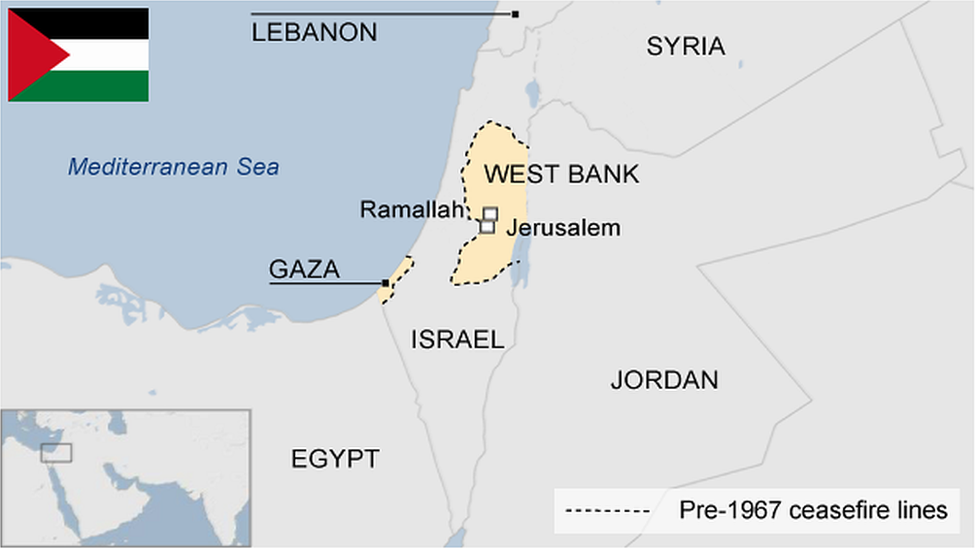
- 1948: After the Arab-Israeli War, the West Bank was occupied and later annexed by Jordan (1949–1967).
- 1967: During the Six-Day War, Israel captured the West Bank from Jordan, and it has remained under varying degrees of Israeli control since.
- 1993–1995 Oslo Accords: These agreements created the Palestinian Authority (PA) and divided the West Bank into three areas:
- Area A: Full Palestinian civil and security control.
- Area B: Palestinian civil control and joint Israeli–Palestinian security.
- Area C: Full Israeli control (about 60% of the West Bank).
Source: TH
Euthanasia
Syllabus :GS 2/Governance
In News
- The Kerala government has decided to allow local bodies to carry out euthanasia of diseased stray dogs by making use of the provisions of the Prevention of Cruelty to Animals (Animal Husbandry Practices and Procedures) Rules 2023.
| Do you know? – Under Section 8 of the Animal Husbandry Rules, euthanasia of an animal is allowed if it is severely diseased and poses a risk of spreading the disease, or if it is mortally or severely injured. – A registered veterinary practitioner must certify that keeping the animal alive would be cruel. |
Euthanasia
- It refers to the practice of an individual deliberately ending their life, oftentimes to get relief from an incurable condition, or intolerable pain and suffering.
- It can be administered only by a physician, and can be either ‘active’ or ‘passive’.
- Active euthanasia involves an active intervention to end a person’s life with substances or external force, such as administering a lethal injection.
- Passive euthanasia refers to withdrawing life support or treatment that is essential to keep a terminally ill person alive
Supreme Courts Observations
- In 2011, the Supreme Court of India allowed passive euthanasia for the first time in the case of Aruna Shanbaug, distinguishing it from active euthanasia and permitting it in certain situations.
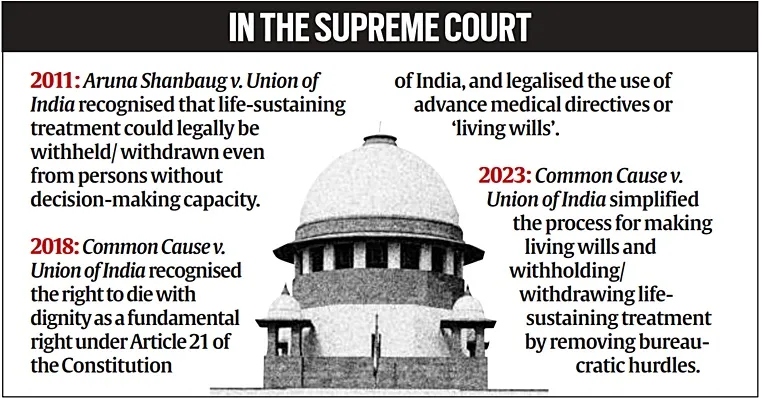
- In 2018, the court further recognized the legality of passive euthanasia for terminally ill patients, affirming the ‘right to die with dignity’ under Article 21 of the Constitution.
- It provided guidelines for withdrawing life support based on advance directives or in their absence.
- The Supreme Court and draft guidelines clarify that withholding or withdrawing life-sustaining treatment, including do-not-resuscitate orders, is legal in India when it no longer benefits the patient or only prolongs suffering.
Source: TH
HIV Pre-exposure Prophylaxis (PrEP)
Syllabus: GS2/ Health
In News
- Generic drugmakers Aurobindo Pharma, Cipla and Viatris will develop, manufacture and supply long-acting injectable cabotegravir (CAB LA) for HIV treatment in 133 countries.
- It builds on the voluntary license for CAB LA for HIV pre-exposure prophylaxis (PrEP).
About Pre-exposure prophylaxis (PrEP)
- It is a preventive strategy where HIV-negative individuals take antiretroviral medication to reduce their risk of acquiring HIV infection.
- PrEP blocks the HIV life cycle, preventing the virus from taking hold and spreading in the body after exposure.
- Forms of PrEP:
- Daily oral pills: Truvada (TDF/FTC) and Descovy (TAF/FTC) are approved options.
- Long-acting injectables: Apretude (cabotegravir) is administered every two months, and Yeztugo every six months.
Source: TH
NATO
Syllabus: GS2/Regional Groupings
Context
- The NATO Secretary said that countries like India, China and Brazil could be hit very hard by secondary sanctions if they continued to do business with Russia.
About
- India and China are the top importers of Russian crude.
- India depends on imports to meet around 88 per cent of its crude oil needs.
- Oil imports from Russia were at 87.4 million tonnes in the financial year 2024-25, accounting for almost 36 per cent of India’s total oil imports of 244 million tonnes.
- Prior to the war in Ukraine, Russia’s share in India’s oil import basket was less than 2 per cent.
About NATO
- NATO, or the North Atlantic Treaty Organization, is a military alliance of countries.
- Establishment: It was founded in 1949 with the signing of the North Atlantic Treaty, more popularly known as the Washington Treaty.
- Aim: To ensure the security and defense of its member countries through collective defense.
- Founding Members: The original members of NATO were Belgium, Canada, Denmark, France, Iceland, Italy, Luxembourg, the Netherlands, Norway, Portugal, the United Kingdom, and the United States.
- Collective Defense: The cornerstone of NATO is Article 5 of the North Atlantic Treaty, which states that an armed attack against one or more of its members is considered an attack against all members.
- Decision-Making: Decisions within NATO are made on the basis of consensus among member countries.
- The North Atlantic Council, which includes the ambassadors of all member countries, is the principal political decision-making body.
- Members: It has 32 member countries, Finland and Sweden became the 31st and 32nd members respectively.
- On signing the Treaty, countries voluntarily commit themselves to participating in the political consultations and military activities of the Organization.
Source: IE
Prime Minister Professorships
Syllabus: GS3/Science and Technology
Context
- The Anusandhan National Research Foundation (ANRF) has announced the Prime Minister Professorships.
About
- The scheme facilitates structured mentorship engagements, wherein superannuated/retired, active experts will provide sustained academic and research support to faculty and students in institutions with emerging research capacity.
- Duration: Up to 5 years, based on performance evaluated by the expert committee constituted for the purpose.
- Eligibility: Open to overseas scientists, including Non-Resident Indians, Persons of Indian Origin, and Overseas Citizens of India.
- Professionals from industry and experienced Professors of Practice with a “distinguished record” of research and innovation are eligible to apply.
- Funding Support: The PM Professor will receive a fellowship of Rs. 30 lakh plus Research Grant of Rs.24 Lakh per annum. Additionally, Rs. 1.00 Lakh (fixed) is provided as overhead to the host institute per year.
- Eligible host institutions are the state universities which have been qualified/listed as spoke institutions, in Category A of recently awarded PAIR program of ANRF.
Anusandhan National Research Foundation (ANRF)
- It has been established with the ANRF 2023 Act, under the Department of Science & Technology.
- Aim: To seed, grow and promote research and development (R&D) and foster a culture of research and innovation throughout India’s universities, colleges, research institutions, and R&D laboratories.
- It will act as an apex body to provide high-level strategic direction of scientific research in the country as per recommendations of the National Education Policy (NEP).
- The Science and Engineering Research Board (SERB) established in 2008 has been subsumed into ANRF.
Source: TH
Tribal Genome Sequencing Project
Syllabus: GS3/ S&T
In News
- Gujarat has become the first state in India to launch a Tribal Genome Sequencing Project.
About
- Objectives: Identify genetic markers associated with various hereditary and immunity-related conditions.
- Key Implementation Agency: Gujarat Biotechnology Research Centre (GBRC)
- Sample Size & Scope: The project will sequence the genomes of 2,000 individuals from tribal communities across 17 districts of Gujarat.
- Target Population: Focus includes major tribal groups such as Bamcha, Garasia Bhil, Chaudhar, Dubla, Gond, Nayaka, Warli, and the Sidi community.
Source: TH
Javelin anti-tank guided missiles (ATGMs)
Syllabus :GS 3/Defence
In News
- India has submitted a letter of request to the United States for co-production of Javelin anti-tank guided missiles (ATGMs) in the country.
Javelin anti-tank guided missiles (ATGMs)
- It is a single man-portable fire-and-forget medium-range antitank weapon system designed to defeat all known and projected threat armor.
- Its fire-and-forget capability provides superior survivability by enabling the operator to immediately relocate after firing.
- It can defeat all known and anticipated battlefield armor, including main battle tanks and softer targets, and can be launched in both top-attack and direct-attack modes.
- It is developed and produced jointly by American defence majors Raytheon and Lockheed Martin.
Source :TH
ADEETIE Scheme
Syllabus :GS 3/Economy
In News
- The Assistance in Deploying Energy Efficient Technologies in Industries & Establishments (ADEETIE) scheme was officially launched at Arya (P.G.) College, Panipat, Haryana.
ADEETIE scheme
- The ADEETIE scheme, with a budgetary outlay of ₹1000 crore, is an initiative by the Ministry of Power, Government of India, is being implemented by the Bureau of Energy Efficiency (BEE).
- It is structured to provide end -to-end hand holding through subvention on loans, Investment Grade Energy Audits (IGEA), Detailed Project Reports (DPRs), and post-implementation Monitoring and Verification (M&V).
- The scheme covers 14 energy-intensive sectors: Brass, Bricks, Ceramics, Chemicals, Fishery, Food Processing, Forging, Foundry, Glass, Leather, Paper, Pharma, Steel Re-rolling, and Textiles.
- It envisages to provide interest subvention of 5% for Micro and Small Enterprises, and 3% for Medium Enterprises on loans, ensuring accessibility and affordability for MSMEs seeking financial aid for energy efficiency (EE) projects.
Importance
- It marks a decisive step toward India’s transition to a low-carbon economy by enabling Micro, Small, and Medium Enterprises (MSMEs) to upgrade to energy-efficient technologies through comprehensive financial and technical support.
| Bureau of Energy Efficiency (BEE) – The Government of India set up the Bureau of Energy Efficiency (BEE) on March 1, 2002 under the provisions of the Energy Conservation Act, 2001. – It aims to assist in developing policies and strategies with a thrust on self-regulation and market principles, within the overall framework of the Energy Conservation Act, 2001 with the primary objective of reducing the energy intensity of the Indian economy. – It coordinates with designated consumers, designated agencies and other organizations and recognises, identifies and utilises the existing resources and infrastructure, in performing the functions assigned to it under the Energy Conservation Act. |
Source :PIB
CAFE Norms
Syllabus: GS3/Environment
Context
- The Government of India is finalizing stricter Corporate Average Fuel Efficiency (CAFE) norms—CAFE-III and CAFE-IV, to be implemented between 2027 and 2037.
About
- These norms mandate fleet-wide CO₂ emission reductions for automakers to promote fuel efficiency and clean technologies.
- Introduced in 2017 by the Bureau of Energy Efficiency (BEE) under the Ministry of Power to regulate fuel consumption and CO₂ emissions from passenger vehicles (PVs).
- Applicable to all vehicles under 3,500 kg, including those powered by petrol, diesel, LPG, CNG, hybrids, and EVs.
- Objectives:
- Reduce oil imports and energy dependency.
- Curb air pollution and emissions.
- Encourage production of low-emission vehicles (EVs, hybrids, and CNG models).
- CAFE-II Norms (Effective from FY 2022–23)
- Set stricter benchmarks: Fuel consumption ≤ 4.78 litres per 100 km.
- CO₂ emissions ≤ 113 grams/km (directly linked to fuel use).
- Non-compliance penalties were increased to ensure stronger enforcement.
Impact on Automakers and Innovation
- The framework penalizes lightweight cars:
- Although reducing weight is a proven strategy to improve fuel efficiency and reduce emissions, the CO₂ target becomes even more demanding for such lighter vehicles.
- Hence, lightweighting is not adequately rewarded, especially for entry-level small cars.
- This disincentivizes innovation in the affordable car segment, which is crucial for mass mobility in India.
Source: BS
Previous article
Artificial Intelligence (AI) Appreciation Day
Next article
Mitochondrial Replacement Therapy (MRT)
