


Syllabus: GS3/Economy
Context
- The Ministry of Shipping, Ports and Waterways launched major initiatives to modernize India’s maritime infrastructure, strengthen global trade presence, and promote sustainability.
Initiatives Launched
- One Nation-One Port Process (ONOP): Aimed at standardizing and streamlining operations across India’s major ports, reducing inefficiencies, operational delays, and costs.
- Sagar Ankalan – Logistics Port Performance Index (LPPI): A tool to enhance efficiency and global competitiveness of India’s ports, measuring key performance indicators like cargo handling and turnaround time.
- Bharat Global Ports Consortium: Strengthening global trade by expanding India’s maritime reach and enhancing trade resilience.
- MAITRI (Master Application for International Trade and Regulatory Interface) App: To streamline trade processes, reduce bureaucratic redundancies and expedite clearances, reinforcing India’s commitment to ease of doing business.
- India Maritime Week (October 27-31, 2025): A bi-annual global maritime event to celebrate India’s maritime heritage and development, expecting 100 countries and 100,000 delegates.
India’s Maritime Sector
- Strategic Position: Located along the world’s busiest shipping routes, India is a key trading hub and a rising global power.
- India’s Maritime Sector Overview: Handles 95% of India’s trade by volume and 70% by value, with port infrastructure critical to the economy.
- Growth in Cargo-handling: Between 2014-15 and 2023-24, major ports increased their annual cargo-handling capacity by 87.01%.
- Surge in Merchandise Exports: India’s merchandise exports rose to USD 451 billion in FY23, up from USD 417 billion in FY22.
- Maritime Sector’s Importance: India is the 16th-largest maritime nation, occupies a key position in global shipping, with major trade routes passing through its waters.
- Future Goals: India has outlined investments of US$ 82 billion in port infrastructure projects by 2035 to bolster the maritime sector.
- India plans to establish a new shipping company to expand its fleet by at least 1,000 ships within a decade.
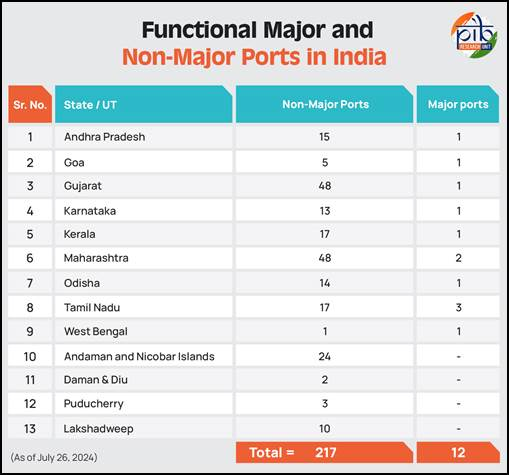
Challenges
- Infrastructure Gaps: Inadequate port infrastructure and outdated facilities at some ports, limiting capacity and efficiency.
- Congestion: High traffic volumes at major ports leading to delays, increased turnaround times, and reduced productivity.
- Environmental Concerns: Pollution and sustainability issues, including emissions from ships and port operations.
- Logistics Bottlenecks: Inefficient transport connectivity between ports, roads, and railways, impacting smooth cargo movement.
- Global Competition: Rising competition from other global maritime hubs, necessitating continuous investment and modernization.
Initiatives by Government
- Sagarmala Programme: Focuses on leveraging India’s coastline and of navigable waterways.
- Supports port infrastructure, coastal development, and connectivity.
- Financial aid for projects like coastal berths, rail/road connectivity, fish harbours, cruise terminals.
- Maritime India Vision 2030 (MIV 2030): Aiming for India to become a top 10 shipbuilding nation by 2030 and create a world-class, efficient, and sustainable maritime ecosystem.
- Includes 150+ initiatives across ten key maritime sectors.
- Inland Waterways Development: 26 new national waterways identified by the Inland Waterways Authority of India (IWAI).
- Provides alternative, sustainable transport, easing road/rail congestion.
- Green Tug Transition Program (GTTP): Aims to replace fuel-based harbour tugs with eco-friendly, sustainable fuel-powered tugs.
- Transition to be completed by 2040 across major ports.
- Sagarmanthan Dialogue: An annual maritime strategic dialogue to position India as a global center for maritime conversations.
- Maritime Development Fund: ₹25,000 crore fund for long-term financing to modernize ports and shipping infrastructure, encouraging private investment.
- Shipbuilding Financial Assistance Policy (SBFAP 2.0): Modernized to help Indian shipyards compete with global giants.
Conclusion
- India’s maritime sector is poised for significant growth, underscored by its strategic initiatives and government schemes.
- The first edition of Sagarmanthan has further cemented India’s commitment to becoming a global maritime leader, bringing together stakeholders to discuss key themes such as sustainability, connectivity, and governance.
- The efforts will take India’s maritime sector toward a sustainable, innovative, and future-ready ecosystem, ensuring its place as a central player in the global maritime landscape.
Source: PIB
Previous article
India-European Commission Partnership
Next article
National Science Day 2025
