 Residential Course
Down To Earth (01-15 October, 2025)
The following topics are covered in the Down To Earth (01-15 October, 2025):
Rethinking Development in the Fragile Himalayas
Context
- The recent floods, landslides, and glacial bursts across Himalayan states in India have underscored the urgent need to rethink the model of growth that the Himalayas can safely sustain.
Fragility Amplified by Unsustainable Growth
- The Himalayas, stretching across five countries and nurturing the headwaters of major rivers. They are living ecosystems and cultural landscapes that sustain nearly 240 million people.
- Himalayan environmental degradation observed that the construction of highways, tunnels, and hydropower projects has been prioritized without adequate ecological safeguards.
- The Char Dham Highway project and multiple run-of-the-river hydropower dams have destabilized slopes, disrupted aquifers, and led to recurring disasters such as those in Joshimath and Chamoli.
- According to the National Disaster Management Authority (NDMA), the frequency of ‘compound disasters’—where landslides coincide with floods— has doubled in the past decade due to deforestation and slope destabilization.
- It indicates that the Himalayas are not just facing natural hazards but human-induced vulnerabilities.
Climate Change and the New Normal
- Reports by the Indian Institute of Science (IISc) and the Himalayan State Climate Outlook 2025 highlight an alarming trend: the Himalayan glaciers are retreating faster than the global average.
- In states like Sikkim and Himachal Pradesh, glacier melt contributes to flash floods and the sudden formation of glacial lakes.
- The Sikkim flood (2023) was caused by the South Lhonak Lake outburst, and was intensified by unusually high rainfall and infrastructure exposure along river valleys.
- The combination of climate instability and overconstruction is creating a dangerous feedback loop, where developmental projects amplify climate risks, and climate risks, in turn, erode development gains.
- Local Livelihoods and the Displacement Dilemma: Hydropower projects, mining, and road expansion have uprooted thousands of families while offering few long-term economic benefits.
- MoEFCC emphasized that localized, small-scale economies — such as eco-tourism, traditional agriculture, and forest-based livelihoods — are better suited for these terrains than extractive models of growth.
Governance and Policy Gaps
- Environmental Impact Assessments (EIAs) are often diluted, and state disaster management plans are reactive rather than preventive.
- The National Mission for Sustaining the Himalayan Ecosystem (2023) called for integrated watershed management, but implementation remains sporadic.
- The Himalayan Sustainable Development Forum (2024) urged the inclusion of indigenous knowledge systems and community-based monitoring into official planning.
- It could bridge the gap between top-down development and ground-level realities.
Path Toward Resilience
- Rethinking development in the Himalayas requires balancing ecology, economy, and equity.
- The region needs a ‘mountain logic’—a framework that values biodiversity, water security, and cultural continuity over short-term GDP gains, rather than replicating the plains’ industrial growth.
- Resilient Himalayan development means:
- Respecting eco-zones as no-construction areas.
- Investing in climate-resilient infrastructure.
- Empowering local governance institutions like Van Panchayats.
- Integrating early warning systems for landslides and glacial lake outbursts.
- Respecting Carrying Capacity: Development needs to stay within the region’s carrying capacity.
- Urban expansion has outpaced ecological tolerance — while population in Himalayan states grew 1.5 times between 1971 and 2021, the urban population quadrupled.
- Urban planning needs to identify no-construction zones, establish slope-specific building codes, and develop water and sewage systems suited for mountainous terrains.
- Rethinking Development Models: Environmentalists have argued for a ‘localization model of growth’ — a shift away from large-scale industrial development toward community-led, eco-sensitive initiatives. It involves:
- Limiting construction on slopes above a certain gradient.
- Redefining carrying capacity for Himalayan towns.
- Restoring degraded watersheds and springs.
- Promoting decentralized renewable energy systems.
Gendered and Regional Dimensions Of Cancer in India
Context
- A recent analysis by the National Cancer Registry Programme (NCRP) highlights the disparities in India’s cancer burden across gender, geography, and socio-economic settings.
Gender Differences in Cancer Burden
- Higher Incidence Among Women: In 2024, NCRP data showed 1.56 million cancer cases, with 780,000 each among men and women.
- However, the Crude Incidence Rate (CIR) was slightly higher among women (113.3) than men (107.4).
- Earlier data from 2020 reported a similar trend— 103.6 among women versus 94.1 among men.
Why Are Women at Greater Risk?
- According to a 2022 Cancer Epidemiology study, multiple factors contribute to women’s heightened vulnerability:
- Lifestyle and occupational changes leading to reduced physical activity.
- Dietary habits, tobacco and alcohol use.
- Reproductive patterns, including delayed childbirth.
- Hormone-related diseases—notably breast and ovarian cancers—are linked to pollution, cosmetics, and processed foods.
- These cancers tend to have higher survival rates when detected early, explaining women’s lower mortality despite higher incidence.
- Common Cancers by Gender:
- Men: Oral, lung, and prostate cancers.
- Women: Breast, cervical, and ovarian cancers.
Rising Male Mortality and Noncommunicable Diseases
- A Lancet study noted a steady rise in the probability of dying from noncommunicable diseases (NCDs) — including cancer — among Indian men, from 56% in 2001 to 57.9% in 2019.
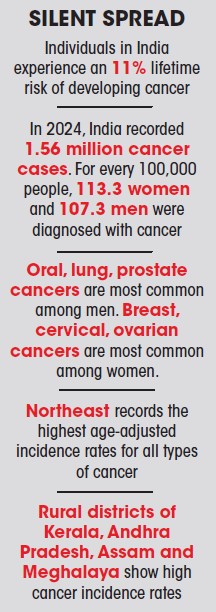
- India is one of only five countries where male lung cancer deaths continue to increase, even as global mortality declines.
- For women, the probability rose from 46.6% in 2010 to 48.7% in 2019, still lower than that for men.
Northeast: India’s Cancer Hotspot
- High Incidence Across States: The analysis identifies Aizawl, Kamrup Urban, Papumpare, and Hyderabad as having the highest Age-Adjusted Incidence Rate (AAIR) among women, and Aizawl, East Khasi Hills, Papumpare, Kamrup Urban, and Mizoram among men.
- Except Hyderabad, all are in the Northeast, marking the region as a cancer hotspot.
- Unique Cancer Patterns: The region records elevated cases of oesophageal, nasopharyngeal, and stomach cancers.
- Mizoram stands out with a lifetime cancer risk of 21.1% in men and 18.9% in women, nearly double the national average (11%).
- Diet and Lifestyle Factors: Traditional dietary habits—such as charred meats, smoked vegetables, and fermented pork, coupled with tobacco use and tuibur (a smoked-tobacco liquid)—introduce carcinogenic compounds like heterocyclic amines and polycyclic aromatic hydrocarbons, linked to digestive tract cancers.
Emerging Rural Trends
- Rising Rural Incidence: Out of 43 population-based cancer registries (PCBRs) sites, 30 have over 50% rural populations.
- While urban areas still show higher overall cancer incidence, rural districts such as Pathanamthitta (Kerala) and Pulwama (J&K) report high CIRs of 261 and 132 among men, respectively.
- Shifting Consumption Patterns: The Household Consumption Expenditure Survey (2023–24) indicates a worrying increase in processed and highrisk food consumption in rural India.
- Processed foods and beverages now form 9.84% of rural food expenditure, outpacing healthier options like milk (8.44%) and vegetables (6.03%).
Way Forward
- The NCRP study underscores the urgent need for improved cancer documentation, targeted prevention, and region-specific control strategies. Key measures include:
- Expanding screening programs for breast, cervical, and oral cancers.
- Addressing dietary and environmental carcinogens, particularly in the Northeast.
- Enhancing health infrastructure in rural regions.
- Promoting gender-sensitive awareness and early detection initiatives.
Transmission Trap: Challenges With India’s Renewable Energy
Context
- Despite record solar and wind installations in India, inadequate transmission infrastructure and poor demand forecasting are forcing large-scale curtailments — leaving clean energy projects idle and developers counting heavy losses.
Curtailments and Mounting Losses
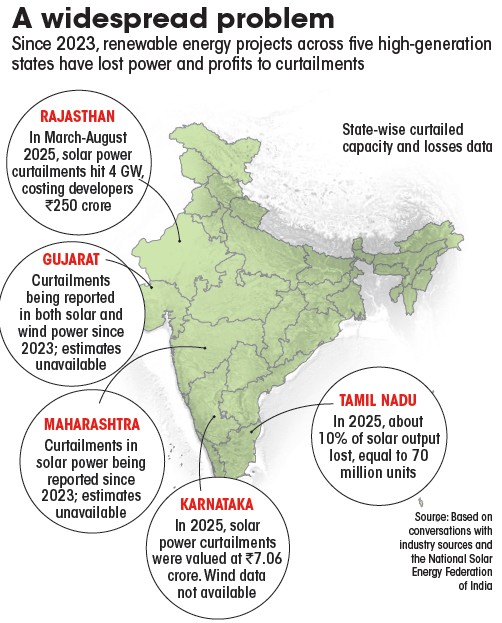
- At least 30 solar and wind projects across India faced curtailments, resulting in losses of up to ₹700 crore, according to industry insiders between March and August 2025.
- Plants in Rajasthan, Gujarat, Maharashtra, and Tamil Nadu—key renewable hubs—are among the hardest hit.
- In Rajasthan alone, projects totaling 4 GW of capacity were ordered to cut generation by nearly half during peak midday hours, leading to losses of around ₹250 crore.
- Developers such as Adani Renewable Energy, Tata Power, and Azure Power have been affected.
Transmission Bottlenecks
- At the heart of the crisis lies India’s slow progress in building and upgrading electricity transmission lines.
- Renewable projects require General Network Access (GNA) from the Central Electricity Regulatory Commission (CERC) to feed power into the grid.
- However, many new projects are operating on Temporary General Network Access (TGNA), which offers only conditional grid access without compensation for curtailments.
- The National Solar Energy Federation of India (NSEFI) reported that of 22.5 GW of commissioned solar capacity in Rajasthan, nearly 8.5 GW operates under TGNA due to delayed transmission lines.
- These delays often stretch 18–20 months, stalling project utilization and investment returns.
Forecasting Failures and Demand Slumps
- Beyond transmission delays, inaccurate demand forecasting has worsened curtailments. The Central Electricity Authority (CEA) had predicted a 2025 peak demand of 270 GW, but unexpected monsoon patterns reduced consumption sharply.
- As a result, India’s grid operators curtailed nearly 10 GW of power daily during low-demand hours to maintain grid stability. Even coal plants were affected, running at only 40% capacity, a level detrimental to their machinery.
Economic and Policy Impacts
- The repeated curtailments are shaking investor confidence. Under GNA, developers receive compensation for forced outages through Power Purchase Agreements (PPAs).
- Under TGNA, however, no compensation is provided, leaving developers to absorb the full financial hit.
- Industry bodies warn that this uncertainty could jeopardize India’s 500 GW non-fossil fuel target by 2030.
- New renewable tenders may face reduced participation as investors re-evaluate risks.
Underlying Causes
- Transmission Delays: Construction of lines typically takes 2–3 years, outpacing the 18–24 month project timelines for solar and wind plants.
- Regulatory Gaps: Limited clarity on GNA issuance and compensation for curtailed TGNA projects.
- Planning Mismatch: Renewable capacity has expanded faster than infrastructure to integrate it.
- Environmental and Legal Hurdles: Land acquisition and clearance delays for new lines exacerbate grid congestion.
Government Response
- Officials at the Ministry of New and Renewable Energy (MNRE) acknowledge the issue but attribute curtailments to ‘emergencies’.
- The ministry has yet to quantify the total losses but has pledged to coordinate with the CEA and Union Ministry of Power for a detailed assessment.
Proposed Solutions
- Accelerate Transmission Expansion: Experts urge immediate prioritization of transmission projects in high-generation states.
- High Voltage Direct Current (HVDC) lines, capable of transferring large loads over long distances, could ease congestion and link regions with varying demand profiles.
- Deploy Energy Storage Systems: Battery Energy Storage Systems (BESS)—whose costs have fallen by 70% in four years—can store excess midday power and release it during peak evening demand.
- Improve Forecasting and Planning: The CEA is enhancing its weather forecasting model from a 12 km × 12 km to 4 km × 4 km resolution for more localized predictions.
- It plans to shift from a five-year to an annual planning cycle for better responsiveness.
- Regulatory and Financial Reforms: The NSEFI has proposed compensation for curtailed developers through the Power Systems Development Fund, which currently supports only public transmission upgrades.
Sand Replenishment Study a Legal Prerequisite for Mining Clearances: Supreme Court
Context
- Recently, the Supreme Court of India ruled that a scientific assessment of river sand replenishment is now a legal requirement for obtaining environmental clearance to mine river sand.
Background: Srinagar NHAI Project Case
- The Jammu and Kashmir State Environment Impact Assessment Authority (JKEIAA) had granted environmental clearance to three sand mining sites associated with the Srinagar ring road and four-lane bypass project, despite the Jammu and Kashmir Expert Appraisal Committee (JKEAC) having earlier rejected the projects on grounds of over-exploitation and absence of a replenishment study.
- Case before the National Green Tribunal (NGT) highlighted multiple violations, including:
- Absence of a replenishment study in the District Survey Report (DSR);
- Use of prohibited heavy machinery, and
- Violation of the J&K Minor Mineral Concession Rules (2016), which bars mining within 25 metres of river embankments.
NGT and Supreme Court Decisions
- The NGT ruled that a DSR without a replenishment study is incomplete, making any environmental clearance based on it illegal.
- It subsequently cancelled all three ECs granted in 2022.
- The project proponents — Union Territory of Jammu and Kashmir and NHAI — appealed to the Supreme Court, which upheld the NGT’s decision.
- The apex court confirmed that ‘sand mining can only be granted when DSR is complete and effective. Any clearance based on a draft DSR is legally invalid’.
- The Court emphasized that DSRs need to comply with the Environmental Impact Assessment (EIA) Notification, 2016, and the Sustainable Sand Mining Management Guidelines, 2016 and 2020, ensuring decisions are made on scientific grounds and after assessing the annual sand replenishment rate.
Implementation Challenges and Expert Concerns
- Replenishment Studies Require Time: Experts note that scientific replenishment studies are long-term exercises, as it takes at least three years of study, covering pre- and post-monsoon seasons, to estimate average replenishment accurately.
- Typical licences allow extraction of up to 1 metre of sand, but miners often extract up to five times that limit, causing severe ecological harm.
- A robust replenishment study, therefore, is essential for sustainable mining.
- Accuracy and Practical Constraints: Replenishment estimates can only be 70% accurate due to unpredictable factors like rainfall, flow velocity, and weather variability.
- Excessive mining damages rivers, no mining at all can raise flood risks, as sediment buildup reduces a river’s carrying capacity.
Conclusion
- The Supreme Court’s 2025 judgement establishes a critical precedent for environmentally responsible sand mining in India.
- By mandating replenishment studies as a legal prerequisite for environmental clearances, it reinforces the importance of scientific validation, sustainable resource management, and legal accountability.
Africa’s Climate Resilience: Homegrown Solutions Amid Global Injustice
Context
- Africa stands at the frontline of the global climate crisis — a paradox given its negligible contribution to the problem.
About Africa: A Continent Under Unequal Pressure
- Sub-Saharan Africa accounts for just 1.9% of global cumulative fossil fuel emissions, with South Africa alone responsible for 1.3%. But, the region bears a disproportionate share of climate-induced suffering.
- According to the Brookings Institution, seven of the ten most climate-vulnerable countries in the world are in Africa.
- The IPCC’s Sixth Assessment Report (2021) highlights that the continent has warmed faster than the global average over the past 60 years — a pace unmatched in two millennia.
Escalating Impacts Across the Continent
- The World Meteorological Organization’s (WMO) ‘State of Climate in Africa 2024’ report, reveals that 2024 ranked as either the warmest or secondwarmest year in Africa’s history.
- The year brought devastating floods, droughts, and marine heatwaves, crippling agricultural systems and threatening food security for millions.
- Forecasts indicate that Africa could surpass the 1.5°C warming threshold by 2040, a development that would amplify losses in agriculture, health, and infrastructure — sectors on which the majority of Africans depend for their livelihoods.
Financial Burden of Climate Ambition
- African countries need an estimated US $2.8 trillion between 2020 and 2030, to fulfill their Nationally Determined Contributions (NDCs) under the Paris Agreement.
- Alarmingly, only 24% of this amount is earmarked for adaptation — despite Africa’s acute vulnerability to climate extremes.
- At the same time, economic headwinds and limited fiscal capacity have deepened dependence on foreign loans.
- The UN’s ‘World Economic Situation and Prospects 2025’ warns that African nations are expected to allocate nearly 30% of government revenue to debt servicing in 2025, with 25 countries already devoting over 10% of their revenue to net interest payments.
- It restricts investment in climate resilience and forces nations to borrow even more for disaster recovery.
Resilience Through Innovation and Tradition
- African nations are refusing to remain passive victims, despite formidable challenges.
- They are forging pragmatic, hybrid solutions that blend traditional ecological knowledge with modern technological innovation.
- Across the continent, governments and communities are rolling out national strategies for net-zero emissions, community-based adaptation programs, and nature-based solutions such as reforestation, sustainable water management, and droughtresistant agriculture.
- This bottom-up, inclusive approach offers a blueprint for the broader Global South, showcasing how nations with limited resources can craft effective, locally rooted responses to global crises.
Conclusion: A Call for Climate Justice
- Africa’s predicament underscores a deep climate injustice — a continent least responsible for emissions, but most burdened by their consequences.
- As the world races to stabilize the planet’s temperature, global financial systems and climate finance mechanisms need to evolve to ensure equitable access to funding, debt relief, and technology transfer.
- Africa’s resilience and innovation illuminate a path forward — one that intertwines sustainability, equity, and indigenous wisdom.
Civil Society and the Climate Imperative: Reclaiming Global South Unity
Context
- In an era marked by unilateralism and fraying multilateral institutions, the climate crisis has become a casualty of geopolitical fragmentation.
- Global South cohesion needs to become a top priority to effectively confront climate change.
Lessons from History: Moments of Southern Solidarity
- The Global South, encompassing the G77 coalition of developing nations, shares a legacy of colonial exploitation and systemic inequity.
- But, throughout history, solidarity among these countries has catalyzed transformative change.
- Bandung Conference (1955): Established a collective front against colonialism and initiated the nonalignment movement.
- Rio Earth Summit (1992): Introduced the principle of common but differentiated responsibilities—a cornerstone of global climate negotiations.
- COVID-19 Crisis: India and South Africa led the call for a TRIPS waiver at the WTO, while Cuba demonstrated solidarity through medical diplomacy.
- COP27 in Egypt: G77 unity achieved a landmark victory—the creation of the Loss and Damage Fund, marking the culmination of three decades of advocacy.
- Recent Southern G20 presidencies—Indonesia, India, Brazil, South Africa—have elevated key issues like debt reform, green industrialisation, and financial equity, reaffirming the Global South’s leadership potential.
Challenge of Fragmentation
- The South remains divided, despite these milestones. Internal differences, shifting leadership, and Northern manipulation often fracture alliances.
- Moreover, the BRICS+ bloc faces internal contradictions: limited transparency, restricted civil society participation, and enduring fossil fuel dependencies.
- However, these critiques must be contextualised—industrial pathways and energy demands differ vastly from those of the Global North.
Climate Question: Pathways to a Just Transition
- BRICS+ countries now represent 48% of the global population and nearly half of global fossil fuel output. Yet, they are also at the forefront of renewable energy expansion:
- Renewables Growth: BRICS+ now produces 51% of global solar power, up from just 15% a decade ago.
- Leadership in Action: China leads 74% of global solar and wind capacity construction, while India met its Nationally Determined Contributions (NDCs) five years ahead of schedule.
- The BRICS Declaration (2025) emphasizes this balance, advocating for green industrial policy and ‘polyalignment’, a flexible approach that redefines the geopolitics of green connectivity.
Toward a New Global South Vision
- The Western-led order is faltering under its own ‘polycrisis’—economic instability, ecological decline, and militarism.
- For the Global South, long burdened by debt and dependency, this turbulence presents an opening for transformation.
- A renewed Southern vision should embrace multipolarity, localisation, regional integration, and green industrialisation.
- It needs to champion de-dollarisation, equitable finance, and technology sharing.
- Most importantly, it should place development and climate justice at the heart of global governance.
Role of Civil Society
- Civil society must lead in rewriting the narrative. Beyond state diplomacy, grassroots networks, researchers, and activists are vital to:
- Highlight shared struggles and solutions.
- Build public pressure for accountable climate governance.
- Foster a common identity rooted in sustainability and justice.
- Civil society can transform the Global South from a fragmented grouping into a cohesive climate vanguard—one capable of shaping a truly equitable and green future, by amplifying collective agency.
Local Government Service Commission To Recruit Panchayat Employees
Context
- A recent proposal suggests a separate Local Government Service Commission to recruit panchayat employees which are under-resourced and under-staffed.
About
- India’s Panchayati Raj system, enshrined in the 73rd Constitutional Amendment, was designed to decentralize governance and empower rural communities.
- The idea stems from findings in the Status of Devolution to Panchayats in India (2025), prepared by the Indian Institute of Public Administration (IIPA).
- The report ranks states based on the ‘three Fs’ of devolution:
- Functions: Are panchayats empowered to make decisions?
- Finance: Do they have adequate revenue?
- Functionaries: Are skilled personnel available to execute plans?
- In 2008, a fourth dimension — Framework — was added, and by 2012, two more — Accountability and Capacity Building — were included, making a total of six dimensions.
Financial Devolution and Constraints
- Finance is regarded as the most vital, carrying the highest weightage (30%) in the index.
- The ability of panchayats to raise and manage funds determines their effectiveness in performing their constitutional roles.
- Role of Finance Commissions (Article 243I): There is a need to constitute a State Finance Commission (SFC) every five years to recommend:
- Transfers of financial resources to panchayats.
- Conditional and unconditional grants.
- Article 280(3)(b): It empowers the Union Finance Commission (UFC) to augment state funds and suggest measures to strengthen local bodies.
- From the 10th to the 15th UFC, specific grants have been allocated to panchayats.
Need for Redefining State Finances
- A major recommendation from the 2025 report is to redefine the Consolidated Fund of the State — similar to the Consolidated Fund of India — so that statutory transfers to panchayats and municipalities are deducted in advance. It requires constitutional amendments to:
- Article 266: To formally include panchayats within the State Consolidated Fund.
- Article 243I: To ensure the mandatory and timely constitution of the SFC.
Own Source of Revenue
- Article 243H authorizes state legislatures to empower panchayats to levy and collect taxes, duties, tolls, and fees. However, weak tax collection systems have left most panchayats dependent on higher government grants.
- Karnataka leads in panchayats’ power to impose and collect revenue.
- Kerala tops in retaining maximum available funds.
Challenge of Functionaries
- Despite constitutional provisions under Articles 243G and 243H, most panchayats lack adequate staff. The field survey in the 2025 report found:
- Many panchayats operate without permanent employees.
- Essential posts like gram sachiv (village secretary), accountant, and gram rozgar sevak are either temporary or vacant.
- In Uttarakhand, one gram sachiv serves an average of 17 panchayats — severely limiting efficiency.
- Although digitization efforts have been underway, the shortage of technical and administrative personnel prevents full realization of e-governance goals.
Proposal for a Local Government Service Commission
- The report recommends establishing a Local Government Service Commission (LGSC) to address this chronic manpower shortage.
- The LGSC would be responsible for recruiting panchayat employees at subordinate levels.
- Recruitment for senior positions should remain under the State Public Service Commission (PSC).
- The Governor would appoint the LGSC chairperson and members based on the recommendation of a committee chaired by the Chief Minister.
- Additionally, every gram panchayat should have at least one panchayat clerk or assistant to support administrative and digital functions.
Global Youth Uprising: Understanding The New Wave of Protests
Context
- According to Carnegie’s Global Protest Tracker, there were 30 anti-government protests worldwide in the most recent year.
- In contrast, the preceding 12 months recorded 159 protests across 71 countries, reflecting a significant surge in civic unrest.
About
- A UNICEF report notes that ‘the proportion of people willing to participate in demonstrations has increased to its highest levels since the 1990s.’
- It has been instrumental in regime changes in Nepal, Bangladesh, and Sri Lanka, driven largely by youthled mobilization.
Changing Nature of Protests
- Youth-led protests today differ markedly from earlier movements. They are:
- Leaderless and informal, relying on social networks rather than traditional organizations.
- Globally connected, spreading rapidly across borders through digital platforms.
- Evolving in agenda, shifting from antiliberalization in the early 2000s to current issues such as climate justice, rising living costs, inequality, and political exclusion.
- There were 12,500 protests and riots in 150 countries related to the cost-of-living crisis, with students leading nearly 10% of them (From November 2021 to October 2022).
- Many of these movements, such as the Arab Spring, began locally but inspired regional waves of resistance.
Roots in Inequality and Disillusionment
- The roots of these uprisings trace back to the failures of neoliberal economic policies. In 1995, the UN World Summit for Social Development acknowledged the widening gap between growth and inclusion, pledging to prioritize poverty eradication, full employment, and social inclusion.
- Although more than a billion people have since escaped poverty and global life expectancy has improved, inequality persists and deepens.
- A UN DESA World Social Report 2025 finds that ‘many people believe life is worse now than it was 50 years ago’.
- A Gallup World Poll corroborates this, revealing 60% of people are struggling and 12% suffering, while two-thirds of the world’s population live in countries where inequality has risen since 1990.
- Youth at the Epicenter of Discontent: The world’s largest-ever young population faces exclusion from development benefits and uncertain futures.
- Climate disasters, job scarcity, and social inequity have pushed youth into a state of existential frustration.
- The World Bank estimates that one in five people globally is at risk of climate-related disasters, worsening economic insecurity.
- This combination of economic inequality, environmental crisis, and democratic disillusionment has created fertile ground for rebellion.
- According to UN DESA, over half of the global population has little or no trust in government institutions, fueling polarization and youth rage.
EU Misses Un Deadline to Set New Climate Targets
Context
- Recently, the European Union (EU) confirmed that the bloc will miss the global deadline to set new emissions-cutting targets ahead of the UN General Assembly (UNGA) meeting.
Delay in Climate Commitments
- Originally, the European Union (EU) had planned to finalize its 2035 and 2040 climate targets in August.
- However, key member states — Germany, France, and Poland — have requested additional time to negotiate.
- Temporary Pledge Sent to the UN: In place of final targets, the EU has submitted a ‘statement of intent’ to the United Nations.
- The statement outlines a provisional goal to cut greenhouse gas emissions between 66.25% and 72.5% by 2035, compared to 1990 levels.
- The EU has assured that the finalized targets will be submitted ahead of the COP30 to the UNFCCC, scheduled for November 2025 in Brazil.
UN’s Call for Urgent Action
- The UN had urged all countries to announce new climate targets by September to restore global momentum on climate action.
- It stems from growing concerns about geopolitical disruptions and policy reversals, such as the rollback of environmental policies in the United States.
Global Response So Far
- Fewer than 40 countries had submitted updated emissions-cutting targets for 2035 and 2040. Among those that did were Japan, the United Kingdom, New Zealand, and Australia.
- Meanwhile, major emitters like China are expected to meet the UN’s September-end deadline, according to a Reuters report.
EU Court Upholds Green Label for Gas And Nuclear Investments
Context
- Recently, the Court of Justice of the European Union (CJEU) upheld the European Commission’s 2022 decision to classify investments in natural gas and nuclear power as ‘sustainable’ under the EU Green Finance Taxonomy.
Green Taxonomy Decision (2022)
- The EU Taxonomy Regulation, adopted in 2020, was designed to help investors identify environmentally sustainable activities and direct capital toward projects that advance the European Green Deal and net-zero 2050 targets.
- In 2022, the Commission included natural gas and nuclear energy in the taxonomy as ‘transitional’ activities — meant to support the shift from fossil fuels to renewables.
- It was aimed to ensure energy security amid the phase-out of coal and rising energy demands following the Russia-Ukraine conflict.
- According to the European Commission, nuclear energy can contribute to decarbonization goals, provided high safety and waste management standards are met.
- Similarly, gas-fired power was included as a temporary solution to replace more polluting fuels like coal.
‘Ghost’ Flood Control Projects: Philippines
Context
- Recently, the Philippine government has established an independent commission to investigate a major corruption scandal involving “ghost” or fraudulent flood control projects.
About
- The Philippines, an archipelago frequently battered by typhoons and monsoon rains, faces chronic flooding that disrupts lives, damages infrastructure, and stalls economic growth.
- In response, the government has allocated billions of pesos to flood control projects.
Rise of ‘Ghost’ Projects
- The term ‘ghost projects’ refers to infrastructure schemes that are funded but never built—or are so poorly executed that they fail to serve their intended purpose.
- Key issues include:
- Non-existent Structures: Projects listed as ‘completed’ with no physical evidence on the ground.
- Substandard Construction: Dikes, drainage systems, and floodways built with inferior materials or left unfinished.
- Misallocated Funds: Budgets diverted to unrelated expenses or lost to corruption.
- Lack of Oversight: Weak monitoring mechanisms allow contractors and officials to evade accountability.
Systemic Challenges
- Fragmented Governance: Multiple agencies with overlapping mandates lead to confusion and delays.
- Climate Disconnect: Projects often fail to consider updated climate models and rainfall patterns.
- Urban Planning Failures: Rapid urbanization without proper drainage planning exacerbates flooding.
Calls for Reform
- Transparent audits of all flood control projects.
- Community involvement in planning and monitoring.
- Climate-resilient infrastructure that adapts to future risks.
- Stronger penalties for contractors and officials involved in ghost projects.
Sheep Pox
Context
- A major outbreak of sheep pox has struck Greece, resulting in the culling of approximately 260,000 sheep.
About Sheep Pox
- It is a highly contagious viral disease caused by the Capripoxvirus, primarily affecting sheep and goats.
- It leads to fever, skin lesions, and respiratory distress, and can cause high mortality in susceptible flocks.
- The World Organisation for Animal Health (WOAH) lists it as a notifiable disease due to its severe economic implications.
H3N2 Influenza
Context
- Recently, the National Capital Region (NCR) has witnessed a rise in H3N2 influenza cases.
What Is H3N2 Influenza?
- H3N2 is a subtype of the Influenza A virus, known for causing seasonal flu outbreaks worldwide. It’s particularly concerning due to:
- Longer recovery times;
- Higher risk of complications;
- Greater impact on vulnerable groups like children, the elderly, and those with pre-existing conditions;
- In severe cases, it can progress to pneumonia, which may be life-threatening.
Vulnerable Populations and Clinical Impact
- Children (under 10 years) and senior citizens (above 60 years) are experiencing prolonged recovery periods.
- Patients with asthma, diabetes, or heart disease are more likely to develop severe respiratory distress.
- Some hospitals have reported an uptick in secondary bacterial infections, a pattern similar to earlier influenza seasons.
Public Health Response
- The Ministry of Health and Family Welfare (MoHFW) has issued advisories emphasizing:
- Use of masks in crowded spaces,
- Vaccination drives for high-risk groups,
- Strengthening sentinel surveillance through the Integrated Disease Surveillance Programme (IDSP). Surveillance includes:
- Monitoring Influenza-like Illness (ILI) and Severe Acute Respiratory Infections (SARI);
- Data collection from 28 sentinel sites across the country;
Expert Recommendations
- Enhanced genome sequencing to monitor viral mutations.
- Timely reporting from private clinics to public databases.
- Rapid isolation of confirmed cases in healthcare settings.
- These measures align with the national strategy for influenza containment and pandemic preparedness, as outlined in NCDC’s 2025 policy report.
Subjective Questions for Practise
Q1. Discuss how a more ecologically sensitive and community-driven approach could reshape the future of sustainable development in fragile mountain ecosystems in India.
Q2. Analyze how gender and regional disparities influence cancer prevalence, diagnosis, and treatment outcomes in India.
Q3. How do infrastructural, regulatory, and geographic challenges hinder the integration of renewable sources into the national grid?
Q4. Evaluate the underlying social, economic, and political factors driving the recent wave of global youth uprisings.
QUICK LINKS

 Call
Call