 Residential Course
Down To Earth (01-15 February 2026)
The following topics are covered in the Down To Earth (01-15 February, 2026)
Sustainable Aviation Fuel (SAF)
Context
- Recently, state-owned Indian Oil Corporation (IOC) secured India’s first certification to produce Sustainable Aviation Fuel (SAF) at its Panipat refinery.
About Sustainable Aviation Fuel (SAF)
- It refers to a group of liquid hydrocarbon fuels that can replace conventional jet fuel while significantly lowering lifecycle greenhouse gas emissions.
- It is produced from alternative feedstocks such as used cooking oil (UCO), agricultural residues, municipal waste and non-edible oils, unlike fossil-based aviation turbine fuel.
- According to the International Air Transport Association (IATA), SAF could contribute nearly 65% of the emissions reductions required for global aviation to reach net-zero carbon dioxide emissions by 2050.
Current Status & Future Projection
- IOC has announced plans to produce around 35,000 tonnes of SAF annually using co-processing techniques at its Panipat refinery.
- India has set clear blending mandates:
- 1% SAF blending in international flights by 2027;
- 5% by 2030;
- 15% blending in domestic flights by 2040;
- India is focusing on co-processing SAF in existing refineries, particularly using UCO, as this pathway requires minimal infrastructure modifications and is relatively cost-effective to meet these targets.
Current Status & Future Projection
- India has set graduated SAF blending targets:
- 1% blending in international flights by 2027;
- 5% blending by 2030;
- 15% blending in domestic flights by 2040
- At present:
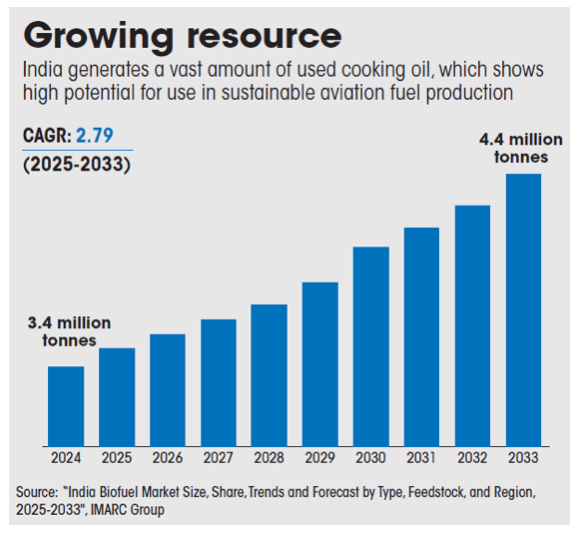
- India generated 3.4 million tonnes of UCO in 2024;
- The theoretical potential is about 2.5 billion litres;
- Actual collection, however, is only ~250 million litres;
- India’s SAF strategy currently relies on co-processing UCO in existing oil refineries, a cost-effective approach that requires minimal infrastructure upgrades.
Related Issues & Concerns
- Weak UCO Collection Ecosystem: Despite large theoretical availability, most UCO is never collected. It is:
- Reused excessively in food preparation;
- Dumped into drains and landfills;
- Diverted to informal markets;
- It severely limits feedstock availability for SAF.
- Public Health & Environmental Risks: Repeated reuse of cooking oil produces toxic compounds such as trans fats, linked to cancer, heart disease, and liver damage.
- Improper disposal clogs drains, pollutes water bodies and releases greenhouse gases.
- Supply Uncertainty for Energy Producers: Biodiesel manufacturers report that insufficient and inconsistent UCO supply makes SAF production commercially unviable at present. Without assured feedstock volumes, scaling SAF remains risky.
Related Efforts & Initiatives
- RUCO Initiative: The Food Safety and Standards Authority of India (FSSAI) launched the RUCO (Repurpose Used Cooking Oil) initiative in 2018 to:
- Prevent harmful reuse of degraded oil;
- Channel UCO into biodiesel production;
- Under RUCO:
- Food businesses must not reuse oil more than three times;
- UCO must be handed over to licensed collectors;
- However, enforcement weakened after initial rollout, leading to widespread non-compliance.
- Startup-led Innovations: KNP Arises Green Energy collects UCO via a mobile app and sourced 4,000 tonnes from 9,000 restaurants in FY25.
- Plans to reach 2,000 tonnes per month and partner with global SAF producers such as Shell.
Way Forward
- Revive and strengthen RUCO: Mandatory audits and state-level enforcement;
- Appointment of dedicated compliance officers;
- Introduce economic incentives: Payments for proper UCO disposal;
- Penalties for oil overuse and illegal resale;
- Expand collection infrastructure: Use petrol pumps as UCO aggregation points;
- Formalise informal collectors;
- Improve traceability: Digital tracking of oil from kitchens to refineries;
- Align health, waste and energy policies: Treat UCO as a strategic resource, not waste;
Uncertainty, Public Distrust, & Global Insularity Become New Normal
Context
- A series of influential global surveys released in early 2026, notably the World Economic Forum’s Global Risks Report 2026 and the Edelman Trust Barometer 2026 revealed a sharp rise in uncertainty, public distrust, and global insularity.
A World Defined by Uncertainty
- The World Economic Forum has identified uncertainty as the defining theme of 2026. Its Global Risks Perception Survey, which synthesised responses from over 1,300 global leaders and experts, paints a bleak picture of the near and long-term future.
- 50% of respondents expect a turbulent or stormy global outlook over the next two years.
- This rises to 57% when looking a decade ahead.
- Only 1% anticipate a calm future in either timeframe.
- For the first time in many years, environmental risks have been displaced in the short term by geopolitical and economic threats, signalling a shift in global anxieties.
Geo-economic Confrontation Takes Centre Stage
- Nearly one in five respondents identified geo-economic confrontation as the most significant risk capable of triggering a global crisis in 2026.
- Trade, finance, and technology are increasingly being used as tools of influence rather than cooperation.
- According to the report, ‘rules and institutions that have long underpinned stability are under siege’, as the world fractures into multiple power centres marked by isolationism and strategic rivalry.
- It has left many societies in a state of shock, struggling to adjust to a rapidly polarising global order.
Polarisation and the Crisis of Governance
- Extremism in social, political, and cultural has intensified distrust in governance structures.
- The surveys point to a growing ‘streets versus elites’ narrative, reflecting widespread disillusionment with traditional political systems.
- Many citizens feel excluded from decision-making processes and sceptical that public policy can meaningfully improve livelihoods.
- This erosion of trust is not limited to governments but extends to leaders and institutions more broadly.
Retreat Into Insularity
- The Edelman Trust Barometer reinforces these concerns, warning of ‘a world retreating towards insularity’. Key findings include:
- 70% of respondents across 28 countries are hesitant or unwilling to trust people with different values, backgrounds, or information sources.
- Only 33% say they trust ‘most people’.”
- 45% describe insularity as a large or crisis-level problem.
- In one of the most troubling conclusions, a majority believe societal distrust has become so deep that people actively try to make things worse for those they see as different.
Losing Faith in Institutions and the Future
- Recent societal and geopolitical events have accelerated this loss of trust.
- About 95% of respondents said such events contributed to declining confidence in institutions, with 40% reporting reduced trust in their national governments.
- When asked whether the next generation would be better off than today, only 32% globally answered yes.
- India stood out, with 53% responding positively, a 13-point increase from 2025, offering a rare note of relative optimism.
EU–Mercosur Trade Pact & Impacts on India
Context
- Recently, the EU–Mercosur Trade Pact was signed with aims to create one of the world’s largest free trade zones, covering nearly 700 million consumers.
About EU–Mercosur Trade Pact
- It is a major proposed trade agreement between the European Union and Mercosur (Argentina, Brazil, Paraguay, and Uruguay).
- If fully ratified, it would create one of the world’s largest free-trade areas.
What Is Mercosur?
- Mercosur, short for Mercado Común del Sur (Southern Common Market), is a regional economic and political bloc in South America.
- It was established in 1991 with the goal of promoting free trade, economic integration, and political cooperation among its member states.
Member Countries
- Full Members: Argentina, Brazil, Paraguay, Uruguay, Bolivia (joined formally in 2023; integration ongoing).
- Associated States: Chile, Peru, Colombia, Ecuador, Guyana, and Suriname.
- Associated states participate in trade agreements with Mercosur but are not part of the customs union.
Objectives of Mercosur
- Eliminate tariffs and trade barriers within the bloc;
- Establish a common external tariff for non-member countries;
- Encourage free movement of goods, services, and factors of production;
- Coordinate macroeconomic and sectoral policies;
What does the pact aim to do?
- Reduce tariffs & open markets: The EU would remove most tariffs on Mercosur agricultural exports (beef, poultry, sugar, ethanol).
- Mercosur would lower tariffs on EU industrial goods (cars, machinery, chemicals, pharmaceuticals).
- Boost trade & investment: Covers a combined market of ~450 million people.
- Intended to make EU companies more competitive in South America and give Mercosur exporters easier access to Europe.
- Rules beyond tariffs: The agreement goes further than classic trade deals by including:
- Services & public procurement (EU firms bidding for South American public contracts)
- Intellectual property protection;
- Sanitary and phytosanitary rules (food safety standards);
- Sustainable development commitments (labor rights, environmental protection);
Why Does the Deal Matters for India?
- Impact on Indian Agriculture: Increased Competition in Global Markets;
- Mercosur countries are among the world’s largest exporters of Soybeans; Beef and poultry; Sugar; Maize and ethanol;
- Mercosur agricultural exports could become more competitive globally with preferential access to EU markets. It may:
- Put downward pressure on global commodity prices;
- Affect Indian farmers exporting sugar, oilseeds, rice and processed foods to third markets;
- Indian agricultural exports to the EU may face stiffer competition from cheaper South American produce.
- Impact on Indian Manufacturing and Exports: As tariffs fall under the EU–Mercosur deal:
- European firms may source raw materials more cheaply from South America;
- Indian exporters of engineering goods, chemicals and automobiles could face tougher competition in the EU market;
- Pressure on India–EU FTA Talks: India and the EU are already negotiating a long-pending India–EU Free Trade Agreement. The Mercosur pact:
- Raises EU expectations on market access;
- May push Brussels to demand deeper tariff cuts from India;
- Strengthens the EU’s leverage in negotiations;
Strategic and Geopolitical Implications for India
- Competition for Critical Minerals: One of the strategic pillars of the EU–Mercosur pact is access to critical raw materials:
- Brazil: graphite, rare earths, niobium;
- Argentina: lithium (key for EV batteries);
- India, which is expanding its electric vehicle and renewable energy sectors, may now face:
- Greater competition for lithium and rare earth supplies;
- Higher costs or reduced bargaining power in global mineral markets;
- It underscores India’s need to accelerate overseas mineral partnerships and domestic exploration.
- Shifting Global Trade Alliances: The pact reflects a broader reordering of global trade, as the EU seeks to reduce dependence on China. For India, this presents:
- A challenge, as South America gains strategic importance;
- An opportunity, if India positions itself as a complementary, not competing, partner in global supply chains.
Forest Law Amendment: A Green Push or a Paper Industry
Context
- An amendment to the Van (Sanrakshan Evam Samvardhan) Adhiniyam, 1980 has triggered intense debate by opening large tracts of forestland to commercial exploitation by the paper industry.
Why the Paper Industry Wanted Forest Access?
- India’s paper industry faces a persistent fibre shortage. Domestic wood availability is estimated at 9 million tonnes per annum (TPA), while demand stands at around 11 million TPA.
- At the same time, paper demand is growing at 6–7% annually, driven by rising literacy, packaging needs, and economic growth.
- Although India is the third-largest paper producer globally, it remains fibre-deficient.
- Nearly 76% of raw material comes from recycled paper, while wood and bamboo contribute about 20%.
- Most wood is sourced from agroforestry and farm forestry, leaving little room for expansion without additional land.
What the Amendment Changes
- Earlier Rules (2023 Guidelines): Under the consolidated guidelines issued in 2023:
- Commercial plantations on forestland were treated as non-forest activities;
- Industries had to pay Net Present Value (NPV), a charge reflecting lost ecosystem services;
- Compensatory afforestation was mandatory for diverted forestland;
- These provisions were designed to discourage forest diversion and offset ecological loss.
- New Amendment (January 2024): The revised notification reclassifies assisted natural regeneration; afforestation; commercial plantations, as ‘forestry activities’, even when undertaken by private or non-government entities.
Forest Health Hazard
- ‘Greenwashing’ Forest Diversion: Former forest officials warn that leasing forestland to industries is, in effect, forest diversion, regardless of whether trees are planted.
- When private lessees profit from plantations, exempting them from ecological compensation amounts to greenwashing.
- Plantation activities, critics argue, are core functions of forest departments, not commercial enterprises and cannot be equated with natural forest conservation.
- Threat of Monoculture: Environmental groups caution that industries will prioritise monoculture plantations, such as eucalyptus and acacia—to maximise profits. These species deplete groundwater, reduce soil fertility, and suppress biodiversity.
- Such plantations may increase tree numbers but degrade forest ecosystems, especially in grasslands, savannas, and floodplains that are not traditionally forested.
Reviving a Struggling Sector
- Paper manufacturers say the amendment offers a lifeline to an industry grappling with rising imports and underutilised domestic capacity. Imports of paper and paperboard from ASEAN countries alone have grown at over 25% annually over the past decade.
- Industry leaders argue that unlike mining, paper plantations increase tree cover rather than destroy it.
- The short-rotation plantations can contribute to India’s climate goals, including:
- Creating an additional 2.5–3 billion tonnes of carbon sinks by 2030;
- Restoring 26 million hectares of degraded land under global commitments such as the Bonn Challenge;
- From the above perspective, applying NPV and compensatory afforestation to plantation-based industries is seen as counterproductive.
India’s Urban Water Crisis
Context
- The deaths caused by contaminated drinking water in Indore are not an isolated failure but a symptom of a deeper, systemic problem in India’s urban water-supply model.
- It exposes how poor regulation, outdated infrastructure, weak data systems and a chronic neglect of sewage management continue to endanger public health across the country.
About India’s Urban Water Crisis
- India’s urban water crisis is increasingly about safety, infrastructure failure and public health.
- Repeated outbreaks of waterborne diseases across cities reveal deep flaws in how drinking water and sewage systems are planned, built and managed.
What Is the Crisis About?
- At its core, India’s urban water crisis has three interconnected dimensions:
- Contaminated drinking water;
- Inadequate sewage and sanitation systems;
- Ageing and poorly maintained infrastructure;
- Sewage frequently leaks into drinking-water pipelines, exposing millions to diseases such as diarrhoea, typhoid, cholera and hepatitis.
Why Contamination Is So Common
- Ageing Infrastructure: Many Indian cities rely on pipelines that are 30–100 years old. Cracks, corrosion and leaks are common, allowing sewage to enter water lines, especially when pressure drops.
- Poor Separation of Sewage and Water Pipes: Engineering rules require water pipelines to be laid above and away from sewer lines.
- In practice, pipes often crisscross or run side by side due to space constraints and unplanned urban growth.
- Intermittent Water Supply: Most cities do not supply water round the clock. When supply stops, negative pressure forms inside pipes, sucking in contaminated water through leaks.
- Lack of Reliable Underground Maps: Many cities lack updated digital maps of underground utilities. Without accurate data, authorities unknowingly damage pipelines while laying roads, drains or toilets.
Why Government Schemes Haven’t Solved It?
- India runs major urban programmes such as the Atal Mission for Rejuvenation and Urban Transformation and the Smart Cities Mission. However:
- Most funding prioritises water supply, not sewage treatment;
- Large non-sewered areas still depend on septic tanks and open drains;
- Wastewater reuse and sludge management remain weak
- Without fixing sewage systems, expanding water supply only increases the risk of contamination.
Why Is Sewage the Missing Link?
- India needs to adopt a sewage-first approach:
- Safely collect and treat all human waste;
- Prevent faecal contamination of groundwater, rivers and pipelines;
- Promote reuse of treated wastewater for industry and agriculture;
- Without proper sewage management, clean drinking water cannot be guaranteed, no matter how many new pipelines are laid.
Way Forward
- To address India’s urban water crisis, cities need to:
- Enforce pipeline safety standards strictly;
- Digitally map underground infrastructure using GIS;
- Shift investment priorities toward sewerage and septage management;
- Ensure continuous, pressurised water supply where possible;
- Protect and rejuvenate local water sources;
Odisha: A Model for Urban Water Safety in India
Context
- Across urban India, safe piped drinking water remains elusive. Ageing pipelines, intermittent supply and poor maintenance frequently lead to contamination, forcing households to rely on boiling, filtration or bottled water. Against this backdrop, Odisha has emerged as a notable exception.
Drink-from-Tap Initiative of Odisha (2017)
- Odisha’s Drink from Tap mission aims to provide safe, potable water directly from household taps on a continuous, 24-hour basis, implemented by the Water Corporation of Odisha (WATCO).
- It currently covers 11 cities of state ie Puri, Gopalpur, Nimapada, Brahmapur, Champua, Rajgangpur, Birmitrapur, Rairangpur, Sundargarh, Hinjilicut and Anandpur, reaching about 3.2 million people through nearly 600,000 connections.
Why Continuous Supply Matters?
- The central principle behind the programme is constant pressurisation of pipelines. In most Indian cities, water is supplied intermittently.
- When supply stops, pressure drops, creating a vacuum that can draw contaminated water into pipelines through cracks, loose joints or illegal connections.
- A continuous, 24-hour supply keeps pipelines pressurised at all times, significantly reducing the risk of external pollutants entering the system—even when leakages exist.
Fixing the Underground Problem
- Pressurisation alone is not enough if water and sewer pipelines are poorly aligned. A common cause of contamination in Indian cities is the close proximity, or overlap of water supply lines and sewerage networks.
- National guidelines mandate a minimum horizontal separation of 3 metres and a vertical separation of 1–1.5 metres between the two.
- Odisha made detailed asset mapping mandatory before introducing round-the-clock supply in any city. Where required, pipelines were realigned or relocated to ensure safe distances.
Changing Household Practices
- The programme also addresses contamination risks within homes. Underground sumps and overhead storage tanks, common in Indian households, can become breeding grounds for bacteria.
- Under the Odisha model, households are encouraged to remove these storage systems and rely directly on the continuous tap supply.
- In Puri alone, around 85% of households voluntarily dismantled storage tanks.
- As a result, many residents now drink water straight from the tap—at home and even in public spaces.
Community Engagement Through ‘Jalasathis’
- A distinctive feature of the programme is the involvement of jalasathis (water friends). These local workers read meters, collect user charges, facilitate new connections and conduct basic field-level water quality tests.
- Their presence has helped build trust, improve compliance and change water-use behaviour at the community level.
Strengthening Water Quality Monitoring
- Odisha has also overhauled its water quality surveillance system by setting up an independent Water Quality Assurance Cell under the Department of Housing and Urban Development.
- Water samples are tested at city, regional and state laboratories, with third-party verification by the Indian Institute of Technology Bhubaneswar.
- Testing covers up to 69 parameters, including microbiological and chemical indicators, with around 50 routinely monitored based on city-specific risks such as heavy metal contamination.
A Model for the Rest of India
- Under the AMRUT 2.0 (Atal Mission for Rejuvenation and Urban Transformation), the Centre is encouraging other states to adopt Odisha’s approach.
- In the long run, a 24-hour pressurised supply is the only structural solution to prevent contamination and avert recurring urban water crises.
Growing Water Crisis & Warming of Earth
Context
- New global climate assessments and scientific reports confirmed multiple record-breaking milestones at once, highlighting an escalating climate emergency with direct human impacts.
Key Reasons
- Record heat confirmed: Scientists reported that 2023–2025 is the hottest three-year period in at least 100,000 years, with global temperatures temporarily crossing the 1.5°C warming limit set by the Paris Agreement.
- Freshwater crisis warnings: Major studies and UN-backed reports linked this extreme heat to rapidly shrinking freshwater supplies, drawing attention to worsening droughts and expanding ‘mega-dry’ regions.
- Water demand outpacing supply: Research showed that human water use now exceeds natural replenishment, prompting experts to describe the situation as global ‘water bankruptcy’.
- Policy urgency: These findings intensified debates ahead of climate summits, pushing governments to confront water security, climate adaptation, and sustainable resource management.
Path to Recovery
- Reversing water bankruptcy requires urgent recognition of the crisis and coordinated global action.
- Conserving water, managing groundwater sustainably, and restoring balance to the planet’s hydrological cycle are essential steps to securing freshwater for the future.
Iran’s Deepening Water Crisis
Context
- Recently, thousands gathered at four shrines in Tehran to offer salat al-istisqa—a communal prayer seeking rain amid a historic drought. It underscored the severity of Iran’s water emergency, now stretching into its sixth year.
Current Status
- With autumn rainfall nearly 90% below long-term averages, reservoirs depleted and Lake Urmia dried up, the crisis has moved from environmental distress to a national emergency.
- Iran’s drought began in 2020 and intensified sharply after 2024, when rains largely failed.
- By 2025, the country recorded a 42% rainfall deficit; 19 dams fell to about 5% capacity, and those supplying Tehran dropped below 10%.
- Scientific assessments suggest the five-year drought, once expected once in 50–100 years without global warming, now has a return period of about a decade due to climate change and rising regional temperatures.
- With land degradation and desertification accelerating, average rainfall may no longer restore water security.
- The outlook points to continued scarcity, heightened social stress and more frequent ‘day zero’ risks for major cities.
Concerns
- The drought has exposed multiple fault lines.
- Environmentally, shrinking lakes and salt storms threaten health and agriculture.
- Economically, water scarcity undermines farming and industry, compounding hardship amid sanctions and isolation.
- Socially, unrest, reportedly severe though hard to verify due to internet shutdowns, has raised fears of instability.
- While some analysts dispute water scarcity as the direct trigger for protests, there is broad agreement that chronic mismanagement, poor institutional coordination and unsustainable consumption patterns have worsened the crisis.
Way ahead
- Iran’s response must extend beyond emergency measures like cloud seeding. Long-term solutions include reforming water governance, improving coordination among institutions, curbing over-extraction, and promoting water-efficient agriculture.
- Projects such as the Hope Transfer Line, designed to move desalinated water across regions require transparency and rigorous assessment to ensure they are viable and equitable.
- Equally crucial is building public awareness and changing consumption behaviour.
- Without structural reforms and climate-adaptive planning, Iran’s water crisis risks becoming a recurring driver of environmental, economic and social upheaval.
Global Water Bankruptcy Report
Context
- The United Nations University Institute for Water, Environment and Health released the Global Water Bankruptcy Report, which introduces the concept of ‘water bankruptcy’ to describe the world’s deepening and systemic water failure, going beyond the commonly used terms like water stress or water crisis.
Understanding ‘Water Bankruptcy’
- Beyond Water Stress and Crisis: Water bankruptcy refers to a state of failure, not a temporary shock.
- Water scarcity may arise naturally, from overuse, or due to poor infrastructure.
- A water crisis is a deviation from normal conditions, where mitigation is still possible.
- Water bankruptcy, however, occurs after prolonged overuse, when ecosystems are already damaged and recovery becomes extremely difficult or impossible.
- It is explained by using a financial analogy:
- Surface water (rivers, lakes) is like a checking account, now largely empty.
- Groundwater is the savings account, already overdrawn.
- Climate change is shrinking ‘income’ by reducing and disrupting rainfall.
- But, water demand from agriculture, cities, power plants and data centres continues unabated.
Drivers of Global Water Bankruptcy
- Climate Change and Mismanagement: The report argues that water bankruptcy is caused by a combination of climate change and human decisions.
- Climate change has altered precipitation patterns, melted glaciers, and disrupted the hydrological cycle.
- However, human choices, such as water-intensive agriculture, poorly planned cities, and outdated dams and treaties have magnified the problem.
- Blaming climate change alone, allows policymakers to avoid accountability, even though land use decisions and consumption patterns are largely human-driven.
Visible Signs of Collapse
- Environmental and Social Impacts: As water systems fail, cascading effects become visible i.e. shrinking and polluted rivers, drying lakes and wetlands, groundwater depletion, land subsidence and sinkholes, desertification, sand and dust storms, wildfires, biodiversity loss, and flood risks from glacial melt.
- Cities such as Chennai, Cape Town, Tehran, São Paulo and Mexico City have already experienced ‘Day Zero’ scenarios, highlighting how close many regions are to complete system failure.
Insolvency vs Irreversibility
- Not All Failures Are the Same: The report distinguishes between:
- Insolvency: when water demand exceeds supply but recovery may still be possible.
- Irreversibility: when prolonged insolvency causes permanent damage, such as land subsidence, which cannot be undone.
- Examples include dried lakes in Central Asia, Iran, and Africa, and geological damage seen recently in Türkiye.
Rethinking the ‘New Water Normal’
- A Call for a New Agenda: The world must accept the new water normal. Some regions may never return to historical conditions, and recovery may be physically impossible in others. Key takeaways include:
- Recognising regional diversity in water stress and vulnerability;
- Updating outdated definitions and metrics;
- Redefining development, agriculture, and urban planning within new ecological limits;
- Understanding water bankruptcy, the report concludes, is essential not only to prevent further damage, but also to adapt responsibly to a future with less water.
World’s Freshwater Is Disappearing with Megadroughts and Sinking Cities
Context
- The A series of recent scientific studies and global reports have warned that the world is entering an era of megadroughts, large-scale groundwater depletion, and sinking cities, leading to a rapid disappearance of freshwater.
- Research published in Science, along with the United Nations University’s report The Global Water Bankruptcy, highlights that freshwater loss is now so severe that it is contributing more to global sea-level rise than melting ice sheets in Greenland or Antarctica.
Rise of Megadroughts
- Megadroughts are prolonged droughts spanning large regions and lasting for years or even decades. Unlike short dry spells, they permanently damage ecosystems, water sources, and livelihoods.
- West Asia (Iran, Iraq, Syria) continues to face severe, long-term drought.
- Chile has experienced a megadrought since at least 2007. Rainfall in central Chile has declined by 20–60%, while mountain lakes, key freshwater sources—have shrunk by up to 25%.
- Emergency measures such as excessive groundwater extraction worsened the crisis. Chile’s groundwater use rose by 383% between 1997 and 2022, forcing water rationing in Santiago.
Cascading Impacts: Fires, Ecosystems & Economies
- Megadroughts trigger chain reactions:
- In Australia and California, prolonged drying combined with extreme heat fuelled catastrophic wildfires.
- California’s 2025 wildfires caused losses of up to US $60 billion, among the costliest climate disasters on record.
- Scientists link these events to ‘hydro-climatic whiplash’, where wet years are abruptly followed by extremely hot and dry ones.
- A 2025 Science study analysing 500 multiyear droughts found:
- Droughts are becoming hotter, drier, and more damaging.
- The land area affected by such droughts expanded by 49,000 sq km every year.
- Vegetation loss was most severe in temperate grasslands, including Mongolia, eastern Australia and the western United States.
Overall Drying Planet
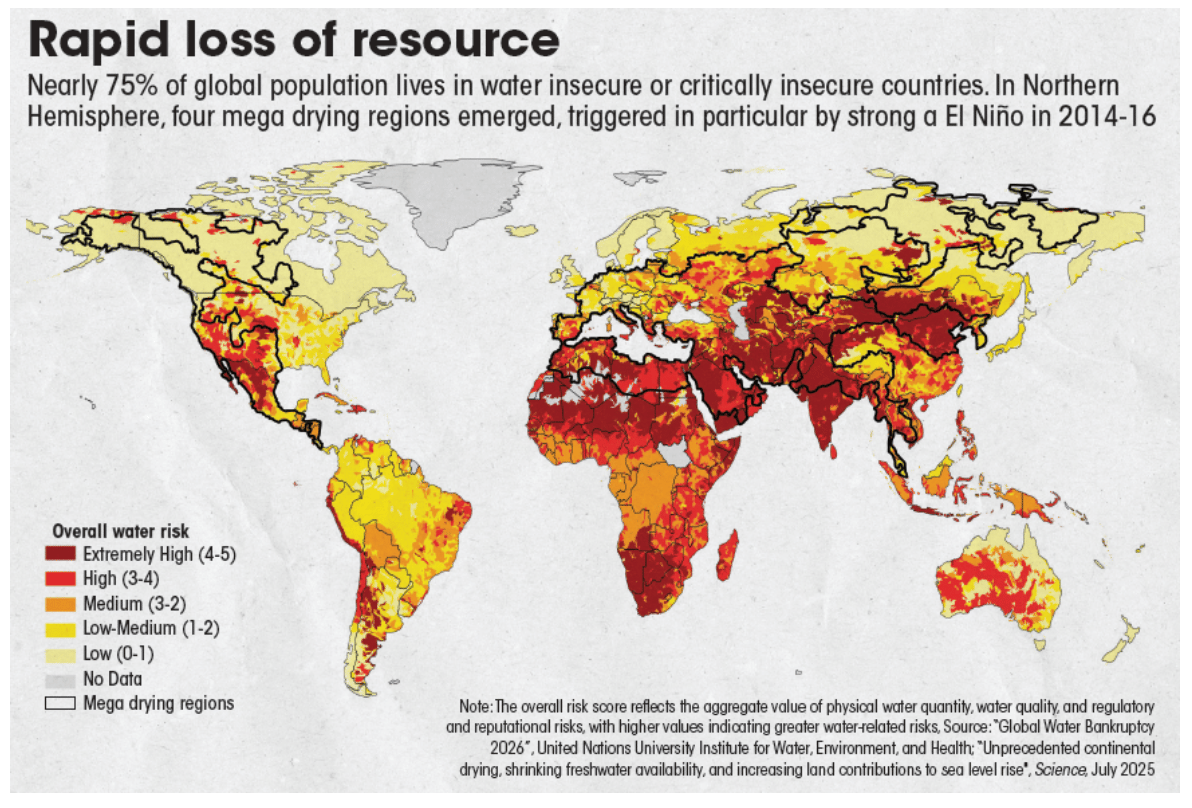
- Another Science study revealed a troubling trend: dry regions are drying faster than wet regions are getting wetter, leading to net global drying.
- Drying zones expanded annually by an area twice the size of California.
- Previously isolated drought hotspots are now merging into vast ‘mega-drying regions’ stretching from western Europe through West and South Asia to East Asia.
- New drying regions are emerging in northern Canada, northern Russia, and Central America.
Why is freshwater disappearing?
- Climate warming and glacier loss: Rising temperatures are accelerating glacier melt, especially in the Himalayas, while reducing precipitation in many regions.
- Natural climate variability: Phenomena such as El Niño, the Arctic Oscillation, and the Pacific Decadal Oscillation intensify dry years and increase drought persistence.
- Groundwater overextraction: Groundwater depletion accounts for 68% of terrestrial water storage loss in non-glaciated regions.
- The Indus basin is losing 1.23 cm of water storage per year.
- The Ganga–Brahmaputra basin loses about 1.09 cm annually.
Freshwater Loss & Rising Seas
- A striking finding is that continental drying now contributes 44% to global sea-level rise, more than:
- Greenland ice melt (37%)
- Antarctic ice melt (19%)
- Nearly 6 billion people, about 75% of the global population, live in countries that have been losing freshwater over the past two decades.
Water Bankruptcy: A Global Crisis
- The UN University describes the situation as ‘water bankruptcy’ where water use exceeds natural recharge.
- Key findings include:
- Three-quarters of the world’s population live in water-insecure or critically water-insecure countries.
- 410 million hectares of wetlands have disappeared in the last 50 years, costing ecosystems services worth US $5.1 trillion.
- Excessive groundwater extraction has caused land subsidence across 6 million sq km, with some cities sinking by up to 25 cm per year.
Agriculture and livelihoods at risk
- Agriculture consumes 70% of global freshwater and is increasingly threatened by shrinking supplies and pollution.
- At the same time, the loss of glaciers and snowpacks endangers communities dependent on meltwater-fed rivers.
- Scientists warn that both ‘blue water’ (surface and groundwater) and ‘green water’ (soil moisture) have crossed safe planetary limits, alongside climate and biodiversity boundaries.
India’s Deepening Dry Spell: From Climate Signals to Water Bankruptcy
Context
- India has come under renewed focus due to a series of recent scientific studies and global reports warning that large parts of the country are entering an era of accelerating drying and ‘water bankruptcy’.
- The global assessments caution that mismanaged water systems could trigger long-term ecological, economic and political instability.
India’s drying trend: What the science shows?
- Early warning signs from the Indo-Gangetic Plain: The Indo-Gangetic Plain (IGP), India’s agricultural heartland, has been identified as a drying hotspot since as early as 2009.
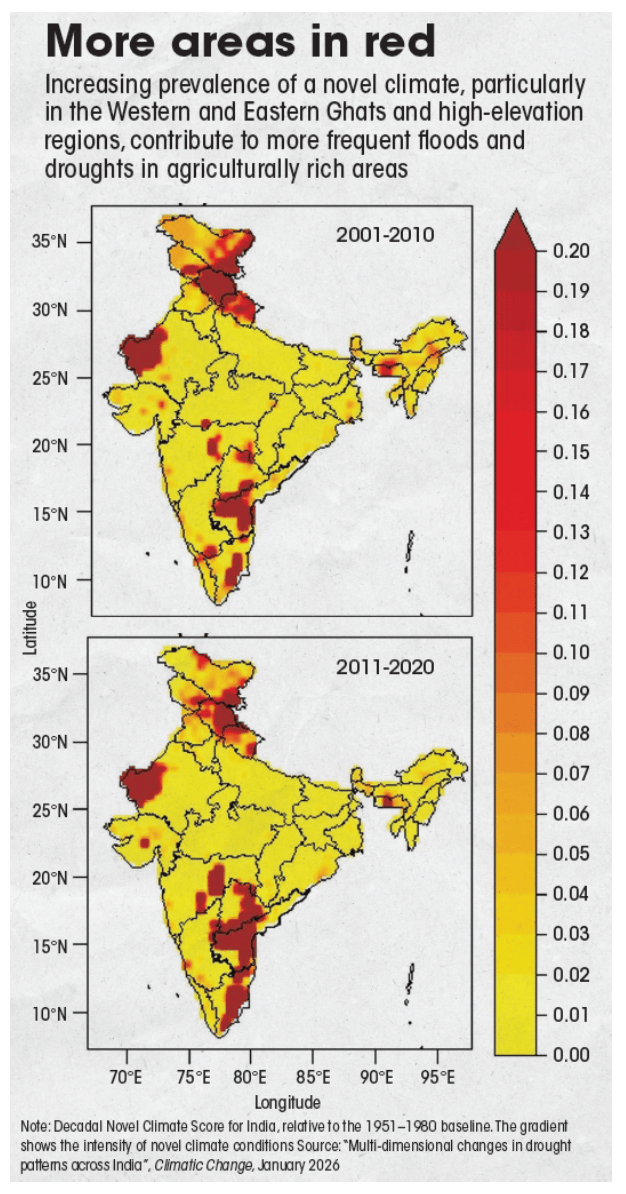
- A study published in Climate Change (December 2025) analysed drought patterns across six regions of India i.e. western, central, Himalayan, IGP, peninsular and northeast India between 1971 and 2020.
- It found that drying is accelerating fastest in the IGP and northeast India using multiple climate indicators such as the Standardised Precipitation Evapotranspiration Index (SPEI).
- Monsoon weakening and rising heat: The findings point to a dangerous combination:
- Weaker monsoon rainfall, leading to rainfall deficits during the monsoon season;
- Rising daytime and nighttime temperatures, increasing evaporation before and after the monsoon;
- The IGP and northeast India show the strongest negative SPEI trends, indicating rapidly intensifying moisture stress.
- In contrast, central and Himalayan regions show weaker but still concerning drying signals.
- Human pressures worsen natural stress: Climate stress is compounded by intensive groundwater extraction, water-intensive cropping, and high evapotranspiration from agriculture.
- In the northeast, once known for abundant rainfall, weakening monsoonal circulation and warming temperatures are steadily eroding water availability.
Historic Low For Ganga Basin
- Another study published in PNAS Earth, Atmospheric and Planetary Sciences places current drying in a long-term context.
- Using tree-ring data to reconstruct river flows from the year 700 onward, researchers found that the Ganga river basin experienced its driest three-decade phase (1991–2020) in the last 1,300 years. This drying was:
- 76% more intense than 16th-century droughts;
- Beyond the range of natural climate variability;
- The evidence strongly points to human-driven climate change as a key driver.
Water Bankruptcy: More Than A Hydrological Crisis
- The concept of ‘water bankruptcy’ refers to a state where water demand consistently exceeds sustainable supply, pushing systems toward irreversible collapse.
- According to the Global Water Bankruptcy Report released in January 2026, water scarcity is as much a political and economic challenge as a climatic one.
- Poor water management can threaten food security, political stability, biodiversity and ecosystems, climate and desertification mitigation efforts.
Can Technology Solve The Crisis?
- Promise and limits of technical fixes: Technologies such as efficient irrigation, desalination, recycling, dams and water transfers can help, but each comes with trade-offs:
- Efficient irrigation often leads farmers to expand cultivation or switch to thirstier crops;
- Desalination creates brine that harms marine ecosystems;
- Large reservoirs disrupt river systems and local livelihoods;
- Technology alone, without safeguards, can worsen the problem.
Data Gap: Why Models Are Not Enough
- Observations still matter: Despite advanced satellites and climate models, ground observations remain critically inadequate, especially in India.
- Groundwater levels can vary dramatically even between nearby wells due to geological heterogeneity.
- Many monitoring wells are not automated, measured only once a year, and do not align with satellite paths.
- Without frequent, shared and reliable data, climate and hydrological models remain poorly calibrated, effectively ‘blind’ to local realities.
Agriculture At The Centre of The Solution
- Agriculture accounts for over 85% of water use in many Indian regions, making it the most urgent sector for intervention. Key priorities include:
- Shifting away from water-intensive crops in stressed regions;
- Scaling up drip irrigation and solar-powered pumping;
- Reforming power subsidies to curb indiscriminate groundwater extraction;
- Promoting practices such as direct-seeded cultivation and soil moisture conservation;
Beyond Technology: Lessons From Global Examples
- Successful water management systems combine technology with institutional and economic reforms.
- Countries like Israel and regions such as California have invested not only in infrastructure, but also in diversifying their economies so that drought does not destabilise national security or employment.
- In contrast, many countries in the Global South cannot rapidly industrialise or withdraw water from agriculture without risking social unrest.
- Delaying reform, however, risks permanent water loss. Balancing these pressures is the central challenge.
Indigenous knowledge and adaptation
- Traditional water systems such as Iran’s ancient underground qanats offer valuable lessons in efficiency and cooperation, but cannot meet modern-scale demand on their own.
- Indigenous practices are most effective when adapted to local contexts and supplemented with modern methods.
- Earlier systems relied heavily on community cooperation. Over time, competition driven by technology has weakened collective water governance, something that future reforms must address.
India’s AI Awakening: A Late Realisation in a Changing Tech Order
Context
- India’s technology ecosystem made headlines after the significant rise of China’s DeepSeek AI chatbot, a large language model whose capabilities rival those of the world’s leading AI systems.
A Year of Reckoning For India’s Tech Sector
- 2025 became a year of reckoning for India’s technology sector. For years, innovation existed in a comfort zone, more services-led than science-driven.
- The rapid advances in AI, advanced avionics, and deep technologies exposed this fragility.
- Instead of investing steadily in future-facing technologies, precious time had been spent glorifying a mythical past, claiming ancient mastery over all sciences.
- The rise of China’s AI ecosystem showed, starkly, where India truly stood in the global hierarchy.
DeepSeek Shock & Government Response
- The debut of DeepSeek and its performance shook the Ministry of Electronics and Information Technology (Ministry of Electronics and Information Technology) into action. Within weeks, the government:
- Invited proposals to develop foundation AI models (large base models that can be adapted for many tasks).
- Asked private companies to earmark GPUs (graphic processing units) for government-led AI research.
- It was significant because India faces a severe shortage of GPUs, the computing backbone of modern AI.
- The response yielded access to nearly 19,000 GPUs at subsidised rates, spurring early, but still limited, interest from private players.
India vs China: Two Startup Philosophies
- China’s dominance is the result of long-term investment in science, engineering education, and deep integration between academia and industry.
- Chinese startups lead in AI, semiconductors, robotics, electric vehicles, and advanced manufacturing.
- India’s contrast was publicly highlighted by Union commerce minister Piyush Goyal at the ‘StartUp Mahakumbh’.
- Indian startups focus largely on food delivery, grocery apps, betting, and fantasy sports.
- Chinese startups prioritise electric vehicles, batteries, AI, robotics, renewable energy, space, and high-speed rail.
China’s Long-term AI Strategy
- As early as 2017, it unveiled the ‘New Generation Artificial Intelligence Development Plan’, a national blueprint to become the world leader in AI by 2030.
- It aligned funding, research institutions, talent development, and industry goals.
- During the same period, India was grappling with internal disruptions such as demonetisation, with little focus on AI strategy.
India’s Delayed But Crucial AI Push
- India’s first serious step came only in 2024 with the launch of the IndiaAI Mission, a $1.25 billion programme aimed at building core AI infrastructure.
- Managed by MeitY, the mission supports startups like Sarvam, which are developing foundation models in Indian languages and targeting sectors such as agriculture, education, and healthcare.
- It remains nascent compared to China’s scale and maturity.
India–AI Impact Summit: Symbolism vs Substance
- AI is now firmly in public discourse, helped by the upcoming India–AI Impact Summit 2026 in New Delhi. India has even invited China, signalling a readiness to learn from the leader.
- China arrives with credibility, having integrated AI into healthcare, manufacturing, transport, infrastructure, and governance under its AI+ Initiative.
- India, by contrast, is still hoping to showcase a handful of foundation model prototypes.
- Despite this, official rhetoric remains heavy on symbolism, invoking ancient sutras and chakras as guiding principles, ideas unlikely to impress leading AI nations focused on execution and scale.
Lessons From China’s Resilience
- Chinese AI firms adapted through architectural innovation, efficiency, and open-source collaboration when faced with US export controls on advanced chips.
- This resilience translated into real self-reliance—far beyond slogans.
- India, meanwhile:
- Continues to lose top talent to the US tech ecosystem. Suffers from chronic computing shortages.
- Seeks global cooperation to compensate for internal deficiencies, as noted by analysts at the AI Insight Think Tank.
Takeaway For India
- China’s rise in AI underscores a simple lesson: technology leadership demands patience, deep investment, and coherence between policy, talent, and infrastructure.
- India’s recent moves suggest awareness, but awareness alone is not enough.
- For Indian startups and policymakers, the message is clear, stop chasing short-term convenience models and start building technologies that shape the future.
- The world has already chosen its AI leaders. India needs to decide how seriously it wants to compete.
Pampadum Shola National Park
Context
- Restoration of grasslands of Kerala's Pampadum Shola National Park, once dominated by invasive Australian wattles, see a return of streams and native species.
About Pampadum Shola National Park
- It is a high-altitude protected area located near Munnar in Kerala’s Idukki district, within the Western Ghats.
- It lies at elevations between 1,900 and 2,300 metres and is characterised by a distinctive shola–grassland ecosystem, where evergreen forests occupy sheltered valleys and rolling montane grasslands cover the hilltops.
Grassland Ecosystem (Shola)
- Sholas are ancient, climate-regulating forests that act like natural sponges.
- They absorb rainfall, release water slowly into streams and rivers, and help maintain groundwater levels in surrounding regions.
- The grasslands between these forest patches are equally important, supporting grazing species and pollinators and preventing soil erosion.
Biodiversity and Endemism
- The park is home to endemic and threatened species such as the Nilgiri marten, Nilgiri tahr, sambar, and a rich diversity of birds, butterflies, and moths.
- Rare plants, orchids, grasses, and medicinal herbs thrive in its cool, moist climate, making the park ecologically significant within the Western Ghats landscape.
Human Impact and Conservation Challenges
- During the mid-20th century, large parts of Pampadum Shola were converted into plantations of exotic species like Australian wattle (Acacia mearnsii), eucalyptus, and pine.
- These fast-growing trees disrupted native vegetation, reduced water retention in soils, and affected wildlife habitats.
- Over time, forest managers recognised that these ‘green’ plantations were ecologically damaging.
Biodiversity Beyond National Jurisdiction (BBNJ) Treaty
Context
- Recently, the UN's Biodiversity Beyond National Jurisdiction (BBNJ) treaty came into force, providing countries with a legally binding framework to tackle threats such as overfishing and meet a target to protect 30% of the ocean environment by 2030.
About the BBNJ Treaty
- It is formally titled the Agreement under the United Nations Convention on the Law of the Sea (UNCLOS) on the Conservation and Sustainable Use of Marine Biological Diversity of Areas Beyond National Jurisdiction, adopted in June 2023.
- It is the first global, legally binding framework dedicated to protecting biodiversity on the high seas and deep seabed, areas that lie outside any country’s control and cover nearly two-thirds of the ocean.
Why does the BBNJ Treaty matter?
- Fragmented governance of the high seas across fisheries, shipping, mining, and conservation bodies.
- Overexploitation and biodiversity loss, especially from fishing and emerging activities.
- Unregulated access to marine genetic resources (MGRs) and inequitable benefit-sharing.
- Lack of global tools to create and enforce high seas marine protected areas (MPAs).
Four Core pillars of the BBNJ Treaty
- Marine Genetic Resources (MGRs) & Benefit-Sharing: Establishes rules for access to genetic material from high seas organisms;
- Introduces non-monetary and potential monetary benefit-sharing, particularly for developing states;
- Aims to balance scientific freedom with equity;
- Area-Based Management Tools (ABMTs), including MPAs: Enables the designation of Marine Protected Areas on the high seas;
- Requires cooperation with existing bodies (e.g., RFMOs, IMO);
- Seen as essential for achieving the ‘30×30’ global biodiversity target;
- Environmental Impact Assessments (EIAs): Mandates EIAs for activities likely to harm biodiversity in areas beyond national jurisdiction;
- Introduces minimum global standards and transparency obligations;
- Capacity-Building & Transfer of Marine Technology: Supports developing countries through training, data sharing, and technology access;
- Central to equity and effective implementation;
- Legal and governance significance: Operates under UNCLOS, not as a replacement;
- Reinforces principles like the common heritage of mankind and due regard;
- Creates new institutional bodies, including a Conference of the Parties (COP) and scientific/technical committees;
Emissions Trading System (ETS)
Context
- Recently, Slovakian Prime Minister called for the suspension of the Emissions Trading System (ETS) due to rising carbon prices and burden on domestic manufacturers.
About the Emissions Trading System (ETS)
- An ETS is a market-based climate policy in which regulators:
- Set a cap on total emissions from covered sectors (power, industry, aviation, shipping in some systems).
- Distribute or auction allowances, each permitting the emission of one tonne of CO₂-equivalent.
- Allow firms to trade allowances, so reductions occur where they are cheapest.
- Tighten the cap over time, ensuring declining total emissions.
Why is ETS economically attractive?
- Cost efficiency: Firms with low abatement costs reduce more and sell allowances; high-cost firms buy allowances.
- Dynamic incentives: A carbon price encourages innovation and cleaner investment.
- Revenue recycling: Auction revenues can fund climate action or offset household impacts.
EU ETS
- Launched in 2005, covering ~40% of EU emissions.
- Early phases (I–II) faced over-allocation and low prices.
- Later reforms introduced auctioning, stricter caps, and the Market Stability Reserve (MSR).
- Empirical studies find significant emissions reductions, especially in the power sector, with limited evidence of carbon leakage when complementary policies are in place.
Current Trends
- Expansion to new sectors (maritime transport, buildings in some jurisdictions);
- Linking ETSs across regions;
- Stronger price-stability tools;
- Integration into broader policy mixes alongside carbon taxes and standards;
Key challenges identified
- Price volatility and uncertainty for investors;
- Carbon leakage risks in trade-exposed sectors;
- Policy interaction issues with renewable subsidies and efficiency standards;
- Distributional effects on households and regions;
Nipah Virus
Context
- Recently, West Bengal has confirmed the presence of Nipah virus after 19 years, as two nurses in North 24 Parganas district are believed to have contracted the infection.
About Nipah Virus (NiV)
- It is a highly pathogenic, zoonotic RNA virus belonging to the genus Henipavirus (family Paramyxoviridae).
- It was first recognized in Malaysia in 1998–1999, and has caused recurrent outbreaks in South and Southeast Asia, especially Bangladesh and India, with high case-fatality rates (40–75%).
- Fruit bats (Pteropus species) are the natural reservoir, and transmission occurs via animal intermediates (notably pigs), contaminated food (e.g., raw date palm sap), and human-to-human spread in healthcare and household settings.
- Clinically, NiV causes acute febrile illness that can progress to fatal encephalitis and respiratory disease.
- There is no licensed vaccine or specific antiviral therapy for humans; management relies on supportive care and public-health prevention.
Diagnosis, Treatment & Prevention
- Diagnosis: RT-PCR, serology (ELISA), virus isolation (BSL-4).
- Treatment: Supportive; investigational antivirals and monoclonal antibodies under study.
Kumbhalgarh Wildlife Sanctuary
Context
- Recently, the Union government declared the Kumbhalgarh Wildlife Sanctuary, part of the Aravalli hills, as an eco-sensitive zone and banned activities such as mining and stone quarrying in 243 sq km.
About Kumbhalgarh Wildlife Sanctuary
- It is a protected forest area in the Rajsamand District of Rajasthan, India, situated in the Aravalli Range, forming an ecological buffer around the historic Kumbhalgarh Fort (a UNESCO World Heritage Site).
- It acts as a natural green corridor between Udaipur and Jodhpur regions.
Fauna (Wildlife)
- The sanctuary is best known for its Indian wolf habitat, which is rare in India.
- Major mammals include: Indian Wolf (Canis lupus pallipes), Indian Leopard (apex predator), Sloth Bear, Striped Hyena, Golden Jackal, Jungle Cat, Sambar Deer, Nilgai, Chinkara (Indian Gazelle), and Chausingha (Four-horned Antelope).
- Avifauna (Birdlife): Grey Junglefowl, Indian Eagle-Owl, Parakeets, doves, woodpeckers, and raptors;
- Reptiles: Monitor lizards, snakes, and other dry-forest species;
Flora & Vegetation
- Dominated by tropical dry deciduous forests;
- Common species: Dhok (Anogeissus pendula); Khair (Acacia catechu); Salar (Boswellia serrata); Bamboo patches in valleys;
- Important for soil conservation and watershed protection;
Cultural & Historical Importance
- Encloses Kumbhalgarh Fort, built by Rana Kumbha (15th century);
- Birthplace of Maharana Pratap;
- Forest historically served as a natural defense shield for the fort;
- Represents a rare blend of natural and cultural heritage;
African Swine Fever (ASF)
Context
- Recently, Mizoram forest officials said that 20 wild boars in Serchhip district were found to have died after contracting African Swine Fever (ASF).
About African Swine Fever (ASF)
- It is a viral disease of domestic pigs and wild suids, characterized by very high mortality, severe economic losses, and major challenges for global animal health.
- It is caused by African swine fever virus (ASFV), the only known member of the family Asfarviridae.
- Its transmission is driven by a combination of direct contact, contaminated pork products, wild boar ecology, and soft ticks.
- It affects domestic pigs and wild boar; it does not infect humans.
- There is still no widely available commercial vaccine; and effective control relies primarily on biosecurity, surveillance, and rapid response.
Sundarbans
Context
- The Sundarbans’ low-lying geography makes it extremely vulnerable to floods and natural disasters, whose frequency is increasing with climate change.
About the Sundarbans
- It is the world’s largest contiguous mangrove ecosystem, spread across nearly 19,000 square kilometres of India and Bangladesh.
- It lies at the delta of the Ganga, Brahmaputra and Meghna rivers, where land and sea constantly interact.
- It is recognised as a UNESCO World Heritage Site owing to its unique biodiversity and ecological value.
Rich Biodiversity and Wildlife
- The Sundarbans is globally famous as the habitat of the Royal Bengal tiger, adapted to survive in a saline, swampy environment.
- It supports estuarine crocodiles, fishing cats, spotted deer, dolphins, snakes, birds and countless species of fish and crustaceans.
- Its mangroves act as a natural shield against cyclones and storm surges.
Climate Change Hotspot
- The Sundarbans’ low-lying geography makes it extremely vulnerable to climate change.
- Rising sea levels, salinity intrusion, cyclones, floods and erosion are occurring more frequently and with greater intensity.
- These hazards have led to loss of land, damaged homes, declining crop yields and forced migration.
Periyar Tiger Reserve
Context
- Recently, the Periyar Tiger Reserve marked its 75th anniversary, a milestone that coincides with a remarkable conservation record: zero officially recorded poaching cases for several consecutive years.
About the Periyar Tiger Reserve
- It is located in the Idukki district of Kerala, within the biologically rich Western Ghats.
- It is one of India’s oldest and best-managed protected forest landscapes.
Historical Background
- Late 19th Century: The construction of the Mullaperiyar dam led to the creation of a large reservoir that submerged forest valleys and altered animal movement patterns.
- 1930s: The Travancore princely state declared surrounding forests as reserved areas to curb unchecked plantation expansion and timber extraction.
- After Independence: The region was notified as a Wildlife Sanctuary in 1950, brought under Project Tiger in 1978, and partially declared a National Park in 1982.
From Forest Crime to Conservation Model
- For decades, Periyar lay along a porous Kerala–Tamil Nadu border, making it vulnerable to poaching, sandalwood smuggling, illegal timber felling, and extraction of forest produce.
- By the 1990s, authorities realised that enforcement alone could not control forest crime.
- It led to two landmark initiatives:
- The Periyar Foundation, enabling flexible use of tourism revenue and donations for conservation and community welfare.
- Eco Development Committees (EDCs), which brought local and tribal communities into forest protection, ecotourism, and surveillance roles.
- Former poachers and smugglers were rehabilitated as forest guards, trackers, and guides, transforming threats into protectors.
Biodiversity and Habitat
- Periyar is part of one of the largest contiguous evergreen and semi-evergreen forest blocks in southern India. Its rich biodiversity includes 40–45 tigers, nearly 1,000 elephants, Gaur, sambar, barking deer, wild pig, and leopards, around 2,000 species of flowering plants, and nearly 300 bird species, along with diverse reptiles and amphibians.
Subjective Questions for Practise
Q1. Explain what Sustainable Aviation Fuel (SAF) is and how it differs from conventional aviation turbine fuel. Examine the potential benefits of SAF in achieving climate targets, particularly for developing countries like India.
Q2. India’s urban water crisis is not merely a problem of scarcity, but a result of poor governance, unplanned urbanisation, and unsustainable consumption patterns. Comment.
Q3. Explain the concept of water bankruptcy. Analyse the key drivers contributing to global water bankruptcy.
QUICK LINKS

 Call
Call