 Residential Course
YOJANA October 2025
The following topics are covered in the YOJANA October 2025:
Chapter 1: Education for the Visually Impaired
Empowering persons with visual impairment through education is a transformative process requiring legal, institutional, and societal commitment. Ensuring equitable access to education enables dignity, independence, and equal opportunity—moving India closer to inclusive development.
Empowerment Through Education
Empowerment begins when individuals recognise their potential and actively participate in shaping their futures. For persons with disabilities, education is the foundation of empowerment—fostering independence, self-advocacy, and civic participation. It breaks the cycle of dependency, enhances employability, and promotes social inclusion.
- India’s National Education Policy (NEP) 2020 and the Rights of Persons with Disabilities (RPwD) Act, 2016 form the cornerstone of this vision. Both emphasize inclusive, barrier-free education and align with constitutional and human rights commitments.
Legal and Policy Framework
- RPwD Act, 2016: Mandates inclusive education, accessibility, and reasonable accommodation. Sections 16–17 require schools to adapt curricula, train teachers, and provide assistive technologies.
- NEP 2020: Calls for barrier-free access, curriculum adjustments, and comprehensive teacher training to support visually impaired students.
- Rehabilitation Council of India (RCI) Act, 1992: Governs training and certification of special educators, ensuring professional support for visually impaired learners.
Major Government Schemes
- Samagra Shiksha Abhiyan: Promotes inclusive education from pre-primary to Class XII through assessment, provision of aids, and special educators for Children with Special Needs (CWSN).
- Scheme for Implementation of the RPwD Act (SIPDA): Provides financial assistance to states and institutions for barrier-free infrastructure, skill training, and assistive technologies.
- Deendayal Disabled Rehabilitation Scheme (DDRS): Funds NGOs and special schools for communitybased rehabilitation of visually impaired persons.
- National Scholarships for Persons with Disabilities: Supports post-matric and professional education to ease financial barriers.
- Assistance to Disabled Persons for Purchase/Fitting of Aids and Appliances (ADIP) Scheme: Active since 1981 (revised in 2024), it provides Braille kits, smart canes, accessible mobile phones, and mobility aids to enhance independence.
- National Action Plan for Skill Development of Persons with Disabilities (NAP-SDP): Targets skilling 2.5 million PwDs, with training, mentorship, and placement support, in collaboration with the Ministry of Skill Development and Entrepreneurship.
Institutional Support
- National Institute for the Empowerment of Persons with Visual Disabilities (NIEPVD), Dehradun: Offers academic and vocational training, produces Braille materials, and conducts research. It introduced science courses for visually impaired students in 2024, promoting inclusion in STEM fields.
- NCERT Initiatives: Through DIKSHA and PM e-Vidya, NCERT provides DAISY-format textbooks, audiobooks, tactile visuals, and teacher training resources. The Barkha Reading Series and accessible e-content exemplify Universal Design for Learning.
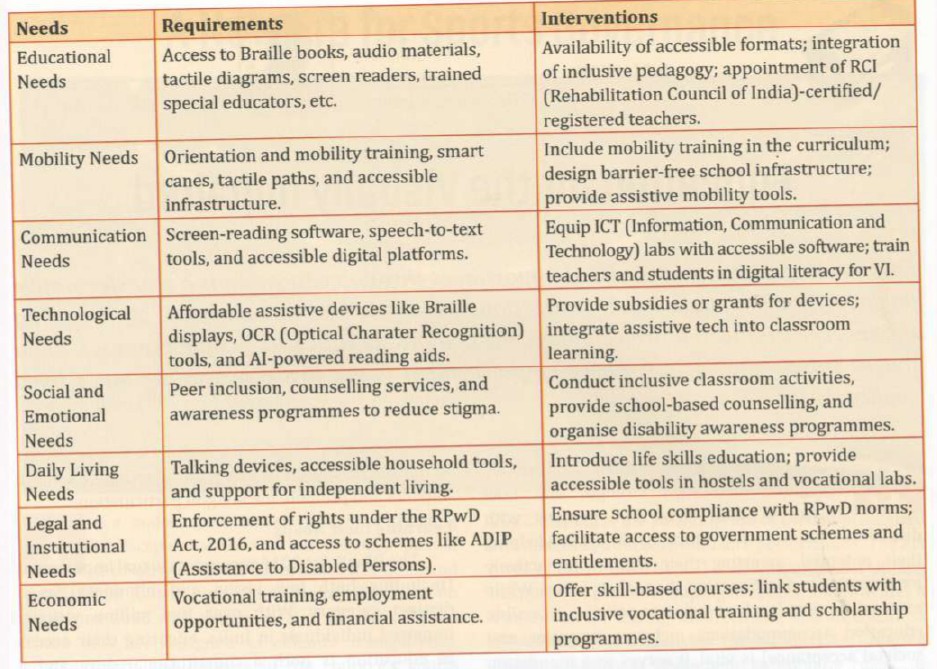
Key Enablers for Inclusive Education
- Accessible Learning Materials- Standard print formats exclude visually impaired learners. To bridge this, the government provides Braille, tactile, audio, and digital formats under the DALM Project (Development of Accessible Learning Material)—an evolved version of the 2014-15 Braille Books Scheme under SIPDA.
- Since 2015-16: Over 115 crore Braille pages produced, benefiting 1.58 lakh students through 25 implementing agencies nationwide.
- Assistive Technologies- Assistive technologies convert visual data into tactile, auditory, or magnified formats—enabling reading, writing, and communication. Devices include Braille displays, OCR tools, magnifiers, AI-powered reading aids, and smart canes. Under the ADIP Scheme (revised 2024), modern aids are distributed through certified agencies, enhancing rehabilitation and employment potential.
- Qualified Educators- Section 17(c) of the RPwD Act mandates teachers trained in Braille and multisensory instruction. The Rehabilitation Council of India (RCI) develops curricula, accredits training institutes, and maintains the Central Rehabilitation Register (CRR) for qualified professionals.
- Barrier-Free Infrastructure- Inclusive campuses must have ramps, handrails, tactile paving, audio cues, and Braille signage. The Accessible India Campaign (Sugamya Bharat Abhiyan) drives universal accessibility across educational spaces and public infrastructure.
- Social and Emotional Support Empathy-based classrooms, peer interaction, and counselling combat isolation and stigma. The Awareness Generation and Publicity (AGP) scheme by DEPwD promotes sensitisation and inclusion, fostering confidence and belonging among students.
Legal and Institutional Oversight
The Office of the Chief Commissioner for Persons with Disabilities (CCPD) ensures compliance with the RPwD Act and monitors the implementation of inclusive education across India. It also acts as a grievance redressal authority for accessibility-related issues.
Recent Developments (Last 10 Years)
- RPwD Act, 2016 enacted, legally mandating inclusive education.
- Unicode-mapped Braille codes launched by DEPwD for digital inclusion.
- DALM Project (2023 update) expanded to include talking books, e-pub, and large-print formats.
- Science stream education introduced (2024) at NIEPVD’s Model School.
- Strengthening of Orientation & Mobility (O&M) training by RCI.
- Revised skill development curricula and introduction of new vocational courses.
- Launch of free coaching schemes for higher education and employment.
- Flexible assessment guidelines introduced for visually impaired students.
Challenges Ahead
Despite progressive laws and policies, gaps remain in:
- Regional disparities in infrastructure and teacher availability.
- Limited awareness among educators and peers.
- Insufficient access to modern assistive technologies in rural areas.
- Societal stigma and emotional isolation.
Sustained investment, technological innovation, and social sensitization are needed to bridge these divides.
Chapter 2: Cultivating Creativity and Enterprise
The National Education Policy (NEP) 2020 emphasises fostering critical thinking, creativity, and problem solving among students, moving beyond rote learning. As India aims to become an innovation-based knowledge economy under Viksit Bharat @2047, education must become the foundation for innovation and nation-building.
Preparing for Industry 5.0
With rapid advances in AI, robotics, and machine learning, education needs to align with emerging industry demands. Institutions of 2047 must focus on interdisciplinary learning, emotional intelligence, and a human centric approach. Building innovation ecosystems within institutions will empower students with real-world problem-solving abilities.
AICTE Initiatives for Innovation
The All-India Council for Technical Education (AICTE) promotes innovation through:
- Smart India Hackathon (SIH) – world’s largest open innovation model engaging 15 lakh+ students.
- KAPILA (Kalam Program for IP Literacy and Awareness) – led to a 247% rise in patent filings.
- Institution’s Innovation Councils (IICs) – 16,300+ councils across India nurturing innovation culture.
- National Innovation and Start-up Policy (NISP) – adopted by 3,000+ institutions to promote entrepreneurship.
- AICTE Innovation Centers – hubs for research collaboration and IP commercialization.
These initiatives embed creativity into academic culture, promoting hands-on learning and tech-driven solutions.
Innovation at the School Level
The National Policy for Promoting Innovations in Schools fosters problem-solving and entrepreneurial skills among 250 million students in 1.5 million schools.
Key initiatives:
- School Innovation Ambassador Training Program (SIATP) – trained 26,800 teachers from 14,120 schools in 5 domains:
- (1) Design Thinking, (2) Idea Generation, (3) Entrepreneurship, (4) IPR, (5) Finance & HR.
- School Innovation Councils (SICs) – established in 20,000+ schools, fostering local problem-solving and connecting with higher education & industry.
- Design Thinking and Innovation (DTI) module - world’s first structured DTI module for schools; 2,400 schools and 1.3 lakh students enrolled.
Digital and Experiential Learning
Online platforms like SWAYAM offer structured courses on Design Thinking and Intellectual Property Rights, democratizing access to innovation education.
Innovation Design and Entrepreneurship (IDE) Bootcamps by AICTE, MIC, and DoSEL trained 9,692 participants in schools and 10,000+ in higher education, across 40+ locations, providing hands-on exposure, mentorship, and industry linkages.
Towards a New Educational Era
These collective efforts are shaping an innovation-driven academic ecosystem across all levels of education. They align with the goals of Atmanirbhar Bharat and Viksit Bharat @2047, building a generation of innovators, problem-solvers, and entrepreneurs. Education is thus redefined as “Shiksha for Innovation”— not just acquiring knowledge but creating, experimenting, and innovating.
Chapter 3: Indian Knowledge System (Iks) in Education
India’s civilizational legacy spans over 5,000 years, encompassing vast knowledge across science, art, philosophy, and governance.
- Despite foreign invasions and colonial influence, this intellectual heritage survived through oral traditions and later written records. However, over the last 200 years, Western epistemic models marginalized indigenous traditions.
- The National Education Policy (NEP) 2020, India’s first major education reform in the 21st century, aims to revitalize these traditions by integrating Indian Knowledge Systems (IKS) into all levels of education — aligning modern learning with India’s cultural heritage and SDG 4 (Quality Education).
Understanding Indian Knowledge Systems (IKS)
IKS refers to India’s vast body of indigenous intellectual and cultural heritage, developed over millennia and preserved across regions and languages. It encompasses:
- Tacit knowledge (through experience and tradition) and explicit knowledge (texts, theories, frameworks).
- A systematic classification of wisdom spanning spiritual, scientific, artistic, and social domains.
- The Bharatiya Gyana Parampara, a living tradition that evolved with time while retaining cultural roots.
The book “Introduction to Indian Knowledge Systems: Concepts and Applications” defines IKS as knowledge emerging from Akhanda Bharata—from Afghanistan to Burma and the Himalayas to the Indian Ocean.
Iks Under Nep 2020
NEP 2020 recognizes IKS as essential for holistic education, encouraging infusion of Knowledge of India (KoI) across all stages and subjects.
Key provisions include:
- Curriculum rooted in Indian context, ethos, and heritage (Clause 4.29).
- Use of local stories, arts, sports, and examples to enhance relatability and creativity.
- Integration of indigenous traditions, philosophy, language, and science to make learning experiential and culturally grounded.
National Curriculum Framework (Ncf) 2023: Subject-Wise Iks Integration
Formulated by NCERT, NCF 2023 operationalizes NEP 2020 by embedding IKS across subjects:
- Art Education: Draws on Natyashastra, Abhinaya Darpanam, Shilpashastra, Vaastushastra, Chitrasutra; students learn raga, tala, laya, rasa, bhava.
- Mathematics: Introduces India’s contributions—zero, negative numbers, geometry, algebra; includes figures like Aryabhata, Brahmagupta, Ramanujan.
- Science: Highlights India’s advancements in astronomy, metallurgy, medicine, chemistry, and space research.
- Social Sciences: Encourages pride in Bharatiyata, exploring India’s democratic ideals, diversity, and values like ahimsa and coexistence.
- Languages: Promotes learning in mother tongue/regional language (R1); India’s 19,500+ dialects strengthen multilingualism and identity.
- Physical Education: Integrates traditional sports — Yoga, Mallakhamb, wrestling, archery, martial arts, and local games (50+ introduced at preparatory stage).
Technological Innovations
Established in 1961, NCERT leads curriculum design, textbook development, teacher training, and digital content creation (e-Pathshala, DIKSHA).
Post-NEP 2020, NCERT:
- Formed a Curricular Area Group on IKS to guide integration across subjects (Grades 1–12).
- Ensured IKS inclusion in textbooks till Grade 8 and in new subjects like The World Around Us, Arts Education, Health and Well-being.
- Developed content in Hindi, English, and Urdu, embedding shlokas, local traditions, and cultural references in lessons.
- Promotes innovative materials like Jaadui Pitara and special IKS modules for experiential learning.
Significance
Revitalising IKS is not about returning to the past but harmonising tradition with modernity. It fosters:
- Holistic learning integrating ethics, science, and creativity.
- Cultural pride and national identity among learners.
- Critical thinking and innovation rooted in indigenous wisdom.
- Alignment with Atmanirbhar Bharat and global educational standards.
Chapter 4: Skill-Based Education
Five years since the rollout of the National Education Policy (NEP) 2020, vocational education in India has undergone a strategic transformation. The policy mainstreams skill-based learning by integrating vocational education from Grade 6 onwards, ensuring every student gain practical exposure and employable skills.
Integration of Skills in School Educationintegration of Skills in School Education
- Grades 6–8: Students undertake 10-day ‘bagless’ internships with local artisans like potters, carpenters, and artists, promoting curiosity and hands-on learning.
- Grades 9–12: Structured skill training through partnerships with ITIs, polytechnics, and industries, often leading to certification or employability pathways.
- Emphasis on bridging the education-employability gap, reducing the academic-vocational divide, and developing community-linked, market-relevant skills.
Key Reforms and Mechanisms
- National Curriculum Framework (NCF) integrates vocational components.
- Skill Labs established under a hub-and-spoke model.
- Digital platforms like SWAYAM and DIKSHA expand access to virtual skill learning.
- Inclusion of Lok Vidya (traditional knowledge) along with modern sectors like AI, Robotics, and IoT.
- Every child to learn at least one vocation and be exposed to several others.
Expansion and Institutional Growth
- Schools offering NSQF-aligned vocational subjects increased from 12,292 (2021–22) to 18,610 (2023– 24) — a 51% rise.
- The focus has shifted from “Education for All” to “Skills for All,” promoting education as an equitable opportunity.
- Employability skills module made mandatory, covering communication, self-management, ICT, entrepreneurship, and green skills.
State-Level Implementation
- Rajasthan: Vocational education integrated into 1,867 schools across 33 districts; 2.56 lakh students trained in 15 trades in 2022–23.
- Himachal Pradesh: Introduced vocational courses in 416 schools (2023–24); 98,000 students enrolled; implemented ‘10 Bagless Days’ in 2,500+ schools; adopted 48-hub model for shared resources.
- Maharashtra: Proposed mandatory internships for all industries receiving state incentives under its new Industrial Policy; promotes academia-industry collaboration.
Digital and Higher Education Initiatives
- AI-powered career guidance tools offer personalized pathways across 1,500 options.
- SWAYAM enrolment rose from 25,905 (2020–21) to over 1 lakh (2024–25).
- Academic Bank of Credits (ABC): Over 32 crore IDs issued; 2,469 institutions onboarded.
- B.Voc degrees and work-integrated programs gaining traction at IIT Delhi, IIT BHU, etc.
- ITIs report rising enrolment under PM SHRI and Samagra Shiksha initiatives.
Challenges
- Dropout rate: 14.1% at the secondary level (2023–24), limiting access to vocational pathways.
- Outdated curricula: Slow alignment with fast-changing sectors like digital services and green energy.
- Societal stigma: Persistent divide between academic and vocational streams; gendered stereotypes restrict girls to “safe” fields like tailoring or beauty services.
- Trainer shortages: Lack of certified, pedagogically trained vocational educators.
Way Forward
- Mainstream vocational education: Integrate into school timetables with clear mandates and funding.
- Shift societal perceptions: Campaigns, teacher sensitisation, and alumni success stories to elevate dignity of labour.
- Strengthen infrastructure: Use cluster models, PPPs, and align with the 6% GDP education spending goal.
- Develop skilled trainers: Establish state-level vocational educator cadres with certification and growth pathways.
- Dynamic curricula: Continuous industry-academia collaboration via standing curriculum boards.
- Career guidance: Annual counselling and aspiration mapping; encourage girls into non-traditional sectors.
- Inclusive design: Accessible labs and curricula for Divyangjan (CwSN) with employer sensitisation.
- Institutionalize internships: Through local partnerships with industries and government schemes like e-Mitra.
- Leverage technology: Integrate DIKSHA and SWAYAM; track participation via UDISE+ and household surveys.
Conclusion
NEP 2020 marks a paradigm shift from rote learning to skill-integrated, inclusive, and future-ready education. By promoting early vocational exposure, industry collaboration, and digital empowerment, India is redefining education as a bridge between learning and livelihood. The success of this reform lies in dismantling the academic-vocational hierarchy and fostering the dignity of labour, paving the way for a skilled, employable, and equitable India.
UPSC MAINS PRACTICE QUESTIONS
Q1. “The National Education Policy (NEP) 2020 envisions transforming India’s education system from degreecentric to skill-centric learning.” Discuss the progress, challenges, and way forward in mainstreaming vocational and skill-based education in India, with reference to recent data and state-level initiatives.
Q2. “NEP 2020 marks a shift from rote learning to knowledge rooted in India’s civilisational ethos.” Critically examine how integrating the Indian Knowledge System (IKS) through NEP 2020 and NCF 2023 can transform Indian education.
QUICK LINKS

 Call
Call