 Residential Course
YOJANA July 2025
The following topics are covered in the YOJANA July 2025:
Chapter 1: PM Mudra Yojana: A Decade of Hope, Opportunity, and Inclusivity
Pradhan Mantri Mudra Yojana (PMMY) was launched in April 2015 to provide collateral-free loans to micro and small enterprises and bridge the credit gap in the informal sector. Over 10 years, the scheme has disbursed Rs 33.32 lakh crore across 52.73 crore loan accounts (as of March 2025).
- It aims to promote entrepreneurship, especially among women (44% share) and SC/ST/OBCs (34.5%), with about 31% of loans going to first-time borrowers.
- PMMY has contributed to job creation, financial inclusion, and reduction of inequality, supported by a negative correlation (-0.84) with the Gini Index and a positive correlation (0.44) with multidimensional poverty reduction.
Key Objectives and Features
- Purpose: "Funding the unfunded" by providing collateral-free, easy-access loans to micro and small, non-corporate enterprises (manufacturing, trading, service sectors).
- Categories of Loans:
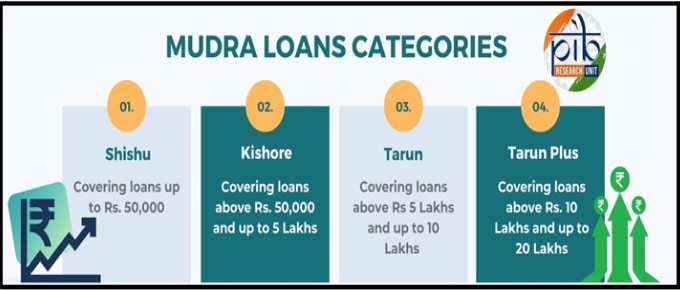
- Eligibility: Any Indian citizen with a viable business plan for a non-farm activity requiring credit below ₹20 lakh.
- Zero collateral: No asset requirement; loans benefit from credit guarantee facilities (CGTMSE/CGFMU).
- Flexible & digital: Repayment linked to earnings, loans accessible via banks, NBFCs, MFIs, SFBs, and the JanSamarth portal.
Performance Metrics (As of 31 March 2025):
- Total Disbursement: Rs 33.32 lakh crore.
- Loan Accounts: 52.73 crore.
- FY25 disbursement: Rs 5.09 lakh crore.
- Sanctions to new entrepreneurs: Rs 10.56 lakh crore across 10.97 crore new accounts (≈31%).
- Women beneficiaries: Rs 14.85 lakh crore (≈44% of cumulative sanctions).
- SC/ST/OBC beneficiaries: Rs 11.72 lakh crore (≈34.5%).
- Geographic Spread: Top states: Tamil Nadu, Uttar Pradesh, Karnataka, West Bengal, Bihar (46.3% share).
- Category-wise Distribution (FY25):
- Shishu: 18.1% of value (80% of accounts historically)
- Kishore: 50.9%
- Tarun: 30.2%
- Tarun Plus: 0.8% (new)
Impact and Transformative Role
- Financial Inclusion: Over 52 crore loans disbursed, many to first-time borrowers and micro-entrepreneurs, catalyzing economic participation at the grassroots
- Marked rise in loans for women, SC/ST/OBC, and new entrepreneurs, supporting inclusive growth.
- Empowerment & Job Creation: PMMY loans enabled millions to start or expand businesses, thereby creating jobs, especially in rural and semi-urban areas. By open eligibility and broad lender participation, PMMY mainstreamed informal businesses and fostered a credit culture.
- Reduction in Inequality and Poverty: Strong negative correlation (-0.84) between Gini Index and PMMY outstanding loans (2016–2022); indicates role in reducing economic inequality. Positive correlation (0.44) between PMMY credit and reduction in multidimensional poverty across leading states.
- Support for the Informal Sector: Significant credit flow to informal micro-enterprises, with many registering on Udyam Assist Platform (UAP).
Role of MUDRA & SIDBI
- MUDRA (Micro Units Development & Refinance Agency): SIDBI’s subsidiary, provides refinance to banks/NBFCs for PMMY lending.
- Disbursed ₹1.00 lakh crore via refinancing; critical for seamless credit flow and stakeholder coordination.
Factors Behind PMMY’s Popularity
- No collateral required
- Affordable, market-linked interest rates
- Flexible, accessible digital process
- Competitive, participatory lender landscape (banks, NBFCs, MFIs, SFBs)
- Credit guarantee support
Challenges and Way Forward
- Regional Imbalance: Scope for higher penetration in populous and under-served states (e.g., UP, Bihar, North-East).
- Awareness: Ongoing need for financial literacy and popularization, especially in marginalized regions.
- Credit Discipline: Growing ticket size and evolving MSME credit needs require proactive risk management and product innovation.
Recent Developments
- Tarun Plus Limit: Increased to ₹20 lakh.
- Rising Loan Size: Doubling since inception; suggests businesses are scaling up.
- NPA Trends: Non-performing assets have remained low.
Chapter 2: Panchayati Raj Institutions: Empowering Rural Women
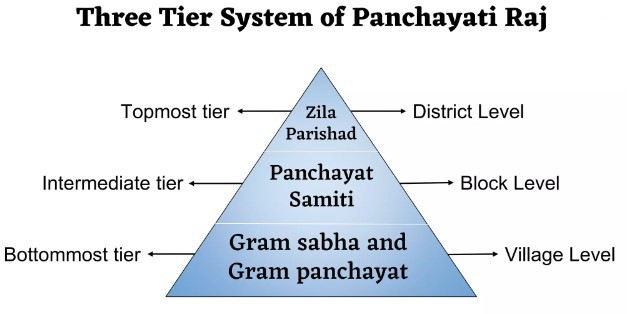
Empowerment of women is essential for socio-economic progress. The 73rd Constitutional Amendment Act, 1992 institutionalized Panchayati Raj Institutions (PRIs) and mandated one-third reservation for women (including SCs/STs/OBCs) in rural local bodies and chairperson posts.
- It came into effect on 24th April 1993, creating a three-tier governance structure to ensure grassroots participation.
- Over the years, many states have increased women’s representation to 50% or more—with Jharkhand (59%), Rajasthan, and Uttarakhand leading. PRIs have enabled women to break social barriers, participate in governance, and gain economic and political confidence at the local level.
Impact: Participation and Empowerment
Data and Trends
- Rising Numbers: Post-2015 elections, out of 29,17,334 Elected Representatives (ERs) in PRIs, 13,41,773 (about 46%) are women.
- State Variations:
- Uttar Pradesh: Highest absolute number (19,992 out of 59,073 sarpanches; 34% of total).
- Odisha: 3,600 women sarpanches (58%).
- Manipur: Among the lowest at just 2%.
- Transformation in Governance:
- Women are increasingly active from grassroots roles to policymakers.
- Their participation is enhancing transparency, dismantling corruption, reducing political and domestic violence, and inspiring others toward economic activities (e.g., through self-help groups).
- Social barriers—like caste dominance and patriarchal control—have weakened, enabling participatory democracy.
Social Impact
- Reduction in Domestic Violence: Women Pradhan/sarpanches are more likely to address cases sensitively, giving victims greater confidence to report grievances.
- Diminishing Patriarchy: There is a significant decrease in the dominance of upper-caste patriarchs and an increase in marginalized groups’ participation.
- Promotion of Economic Activities: Women’s inclusion has sparked the formation of self-help groups, and increased take-up of schemes like MGNREGA for economic independence.
Challenges
- Political Interference: Male relatives sometimes act as proxies, undermining substantive empowerment.
- Limited Awareness and Education: Low literacy and lack of training inhibit effective participation.
- Negative Perceptions: Societal doubts about women’s leadership capacity persist.
- Violence and Intimidation: Politically motivated violence and coercion are on the rise in some regions.
- Lack of Institutional Support: Absence of regular training, mentoring, and recognition for women leaders.
Way Forward for Strengthening Women’s Role in PRIs
- Enhance Political Awareness: Regular awareness campaigns and education initiatives for rural women.
- Comprehensive Training: Frequent and context-specific training/refresher programs at block and district levels.
- Increase Tenure: Rotate reserved seats less frequently (e.g., minimum 10 years) to allow women to consolidate their leadership.
- Recognition & Incentives: Rewards and public recognition for exemplary women members.
- Legal & Administrative Backing: Stronger enforcement of women’s rights in panchayat functioning and legal recourse against proxy use and intimidation.
- Inclusive Policy Making: Government must proactively support research, policy reforms, and monitoring for effective implementation.
- Economic Empowerment: Link more development and livelihood schemes (SHGs, MGNREGA, etc.) to women’s collectives at village levels.
Conclusion
The 73rd Amendment is a watershed moment for rural women’s empowerment. Entry of women into panchayats—whether as heads or members—has begun to challenge and gradually transform the rigid boundaries of patriarchy, caste, and social exclusion.
- Despite prevailing challenges, women today are crucial stakeholders in India’s rural governance and are leading social transformation by combating malpractices, inspiring independence, and strengthening participatory democracy.
- With continued policy support, social awareness, and institutional innovation, PRIs can become the vehicle for genuine gender-inclusive governance, fulfilling the constitutional vision of justice, equality, and empowerment for all.
Chapter 3: Advancing Women-Led Development Through Equity and Capability Building
Empowerment of women is fundamental to achieving inclusive growth and sustainable development. Recognizing this, India has increasingly moved towards a gender-responsive governance model. A key instrument in this transition has been gender budgeting—a fiscal innovation that integrates gender concerns into policy planning, expenditure tracking, and resource allocation.
- With the Union Budget 2025–26 allocating an all-time high of ₹4.49 lakh crore (8.6% of the total budget), India marks a significant shift from welfare to women-led development, emphasizing empowerment, entrepreneurship, and equity.
Gender Budgeting
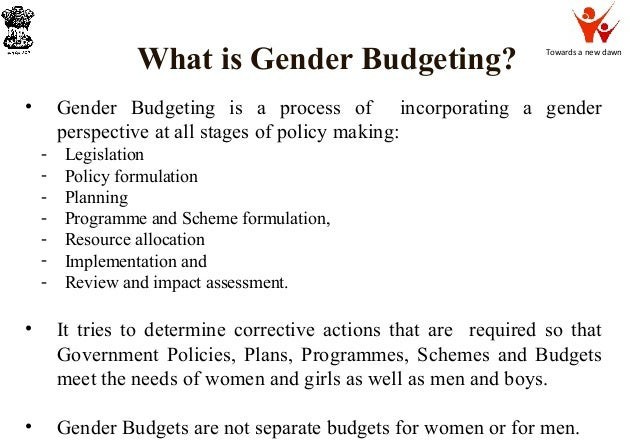
Gender budgeting refers to the systematic incorporation of gender perspectives into all stages of public financial management, including planning, budgeting, and evaluation. It challenges the assumption of budgets being gender-neutral and aims to promote equity, transparency, and accountability in public spending.
Origin in India:
- Institutionalized in 2005-06 with the introduction of the Gender Budget Statement (GBS) by the Ministry of Finance.
- Rooted in the recommendations of the 2001 Working Group on Women’s Empowerment during the 10th Five-Year Plan.
Milestones in India
- Late 1990s: Recognition of the need for gender-integrated governance.
- 2001: The Report of the Working Group on the Empowerment of Women for the Tenth Five-Year Plan advocates gender budgeting as a major policy directive.
- 2005-06: Introduction of the Gender Budget Statement (GBS) in the Union Budget, making India an early adopter in South Asia.
- Institutionalization through Gender Budget Cells (GBCs) across ministries, supported by capacitybuilding initiatives from the Ministry of Women and Child Development.
| Budgetary Commitment (2025-26) | |
|---|---|
| Indicator | Value (2025-26) |
| Gender Budget | ₹4.49 lakh crore (37.7% increase) |
| Share of Union Budget | 8.6% |
| Proportion of GDP | ~1.9% |
| No. of Ministries/UTs | 49 central ministries, 5 UTs covered |
This allocation—the highest to date—signals robust governmental support for gender-responsive economic development.
Employment, Skilling, and Entrepreneurship
- MGNREGS: Allocation increased to ₹40,000 crore. Women contribute 57.8% of total person-days under the scheme.
- Women Entrepreneurship:
- Term loans up to ₹2 crore for five lakh first-time women (SC/ST included) entrepreneurs over five years.
- Mudra Plus Initiative: Collateral-free loans up to ₹20 lakh with interest subvention.
- Self-Help Groups (SHGs): Continued focus on initiatives like ‘Lakhpati Didis’, uplifting one crore rural women to annual incomes of ₹1 lakh.
- Skill Development: Five million women to be trained in digital and emerging skills. The NMEICT (a 100% women-focused scheme) allocated ₹229.25 crore.
Education and Digital Infrastructure
- Department of School Education and Literacy: ₹78,572 crore (16.3% increase).
- Samagra Shiksha Abhiyan: ₹41,250 crore (over 52% of the department’s budget).
- PM POSHAN: 25% increase; now ₹12,500 crore.
- PM-SHRI Schools: 66% budget hike, reaching ₹7,500 crore, targeted at 14,500 schools.
- BharatNet Project: Rollout of broadband connectivity to all government secondary schools and primary health centres, including plans for 50,000 Atal Tinkering Labs.
Asset Ownership and Housing Security
- PMAY-Gramin: Allocated ₹54,832 crore (69% increase).
- Key provision: Mandatory registration of houses in the woman’s name, either solely or jointly—leading to 74% of PMAY-G houses now with women as owners or co-owners. Of 2.41 crore houses constructed:
- 64.3 lakh solely with women
- 1.02 crore jointly owned by couples
- Ministry of Women & Child Development: ₹26,890 crore allocated, including ₹3,150 crore for Mission Shakti (women’s empowerment), and ₹2,521 crore for its Samarthya sub-scheme (PM Matru Vandana Yojana, working women’s hostels, creche schemes, etc.).
Financial and Digital Empowerment
- Customised Credit Cards: Up to ₹5lakh, targeted at micro-enterprises led by women; 10 lakh cards to be issued in the first year.
- Women-Led Enterprises: Dedicated ₹5,000 cror fund to promote grassroots enterpreneurship, especially in under-banked areas.
- Digital Infrastructure: Initiatives aligned with BhratNet and digital skilling to support meaningful participation in the digital economy.
Advancing Gender-responsive Governance
- The Gender Budget Statement (GBS) has been institutionalized for over 20 years.
- A deliberate policy shift: Mainstreaming gender concerns across ministries and adopting a whole-ofgovernment approach.
- Alignment with SDG 5 (Gender Equality) and SDG 8 (Decent Work and Economic Growth) for benchmarking progress and enhancing accountability
- NITI Aayog’s SDG India Index: Serves as a framework, though integration at central and state levels needs strengthening.
Challenges & Recommendations
- Only one-third of MGNREGS’ expenditure is counted within the gender budget, indicating the need for more robust gender-segregated reporting.
- Further institutional strengthening and intersectional monitoring are required to ensure fiscal intent translates to real, measurable outcomes.
- Investments should prioritise capability building, asset control, and structural empowerment over shortterm welfare.
Conclusion
- Gender budgeting in India now represents a paradigm shift:
- From welfare to empowerment
- From targeted schemes to mainstreamed fiscal analysis
- From passive beneficiaries to active agents of economic and social change
With unprecedented financial allocations, robust institutional mechanisms, and a focus on skilling, asset ownership, and digital inclusion, India is moving toward genuine women-led development. This lays the groundwork for resilient, inclusive, and equitable socio-economic progress, recognizing women as pivotal architects of India’s growth trajectory.
Chapter 4: Silent Storm: Why India Must Act on Nitrogen Pollution and Climate Change
Nitrogen pollution is an invisible but mounting crisis at the heart of the climate challenge and environmental degradation in India.
- Excess reactive nitrogen, largely from inefficient fertiliser use and waste mismanagement, is driving air and water quality decline, biodiversity loss, and rising greenhouse gas emissions.
- Addressing nitrogen pollution offers a strategic opportunity to meet both domestic environmental priorities and global climate targets.
The Magnitude of the Challenge
Nitrogen’s Dual Role- Essential nutrient: Nitrogen is vital for proteins, DNA, and food production
- Pollutant: Reactive nitrogen forms—ammonia (NH₃), nitrate (NO₃⁻), nitrous oxide (N₂O), and nitrogen oxides (NOₓ)—are now being released at rates far beyond what ecosystems can safely absorb.
India: A Global Hotspot
- Highest fertiliser use: India applies ~17 million tonnes of nitrogen fertilisers annually, but only about 33% is utilized by crops; the rest pollutes soil, water, and air.
- Agricultural dependence: Over 77% of nitrogen oxide emissions are linked to fertilisers, with animal waste adding to ammonia emissions.
- Efficiency issue: In key states like Punjab and Haryana, nitrogen surplus per hectare has skyrocketed, resulting in record pollution loads.
Air and Water Quality Impacts
- Tripling NOx emissions: India›s NOx emissions have nearly tripled since 1990, reaching 9.4 million metric tons in 2022, with agriculture and fossil fuels being top sources.
- Acute air pollution: Nitrogen oxides form fine particulate matter (PM2.5), driving hazardous AQI levels in metros like Delhi.
- Groundwater crisis: High nitrate levels are detected in groundwater of 440 districts, with 20% of tested samples exceeding safe limits; the worst affected are Rajasthan, Karnataka, Tamil Nadu, Maharashtra, Telangana, Andhra Pradesh, and Madhya Pradesh.
- Human health: Nitrate contamination is linked to diseases like blue baby syndrome and increases chronic health risks.
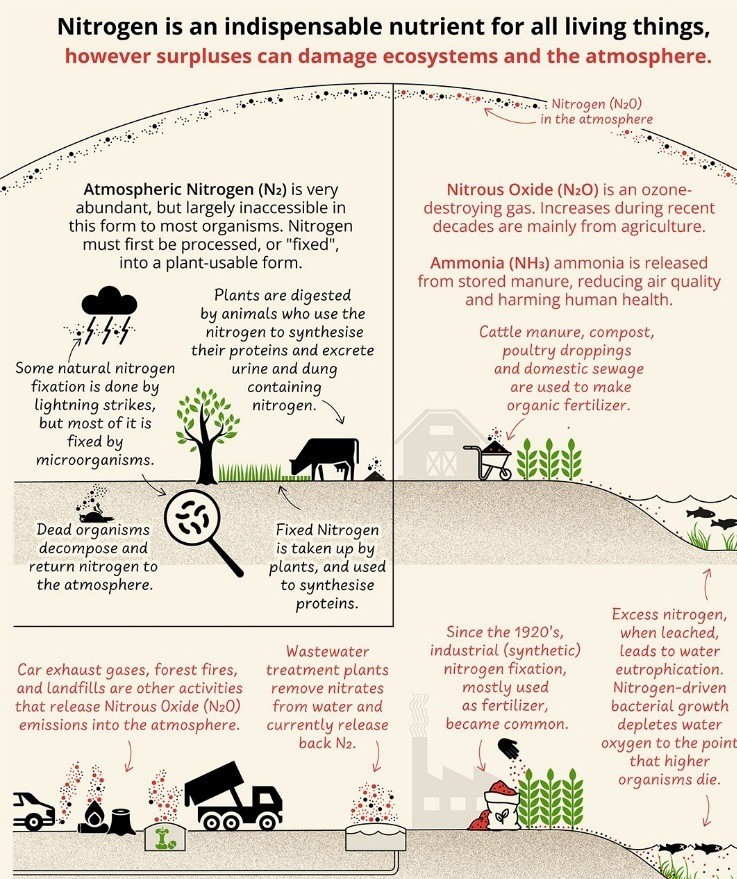
- Ecological threat: Nitrogen-driven eutrophication leads to algal blooms, aquatic dead zones, and biodiversity loss in freshwater and coastal systems.
Nitrogen and the Climate Connection
- Potent greenhouse gas: Nitrous oxide (N₂O) is 300 times more potent than CO₂ as a greenhouse gas.
- Climate potential: Mitigating nitrogen pollution could provide 5-10% of the greenhouse gas reductions needed to adhere to global warming limits.
- Agriculture at the center: Indian agriculture now emits more nitrous oxide than methane, making it a critical sector for intervention.
Causes of the Nitrogen Crisis
- Over-application of fertilisers: Subsidies, lack of soil testing, and knowledge gaps lead up to 70% of farmers to apply unnecessary nitrogen.
- Inefficient irrigation and waste handling: Poor animal waste and sewage disposal contribute to excess nitrate runoff.
- Policy fragmentation: Unlike the EU’s Nitrates Directive, India’s regulatory response remains patchy and insufficiently integrated with climate policies.
Government Response and Gaps
Steps Taken
- Regulatory moves: Neem-coated urea to reduce volatilisation, stricter emission norms for industry, and continuous emission monitoring.
- Schemes: Soil Health Card Scheme for balanced fertilisation, National Mission for Clean Ganga tackling urban loads, and upgradation of sewage treatment plants.
- Air quality monitoring: Identification of NOₓ as a key urban pollutant, with vehicle emission regulations (BS-VI) and fuel upgrades rolled out.
Major Gaps
- Persistently low Nitrogen Use Efficiency (NUE): No mandated improvement targets.
- Absence in climate commitments: Nitrogen mitigation is not explicit in India’s Nationally Determined Contributions (NDCs).
- Worsening trends: Despite efforts, nitrate pollution in groundwater and NOₓ emissions are rising.
Lessons From Global Best Practices
- China set a cap on total fertiliser use with measurable successes.
- The EU’s Nitrates Directive enforces strict controls and has improved groundwater quality.
- Sri Lanka’s abrupt fertiliser ban, however, showed the importance of carefully phased reforms accompanied by farmer support
The Way Forward:
- Integrated Agricultural Partnerships: Foster collaborations among ICAR, state agricultural universities, Krishi Vigyan Kendras, and innovators to promote precision farming and targeted interventions in nitrogen “hotspots”.
- Holistic Water and Waste Strategies: Adopt the “One Water” approach: harmonize management of water sources, waste, and nutrients, focusing on rural and high-risk communities.
- Strengthen Legal and Regulatory Frameworks: Update Water and Environment Acts to set numeric nitrate limits, empower river basin authorities, and incentivise pollution reduction technologies.
- Launch a National Nitrogen Mission: Establish a coordinated multi-ministry mission to set NUE and N₂O reduction targets, support research, and fund innovation.
- Link Nitrogen to Climate Commitments: Integrate N₂O mitigation into India’s NDCs; a 20% reduction target over a decade would align with climate goals and attract climate finance.
- Subsidy and Market Reforms: Phase in Direct Benefit Transfers for fertilisers based on soil health data, encourage neem-coated and slow-release products, and scale up biofertilisers and organic inputs.
- Focus on Remediation and Smart Technology: Expand Soil Health Card data into actionable advisories, geo-tagging, and AI-driven apps. Support innovations like constructed wetlands and bioreactors for nitrate remediation.
- Awareness and Incentives: Nationwide campaigns to highlight health and crop risks, certification for low-nitrate produce, and market incentives for sustainable practices.
- Research, Innovation, and Indigenous Practices: Boost support for nitrogen-efficient crops, affordable diagnostics, and integration of traditional and modern knowledge for location-specific, low-input solutions.
Conclusion
Nitrogen is a double-edged sword for India: vital for food security, but if mismanaged, a “silent storm” threatening health, water, climate, and development progress. The nation is at a crossroads—advance with decisive, coordinated policy, or risk toxic fallout that undermines both growth and ecological stability.
- A National Nitrogen Mission, grounded in science and coordinated governance, is urgently required. Clear targets, smart subsidies, strong regulation, and farmer-centric support will shift the system from chronic overuse to efficient, climate-smart nitrogen management.
- With vision and action, India can transform this invisible crisis into a model of environmental leadership— securing cleaner air, healthier soils and waters, robust agriculture, and a safer climate future.
Chapter 5: India’s Digital Decade: Transforming the Nation’s Economy and Society
India’s digital transformation over the past decade has revolutionized service delivery, governance, economic growth, and social inclusion. Digital industries are now expanding faster than traditional sectors, poised to contribute nearly one-fifth of India’s GDP by 2029-30, overtaking agriculture and manufacturing as primary growth engines.
SCALE AND GROWTH OF THE DIGITAL ECONOMY
- Rapid expansion: India’s digital economy has grown at nearly twice the rate of the overall economy in recent years, with a growth rate of 15.6% from 2014 to 2019—2.4x faster than the rest of the economy.
- GDP share: Digital economy accounted for 11.74% of national income in 2022-23 (₹31.64 lakh crore/ USD 402 billion), projected to rise to 13.42% in 2024-25 and 20% by 2029-30.
- Productivity: The digital sector is five times more productive than the rest of the economy, employing 14.67 million workers.
- Drivers: Growth is powered by Artificial Intelligence, cloud services, rapid diffusion of platforms, and the rise of Global Capability Centres (GCCs)—with India hosting 55% of the world’s GCCs.
Connectivity and Digital Infrastructure
- Telecom penetration: Telephone connections rose from 933 million (2014) to over 1.2 billion (2025).
- Internet growth: Internet connections shot up from 251 million (2014) to 969.6 million (2024)—285.5% increase.
- Broadband surge: Broadband connections jumped from 61 million (2014) to 949.2 million (2024)—a thirteen-fold rise.
- Affordability: Data costs fell from ₹308/GB (2014) to ₹9.34/GB (2022), making digital access more inclusive.
- BharatNet: High-speed fibre-optic internet links over 218,000 Gram Panchayats and connects 615,836 rural villages with 4G as of December 2024.
- 5G leap: In less than two years since its 2022 launch, 5G covers 99.6% of districts, with 474,000 base stations supporting a subscriber base of 1.16 billion.
Inclusive Digital Services
Digital Finance and Payments
- UPI revolution: In April 2025, 1,867.7 crore UPI transactions worth ₹24.77 lakh crore were processed monthly; UPI is now live in seven countries.
- Global leadership: India handled 49% of the world’s real-time digital transactions in 2023.
- Aadhaar backbone: 1.42 billion Aadhaar IDs; enabling e-KYC, direct benefit transfers, financial inclusion, and improved governance.
Direct Benefit Transfer (DBT)
- Efficiency gains: Over ₹44 lakh crore transferred by May 2025.
- Benefit: Elimination of 5.87 crore ineligible ration cards and 4.23 crore fake LPG connections, saving ₹3.48 lakh crore since 2015.
Digital Platforms for Commerce & Governance
- ONDC: Open Network for Digital Commerce, launched 2022, now covers 616+ cities and 764,000+ registered sellers, empowering MSMEs.
- GeM (Government e-Marketplace): Network of 1.6 lakh government buyers and 22.5 lakh sellers, GMV of ₹4.09 lakh crore in FY25.
E-governance Innovations
- Karmayogi Bharat (iGOT): Over 10.7 million civil servants onboarded; 2,588 courses and 32.4 million learning certificates issued (as of May 2025).
- DigiLocker: 516 million users as of April 2025, streamlining access to digital documents.
- UMANG app: 8.21 crore users, 597 crore transactions, and access to 2,300 government services in 23 languages.
Digital Capacity Building and Literacy
- PMGDISHA: Trained and certified 4.77 crore rural citizens in digital literacy, one of the world’s largest digital training efforts.
- NIELIT University: Target to skill 3.7 million more in five years.
- Skill Development in ESDM: Nearly 5 lakh trained; over 1.37 lakh placed.
- Future Skills Prime: Over 500,000 upskilled in IT, with a focus on government officials.
- Bhashini: National language translation initiative expanding access to digital content and services in regional languages.
Strategic, Frontier and Security Technologies
- National Quantum Mission: Advancing quantum computing, secure communication, and sensing.
- IndiaAI Mission: ₹10,372 crore investment to nurture AI research, innovation, and safe deployment—34,000+ GPUs in use by May 2025.
- Semiconductor Mission: ₹76,000 crore for indigenous chip ecosystem; six manufacturing projects approved with ₹1.55 lakh crore investment by May 2025.
Global Standing and Future Outlook
- Third-largest digitalised economy globally and set to be among the world’s top digital societies by 2030.
- CHIPS framework: India is strong in connectivity and innovation but needs to boost digital spending and per capita adoption to match top economies.
- By 2030: Digital economy to account for nearly 20% of GDP, drive innovation, new jobs, inclusion, and global leadership.
Conclusion
India’s digital transformation in the past decade has not only enhanced service delivery and governance but also positioned the nation as a global leader in digital innovation. As India moves towards a $1 trillion digital economy, its strategic focus on digital infrastructure, fintech, AI, and emerging technologies is laying the foundation for inclusive and sustainable development.
UPSC MAINS PRACTICE QUESTIONS
Q1. The 73rd Constitutional Amendment Act has not only deepened democracy at the grassroots but also emerged as a powerful tool for women empowerment.” Critically examine the impact of political reservations for women in Panchayati Raj Institutions across states.
Q2. Nitrogen pollution is often termed the “silent storm” threatening ecosystems, human health, and climate stability. Examine the sources and impacts of nitrogen pollution in India. What policy measures are needed to integrate nitrogen management into the climate change framework?
QUICK LINKS

 Call
Call