 Residential Course
YOJANA December 2025
The following topics are covered in the YOJANA December 2025:
Chapter 1: Infrastructure: India on the Fast Track to Viksit Bharat@2047
Infrastructure is a key driver of productivity, competitiveness, and economic growth. Over the last decade, India has made rapid progress through sustained public investment and integrated planning.
- Capital expenditure increased from Rs 2 lakh crore (2014–15) to Rs 11.21 lakh crore (2025–26). Reflecting this, India’s rank in the World Bank’s Logistics Performance Index (LPI) improved from 44 (2018) to 38 (2023).
- India remains the fastest-growing major economy, with GDP growth of 6.5–6.6% in 2024–25.
Bharat Mala Pariyojana
Launched in 2017, Bharat Mala Pariyojana is India’s largest highway programme aimed at reducing logistics costs and improving connectivity.
- Phase-I target: 34,800 km
- Awarded: 26,425 km
- Completed (mid-2025): 20,770 km
- Investment: Rs 8.5 lakh crore
National Highways expanded by ~60%, from 91,287 km (2014) to 1,46,342 km (2025). Construction pace increased from 12 km/day (2014–15) to 37 km/day (2020–21), remaining robust at 29–34 km/day thereafter.
- Bharat Mala covers economic corridors (8,737 km), expressways (2,422 km), border/international roads (1,619 km) and port/coastal connectivity roads. Logistics costs declined from 16% to ~10% of GDP, approaching global benchmarks.
Expressways and Strategic Projects- High-speed expressways and corridors have improved travel time, safety, and freight efficiency. As of 2025:
- 25 greenfield expressways (10,000 km) announced
- 6,669 km awarded, with 4,610 km completed
- States like Maharashtra, Rajasthan, Uttar Pradesh, and Madhya Pradesh have emerged as major beneficiaries, promoting regional economic integration.
- Iconic projects such as Atal Tunnel, Bogibeel Bridge, Maitri Setu, Sudarshan Setu, and Sona-marg Tunnel highlight the dual role of infrastructure in economic development and strategic security, especially in border and Himalayan regions.
Financing and Implementation Reforms
Challenges include land acquisition, environmental clearances, funding gaps, and contractor issues. Reforms include:
- Bhoomi Rashi Portal (land acquisition)
- Parivesh Portal (environment clearances)
- Online approvals and inter-state coordination
To address funding constraints, NHAI plans public InvITs, alongside asset monetisation, with potential revenue of Rs 15 lakh crore.
Employment and Structural Transformation
- The logistics sector employs 22 million people and is expected to generate 10 million additional jobs by 2027. Formalization, digitalization, and skilling are improving productivity and strengthening India’s demographic dividend.
PM Gati-Shakti National Master Plan (2021)
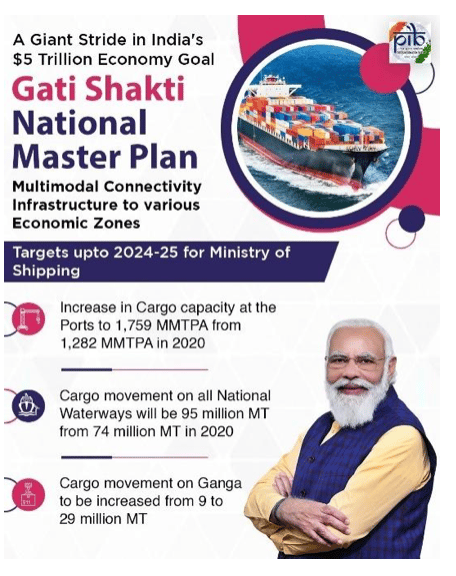
PM Gati Shakti integrates 57 ministries and 36 States/UTs on a geospatial platform with 1,700+ data layers, ensuring coordinated, multimodal infrastructure planning.
- It is guided by six principles: integrated development, connectivity improvement, reduced ecological impact, expedited clearances, allied infrastructure planning, and faster land acquisition.
- The Network Planning Group (NPG) has evaluated 293 projects worth Rs 13.59 lakh crore (100 meetings till Oct 2025), strengthening last-mile and multimodal connectivity.
National Logistics Policy (2022)
The National Logistics Policy (NLP), 2022 was launched to complement the PM Gati Shakti National Master Plan (PMGS-NMP) to reduce logistics costs and improve efficiency through digital platforms such as:
- Unified Logistics Interface Platform (ULIP)
- Logistics Data Bank (LDB) for EXIM cargo tracking
While PMGS-NMP focuses on hard infrastructure and integrated network planning, NLP addresses soft infrastructure reforms necessary for an efficient logistics ecosystem.
- It aims to create a technologically enabled, integrated, cost-efficient, resilient, sustainable, and trusted logistics ecosystem that supports accelerated and inclusive economic growth.
- The policy is operationalized through a Comprehensive Logistics Action Plan (CLAP), structured around eight key action areas, covering regulatory reform, digital integration, standardization, skilling, and performance monitoring.
Multi-Modal Logistics Parks (MMLPs)
- Under Bharatmala, 35 MMLPs have been approved across key locations (e.g., Chennai, Nagpur, Indore, Bengaluru), with 5 expected to be operational by 2027, improving warehousing, modal integration, and supply-chain efficiency.
SMILE Programme (with ADB): Integrated State and City Logistics Plans to reduce logistics costs and enhance efficiency
Key Challenges & Way Forward in India’s Logistics Sector
- Under Bharatmala, 35 MMLPs have been approved across key locations (e.g., Chennai, Nagpur, Indore, Bengaluru), with 5 expected to be operational by 2027, improving warehousing, modal integration, and supply-chain efficiency.
SMILE Programme (with ADB): Integrated State and City Logistics Plans to reduce logistics costs and enhance efficiency
| Key Challenges | Way Forward |
|---|---|
|
|
Conclusion
Through Bharatmala Pariyojana, PM GatiShakti, and the National Logistics Policy, India has significantly upgraded its infrastructure and logistics ecosystem. With sustained execution and reforms, logistics can underpin India’s transition to Viksit Bharat@2047.
Chapter 2: Indian Industries: Issues, Challenges and Opportunities
India’s industrial sector has undergone a profound structural transformation since Independence. From a pre-independence base of small-scale handicrafts and textiles, the post-1950 phase witnessed State-led industrialization, followed by a decisive shift towards liberalization, privatization and global integration after 1991.
- Today, Indian industry spans textiles, automobiles, pharmaceuticals, electronics, IT, defense manufacturing and renewable energy, increasingly embedded in global value chains.
Structural Profile of Indian Industry
- The industrial sector contributes 28–30% of GDP, with manufacturing accounting for 14–16% and construction 8–10% over the past three decades.
- The share of agriculture has declined from nearly 50% to about 15%, while services dominate employment and output.
- India’s share in global manufacturing output remains below 2%, reflecting stagnation despite policy intent to raise manufacturing to 25% of GDP (National Manufacturing Policy, 2011).
- Industrial growth remains uneven across regions and sectors, posing challenges for inclusive development.
Post-1991 Reforms and Outcomes
The Industrial Policy of 1991 dismantled licensing, encouraged private participation, and opened several sectors to FDI. This resulted in:
- Increased competition, efficiency and modernization
- Growth in capital-intensive and import-intensive industries
- Expansion of exports and integration with global supply chains
However, concerns persist regarding:
- Rising import intensity of exports
- Declining labor intensity of manufacturing
- Overdependence on a few sectors (e.g., automobiles contributing nearly half of manufacturing output)
Key Challenges Facing Indian Industry
1. Fragmented Industrial Structure
- Around 7 crore MSMEs account for ~99% of enterprises, promoting entrepreneurship but resulting in low economies of scale, quality issues and weak global competitiveness.
- Policy dilemma between scaling up production and preserving employment intensity.
2. Infrastructure and Logistics Bottlenecks
- Logistics costs are around 14% of GDP, compared to 8–10% in developed economies.
- Power shortages, transport inefficiencies and unreliable supply chains affect competitiveness.
3. Regulatory and Governance Stress
- No one-size-fits-all regulation due to enterprise diversity.
- Nearly one-third of 29 lakh registered companies remain inactive, straining regulatory oversight.
4. Cross-subsidization Burden
- Higher freight tariffs subsidizing passenger rail services.
- Industrial power tariffs subsidizing agriculture and households, leading to freight diversion to roads and captive power generation.
5. Environmental and Social Constraints
- Industrial closures due to environmental concerns (e.g., Sterlite Copper plant).
- Phasing out of Pharma PSUs has increased reliance on imported bulk drugs.
6. Employment and Informality
- Over 85% of workers are in the unorganized sector, lacking comprehensive social security.
7. Technology and Skill Gaps
- Industry 4.0 adoption requires high capital investment, skilled labor and R&D capacity, posing challenges for MSMEs.
Emerging Opportunities
1. Demographic Dividend
- One of the world’s youngest workforces provides a large labor pool and sustained domestic demand with proper skilling.
2. Industry 4.0 and New Business Models
- AI, IoT, robotics, additive manufacturing (3D printing) enable productivity gains, decentralized production and customized solutions.
- Shift from product ownership to service-based and shared economy models.
3. Green and Sustainable Manufacturing
- Opportunities in electric vehicles, renewable energy, energy storage and green technologies aligned with climate goals.
4. Policy Support and Incentives
- PLI Scheme (2020) covering 14 sectors, attracting investments of Rs 1.76 lakh crore, sales over Rs 16.5 lakh crore, and generating 12 lakh jobs.
- Semiconductor Mission backed by Rs 76,000 crore, boosting electronics manufacturing.
- Rising defense manufacturing and exports enhancing industrial depth.
5. Infrastructure Push
- National Infrastructure Pipeline, Bharatmala, Sagarmala, Dedicated Freight Corridors, industrial corridors (e.g., Delhi–Mumbai Industrial Corridor), rail electrification and port capacity expansion to 10,000 MTPA.
Way Forward
- Strengthen manufacturing competitiveness through scale, standardization and quality control.
- Enhance skill development aligned with Industry 4.0 and emerging technologies.
- Reduce logistics costs via multimodal transport integration and infrastructure efficiency.
- Promote export-oriented manufacturing for capital-intensive sectors like defense.
- Balance regulation with flexibility, recognizing enterprise diversity.
- Build the ‘India’ brand as a symbol of quality, while allowing inefficient firms to exit.
Conclusion
India is transitioning from a service-led, consumption-driven economy to a more balanced industrial ecosystem. With robust policy support, infrastructure expansion, demographic advantage and technological adoption, the National Manufacturing Mission aims to integrate policies, improve governance and create a sustainable manufacturing ecosystem. If structural constraints are addressed effectively, Indian industry can emerge as a resilient 21st-century industrial powerhouse, driving inclusive growth and global competitiveness.
Chapter 3: Education for the Next Century
India’s demographic trajectory presents a historic opportunity. Improvements in healthcare, longevity and working life ensure that India will retain one of the world’s largest working-age populations with a low dependency ratio for decades.
- The central challenge is to convert this demographic advantage into sustained employability, entrepreneurship and decent jobs, rather than mere enrolment expansion.
Changing Nature of Education and Work
The 21st-century labor market is characterized by:
- Rapid technological change
- Shorter skill life cycles
- Rising importance of soft skills and adaptability
- Blurring boundaries between education, skilling and work
In this context, lifelong learning, rather than front-loaded education, becomes the organizing principle of human capital development.
NEP 2020: Conceptual Foundation
The National Education Policy (NEP) 2020 provides the philosophical and structural backbone by:
- Emphasizing “learning how to learn” through experiential, inquiry-driven and multidisciplinary pedagogy
- Removing hard separations between:
- Arts and sciences
- Academic and vocational education
- Curricular and co-curricular learning
- Promoting permeability and flexibility across learning pathways
This aligns education with a dynamic skills ecosystem where adaptability matters more than static qualifications.
Micro-Credentials and the National Credit Framework (NCF)
A key operational reform is the National Credit Framework, jointly developed by UGC, AICTE, NCVET and other regulators. It enables:
- Credit accumulation and transfer across school education, higher education and skilling
- Recognition of micro-credentials—short, focused, credit-bearing certifications aligned to industry needs
- Stacking of credentials into larger qualifications over time
For example, a short solar safety module can later count towards a full energy technician certification, ensuring that learning outcomes are not fragmented or wasted.
Quality Assurance through NCVET
The National Council for Vocational Education and Training (NCVET) has strengthened credibility by:
- Standardizing National Occupational Standards
- Issuing detailed guidelines on micro- and nano-credentials
- Mandating industry validation, assessment norms, credit hours and evidence of labor-market demand
This ensures that micro-credentials act as a portable and trusted currency, avoiding the pitfalls of weak standards and poor employer recognition highlighted by the ILO (2025).
Institutional Modernization: Upgrading ITIs
Institutional reform forms the second pillar. Industrial Training Institutes (ITIs) are being transformed into Centres of Excellence with:
- Modern equipment and simulators
- Industry-aligned trades and apprenticeships
- Faculty upskilling through industry exposure
In May 2025, the Union Cabinet approved PMSETU (Pradhan Mantri Skilling and Employability Transformation through Upgraded ITIs) to:
- Upgrade 1,000 Government ITIs
- Establish 5 National Centres of Excellence for Skilling
- Enable multi-source financing and industry participation
This improves placement outcomes, wage prospects and supports MSMEs through shared testing and prototyping facilities.
Digital Public Infrastructure for Skills
The third pillar is digital integration through the Skill India Digital Hub, which:
- Integrates courses, assessments, credentials and employment opportunities
- Provides digitally verified learner profiles and portable credentials
- Enables skill-based job discovery and career progression pathways
The platform is evolving from job listings to smart career guidance, helping workers transition to higher-value roles (e.g., electrician to solar installer, machine operator to 3D printing technician). This is especially critical for:
- Women re-entering the workforce
- Workers transitioning to green and digital jobs
Integrated Impact and Way Forward
Together, these reforms:
- Make learning flexible, modular and lifelong
- Align education with real workplace experience
- Enhance transparency, portability and trust in credentials
To realize full benefits, focus must shift from counting training numbers to tracking:
- Skill acquisition outcomes
- Job placements
- Wage growth and productivity gains
Conclusion
India’s education and skilling reforms are moving beyond intent to execution. By integrating micro-credentials, modern institutions and digital public infrastructure, the traditional divide between learning and earning is being dismantled. If effectively implemented and outcome-focused, this ecosystem can extend India’s demographic dividend, raise household incomes, boost industrial productivity and support a greener, innovation-led economy. The path from learning to earning will no longer be episodic—it will become a continuous journey across a lifetime.
Chapter 4: India’s Quantum Leap in the Global Innovation Landscape
India’s rise in the Global Innovation Index (GII) from rank 81 (2015) to rank 38 (2025)—a jump of 42 positions—marks the fastest sustained improvement by any large economy, placing India as the top innovator in Central and Southern Asia and an “innovation overperformer” relative to its GDP per capita.
- The GII, published by WIPO with Cornell University and INSEAD, evaluates 139 economies using 80 indicators across Innovation Inputs (institutions, human capital, infrastructure, market and business sophistication) and Outputs (knowledge, technology and creative outputs), where India now ranks 22nd globally in knowledge and technology outputs.
Policy Architecture and Entrepreneurial Ecosystem
India’s innovation transformation is rooted in Startup India (2016), which simplified entry barriers through a single digital portal, tax exemptions for the first three profitable years, and a Rs 10,000 crore Fund of Funds.
- Recognized startups expanded from about 500 in 2016 to over 1.61 lakh, generating nearly 17 lakh jobs, with tier-2 and tier-3 cities contributing ~51% of new startups.
- Complementing this, the Insolvency and Bankruptcy Code (IBC) improved risk resolution, accounting for 48% of bank recoveries in FY24 with a recovery rate of 32–33%, strengthening investor confidence and encouraging entrepreneurial risk-taking.
Digital Public Infrastructure (DPI) as Innovation Enabler
The Digital India Mission (2015) created foundational DPI through Aadhaar, UPI and open APIs, democratising access to markets and finance.
- UPI alone processed Rs 24.9 lakh crore transactions in September 2025, enabling fintech innovation, MSME lending via Account Aggregators, and inclusive digital commerce through ONDC.
- This frictionless digital backbone has allowed even micro-entrepreneurs to innovate, contributing to India’s global leadership in ICT services exports (ranked 1st worldwide).
Manufacturing–R&D Integration
The Production Linked Incentive (PLI) Scheme (2020) across 14 sectors has mobilized Rs 1.76 lakh crore in investments and created over 12 lakh jobs, while mandating domestic value addition and localization of R&D.
- This has led to a 146% surge in electronics manufacturing (Rs 2.13 lakh crore in FY21 to Rs 5.25 lakh crore in FY25), 60% import substitution in telecom products, and a seven-fold expansion of the drone sector, largely driven by MSMEs.
- The launch of PLI 2.0 and the approval of a Rs 1 lakh crore Research Development and Innovation (RDI) Scheme further reinforce India’s shift from Make in India to Design, Invent and Make in India.
Education, Research and Knowledge Creation
The National Education Policy 2020 promotes interdisciplinary, research-driven learning, institutionalized through the Anusandhan National Research Foundation (ANRF) with Rs 50,000 crore funding.
- As a result, India now ranks 3rd globally in research publications, with output rising 142% since 2015, PhD enrolment doubling to 2.34 lakh, and female enrolment increasing by 135.6%.
- Programmes like KAPILA have strengthened intellectual property awareness in higher education, aligning academia with industry and innovation needs.
Institutional Capacity and IP Ecosystem
Since 2014, India has established 42 new Central Higher Educational Institutions, while Rs 11,828 crore has been approved to expand five new IITs, adding 6,500 seats and research parks.
- The Atal Innovation Mission (AIM) has created 10,000 Atal Tinkering Labs and incubated 3,500+ startups, generating over 32,000 jobs.
- Concurrently, India’s IP ecosystem has matured, ranking 6th globally in patent filings (64,480 in 2023), with 55.2% filings by domestic residents, signaling a decisive shift towards indigenous innovation.
Way Forward
To sustain momentum towards Viksit Bharat@2047, India must raise GERD from 0.7% to 2% of GDP, deepen private-sector R&D participation, promote MNC–startup–university co-innovation, expand district-level innovation hubs, accelerate patent commercialization, and further decentralize UPI, ONDC and DPI to the hinterlands, enabling technology-led Vocal for Local solutions.
Conclusion
India’s GII ascent reflects a structural transformation driven by coordinated reforms in startups, digital public infrastructure, manufacturing-linked R&D, education, and intellectual property creation. With sustained investment and decentralized innovation ecosystems, India is transitioning from an innovation adopter to a global innovation originator, capable of shaping solutions to local, national, and global challenges in the 21st century.
Chapter 5: NISAR: Science from Orbit, Impact on Earth
NASA–ISRO Synthetic Aperture Radar (NISAR) is a Low Earth Orbit (LEO) Earth-observing satellite placed in a Sun Synchronous Polar Orbit (SSPO) at an altitude of about 747 km, launched by GSLV Mk-II (F16) on 30 July 2025.
- It can map the entire globe every 12 days, generating spatially and temporally consistent data to monitor ecosystems, ice mass, vegetation biomass, sea-level rise, groundwater, and natural hazards such as earthquakes, tsunamis, volcanoes, floods, and landslides.
- The mission represents the largest-ever civil space collaboration between ISRO and NASA.
Payload and Technological Innovation
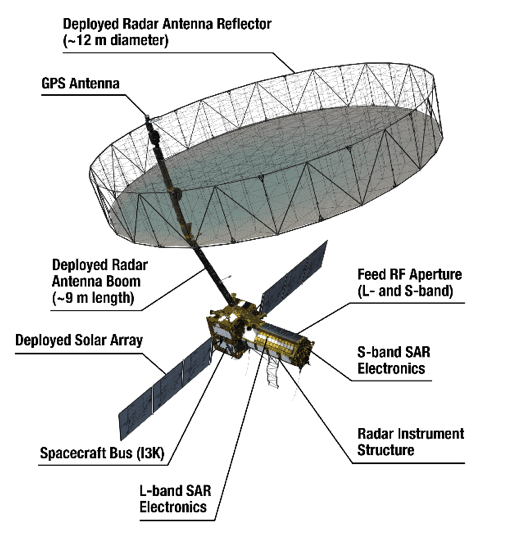
NISAR carries dual-band Synthetic Aperture Radar (SAR)—L-band and S-band—with all-weather, day-night imaging capability, overcoming cloud cover limitations common in tropical regions like India.
- It is the first mission globally to fly Sweep SAR technology, enabling a wide swath of ~240 km with high resolution, made possible by a deployable 12-metre reflector and boom.
- The spacecraft uses ISRO’s 13K bus, with advanced power, thermal management, high-data-rate downlink, and fault detection, isolation and recovery (FDIR) systems.
- A micrometeoroid and orbital debris shield, indigenously developed, protects critical components like the fuel tank.
Science Applications over India
Given India’s diverse topography—Himalayas, plains, plateaus, deserts, coasts and islands—and vulnerability to monsoon-linked disasters, NISAR provides critical support to disaster management and climate monitoring. L-band coverage spans global landmasses and ice regions, while joint L & S band observations focus on India and Antarctica. Key science outputs include:
- 12-day monitoring of Himalayan and Antarctic cryosphere deformation at ~100 m scale
- Glacier face, wet snow cover, and sea-ice drift near Indian Antarctic stations
- Forest above-ground biomass and disturbance mapping at hectare scale
- Crop growth, flood/inundation mapping, and soil moisture at 100 m resolution
- Annual mangrove cover mapping of India at 25 m resolution
- Rapid disaster response, with rescheduling within 24 hours and data delivery within 5 hours
- Sea-ice characteristics around Antarctic stations at 500 m resolution
Joint Collaboration and System Integration
The mission integrates ISRO and NASA strengths:
- Satellite bus by UR Rao Satellite Centre (ISRO)
- Boom-reflector system by Jet Propulsion Laboratory (NASA)
- Integrated Radar Instrument (IRIS) jointly developed by JPL and SAC, Ahmedabad
Integration and testing occurred in four stages, progressing from independent radar development to joint operation testing, space-environment validation, and final integration with the spacecraft bus, reflector, solar panels, and antennas.
- The decade-long collaboration required harmonising design philosophies, operational procedures, and qualification standards, demonstrating deep institutional synergy.
In-Orbit Deployment and Operations
Post-launch, solar panels deployed successfully, and the spacecraft achieved Earth-pointing orientation. The high-precision data downlink (narrow beam width of ~0.5°) was established before deployment of the 12 m reflector.
- First light from S-SAR and L-SAR was achieved in August 2025, followed by orbital manoeuvres to reach the final science orbit and begin calibration.
- During its science phase, NISAR is expected to generate ~80 TB of data, with L-band data downlinked at NASA stations and S-band data at ISRO stations.
Strategic and Governance Relevance
NISAR strengthens India’s disaster preparedness, climate resilience, water and agricultural management, and cryosphere studies, while advancing Earth system science.
- It enhances India’s role in global climate monitoring, supports SDGs, and exemplifies science diplomacy, positioning India as a credible partner in high-end space technologies.
Conclusion
NISAR marks a quantum leap in Earth observation, combining cutting-edge radar technology with institutional collaboration. By translating science from orbit into actionable insights on Earth, it reinforces India’s capabilities in disaster management, climate action, and sustainable development, while showcasing the maturity of ISRO–NASA cooperation in addressing global challenges.
UPSC MAINS PRACTICE QUESTIONS
Q1. Discuss the technological innovations introduced by the NISAR mission, particularly dual-band SAR and Sweep SAR, and explain how they enhance Earth observation capabilities.
Q2. Critically examine the role of skill-based, vocational and lifelong learning models in aligning education with the future of work in India.
QUICK LINKS

 Call
Call