 Residential Course
YOJANA August 2025
The following topics are covered in the YOJANA August 2025:
Chapter 1: Freedom to Innovate
Historical & Civilisational Roots
Human progress has always been anchored in innovation from stone tools to artificial intelligence and space exploration.
- India’s civilisational ethos reflects a strong knowledge tradition, with contributions by Aryabhata, Bhaskara, Pingala, and institutions like Nalanda and Vikramshila in mathematics, astronomy, medicine, metallurgy, Ayurveda, and linguistics.
- Despite invasions and colonial rule, India’s scientific and cultural innovation endured, showcasing resilience and continuity.
Constitutional Ethos & Freedom to Innovate
Modern freedom extends beyond political sovereignty to include the ability to create, solve, and innovate. The Freedom to Innovate represents converting indigenous wisdom into global relevance. It is constitutionally anchored in:
- Art. 14 – Equality of opportunity
- Art. 21 – Right to life & dignity
- Art. 21A – Right to education
- Art. 51A(h) – Duty to develop scientific temper
Governmental Push for Innovation
Policy & Budgetary Boost
- Union Budget 2025–26: ₹20,000 cr for R&D (AI, quantum, biotech, clean energy, semiconductors).
- Deep-Tech Fund of Funds (SIDBI): ₹10,000 cr.
- 10,000 PM Research Fellowships (₹70–80k/month).
- Innovation reframed as a national imperative, not a privilege.
Institutional Reforms
- ANRF (2023): Replaces SERB; ₹50,000 cr corpus (2023–28).
- RDI Scheme (2025): ₹1 lakh cr long-term, low-interest financing for private-sector R&D.
- Regulatory Ease: Procurement autonomy, trust-based governance.
Grassroots Innovation
- National Innovation Foundation (NIF): 1400+ patents, 120+ tech transfers; grassroots/student innovators (some won Padma Shri).
- Unnat Bharat Abhiyan (UBA): Links universities with villages to design contextual tech solutions.
Digital Public Infrastructure (DPI)
- Platforms: Aadhaar, UPI, DigiLocker, ONDC → drivers of inclusive innovation.
- ONDC: 7 lakh+ sellers, 20 cr+ transactions (2025); empowers MSMEs.
- India Energy Stack (IES): UPI-like system for renewable energy, benefits farmers & DISCOMs.
Sectoral Innovation Push
- Health:
- Ayushman Bharat Digital Mission (ABDM): 70 cr ABHA IDs, digital health ecosystem.
- PRIP: ₹5000 cr for pharma & MedTech R&D.
- ICMR Action Plan (2024–29): Promotes indigenous & affordable health tech.
- Agriculture 4.0:
- Drone Didi, Akashdoot, Agri-startups, Hackathons, ARYA, RKVY-RAFTAAR.
- Focus on precision farming, AI, IoT, drones.
- Deep Tech:
- NM-ICPS, NQM, Atal Innovation Labs in Tier-II/III areas.
- Focus on AI, quantum, cyber-physical systems.
Global Impact & Achievements
- Global Innovation Index 2024: Rank 39.
- Patent filings (WIPO 2023): 6th globally.
- Network Readiness Index: 89 (2015) → 49 (2024).
- Startup Ecosystem: 1.57 lakh DPIIT-recognised startups, 100+ unicorns, 51% from Tier-II/III cities.
Civilisational Shift
- Innovation radiating from grassroots to ISRO labs → “oceanic circles of change.”
- Jan Bhagidari (people’s participation) + Srijan (creative expression) as pillars.
- Driving Aatmanirbharta & vision of Viksit Bharat @ 2047.
Chapter 2: India’s War Against Terrorism
Terrorism remains one of the gravest national security challenges for India, particularly cross-border terrorism from Pakistan.
- The April 2025 Baisaran Valley attack in J&K once again underlined the persistence of this threat.
- Over time, India’s CT approach has evolved from restraint & dialogue to a comprehensive, multidimensional strategy blending military firmness, institutional reforms, financial intelligence, and proactive diplomacy.
Shifts in Counter-Terrorism Doctrine
- Earlier approach: Restraint, bilateral talks, international pressure.
- Current doctrine: Pre-emption & proactiveness.
- Policy assertion (PM, May 2025):
- Terrorist attack = “act of war”.
- No distinction between terrorists and their ecosystem.
- Pakistan’s plausible deniability unacceptable.
Military Response & Rules of Engagement
- Operation Sindoor (2025) → deep strikes on terror camps in Pakistan & PoJK.
- Precedents:
- Surgical Strikes (2016) – Uri.
- Balakot Airstrikes (2019) – Pulwama.
- Hot Pursuit (2015) – Myanmar.
- Key features: Precision targeting, minimised collateral damage, neutralising Pakistan’s nuclear blackmail.
- Pressure tactic: Suspension of Indus Waters Treaty → “Blood & Water cannot flow together”.
Institutional Reforms in CT Architecture
- Post-2008 Mumbai Attacks → structural strengthening.
- MAC – intelligence-sharing hub.
- NIA (2009) – apex CT agency; 2019 Amendment: cyber-terror, human trafficking, counterfeit currency, extraterritorial jurisdiction.
- NATGRID – real-time data integration.
- FIU-IND & PMLA (2002, amended 2009, 2023):
- Tracking terror financing, crypto regulation, NGO monitoring.
- NIA’s TF-FC Cell → crackdown on J&K terror-funding networks.
Counter-Insurgency in Jammu & Kashmir
- Curbing infiltration:
- 3-tier counter-infiltration grid, fencing along LoC/IB, drones, NVGs, thermal imagers.
- Local recruitment: Fall in militant ranks; rise of “hybrid” terrorists & proxy groups (TRF, PAFF).
- Narco-terrorism: Drug revenues linked to militancy (26 cases in 2022–23, LeT major beneficiary).
- Asset seizures: Properties of smugglers/confiscated.
- Impact: Drop in violence, but sporadic high-profile attacks (e.g., Pahalgam 2025).
Countering Radicalisation
- Challenges: Victimhood narratives, social media propaganda, peer influence.
- Emerging trend: Lone-wolf/self-radicalised attacks (Udaipur, Amravati 2022).
- Response:
- NIA arrests, online monitoring, deradicalisation programs.
- Need: Stronger community engagement, education reforms, digital literacy.
Diplomatic & Global Partnerships
- Multilateral engagement: FATF, G20, UNSC CT Committee, INTERPOL, “No Money for Terror” conference.
- Focus areas: crypto-financing, drones, cyber-terror.
- Bilateral cooperation:
- Extradition of Tahawwur Rana (26/11 accused).
- India–Bangladesh, India–Nepal → crackdown on recruitment & infiltration.
- Limitation: No global consensus on definition of terrorism; India’s CCIT (1996) remains pending.
Trends in Pakistan-Sponsored Terrorism
- Pre-2008: Mass-casualty urban attacks (Delhi 2005, Mumbai 2006, 26/11).
- 2010–2019: Attacks on security forces (Pathankot 2016, Uri 2016, Pulwama 2019).
- Post-2019: Proxy groups (TRF, PAFF) targeting minorities, civilians, security forces post-Article 370.
- Pak narrative: “False flag” claims → increasingly ineffective.
Challenges & Way Forward
- Persisting threat: Pakistan’s “thousand cuts strategy”.
- Evolving tactics: From urban blasts → proxy groups, narco-terror, cyber-terror.
- Global challenge: Selective approach by states.
Way Forward:
- Multi-pronged strategy: military firmness + policing reforms + financial intelligence.
- De-radicalisation: community outreach, counter-narratives, youth engagement.
- Leverage tech: drones, AI, cyber-forensics.
- Diplomacy: push for CCIT, FATF scrutiny of Pakistan.
- Societal resilience: deny terrorism its psychological impact.
Conclusion
India’s CT doctrine has moved from defensive restraint to assertive deterrence. By combining military precision strikes, institutional strengthening, financial crackdown, proactive diplomacy, and grassroots resilience, India is building a comprehensive counter-terrorism architecture capable of deterring both terrorists and their state sponsors.
Chapter 3: Freedom of Good Health
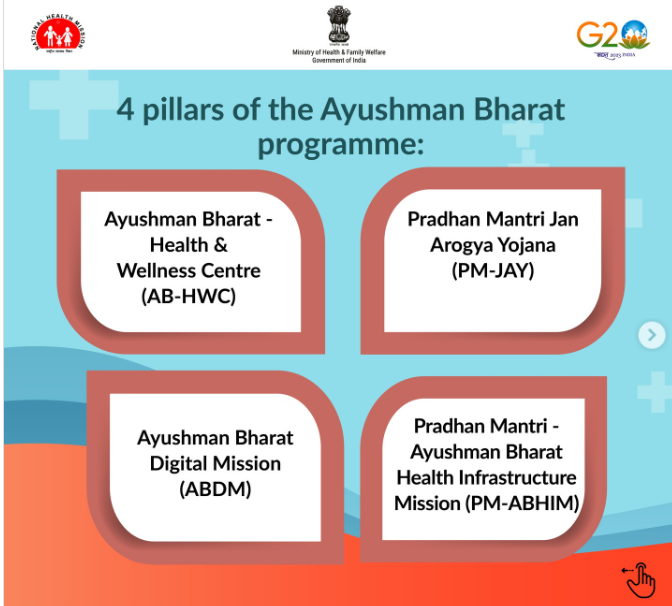
Health is not merely the absence of illness but a matter of dignity, equity, and empowerment. India’s flagship programme, Ayushman Bharat, operationalises this vision of Universal Health Coverage (UHC) through 4 complementary pillars.
Four Pillars of Ayushman Bharat
1. PM-JAY (2018):
- World’s largest publicly funded health assurance scheme.
- Provides ₹5 lakh/year per family for secondary & tertiary care.
- Achievements: 9 crore hospital admissions; 41 crore Ayushman cards issued.
- Network: Pan-India portability; empanelled 32,000+ hospitals (46% private).
- Equity: Women ~50% beneficiaries; transgender coverage (2023).
2. Ayushman Arogya Mandir (AAM):
- Revamped Health & Wellness Centres for comprehensive primary care.
- Cover NCDs, palliative care, free medicines, diagnostics, mental health.
- By 2025: ~1.7 lakh AAMs decentralising healthcare.
3. Ayushman Bharat Digital Mission (ABDM 2020):
- Digital backbone of healthcare; ensures secure and portable health data.
- Key features:
- ABHA (14-digit Health ID).
- HPR – registry of professionals.
- HFR – national database of facilities.
- Innovations: Consent-based Health Information Exchange, Unified Health Interface (UHI) for telemedicine.
- Progress: 61+ crore records linked, >54,000 facilities onboarded.
4. PM-ABHIM (2021):
- ₹64,000 crore infrastructure mission.
- Upgrades critical care blocks, labs, surveillance systems, emergency response.
- Enhances pandemic preparedness and frontline delivery.
Impact
- Financial protection: Reduces out-of-pocket expenditure (currently ~48% of total health spending, among highest globally).
- Equity: Benefits poor, migrants, women, transgender persons.
- Continuity of care: Seamless links across primary → secondary → tertiary → digital care.
- Scale: World’s largest coverage, decentralised to village-level centres.
- Trust-building: Health seen as right of citizenship, not privilege.
Synergy of the Four Pillars
- PM-JAY = Affordability & dignity.
- ABDM = Portability & choice.
- AAMs + PM-ABHIM = Infrastructure & resilience.
- Together create a “One Health Ecosystem” that is preventive, promotive, curative, and participatory.
Value Addition for UPSC
Data & Reports:
- India spends ~2% of GDP on healthcare (Economic Survey 2022-23), below OECD average of ~9%.
- Out-of-pocket expenditure (OOPE): reduced from 62% (2014) → 48% (2022) due to PM-JAY.
- NITI Aayog (2021): “Health Insurance for India’s Missing Middle” report highlighted PM-JAY as a critical step but urged inclusion of uncovered middle-class groups.
- Lancet Report (2023): India’s progress on UHC improved, but regional disparities remain.
Comparative Perspective:
- UK’s NHS: Tax-funded, universal free access.
- Thailand’s Universal Coverage Scheme: Reduced catastrophic expenditure significantly.
- India’s model: Hybrid (public funding + private empanelment + digital backbone).
Ethics/Philosophical Angle (GS-4 / Essay):
- Health = intrinsic part of Right to Life (Article 21).
- Reflects Rawlsian justice: prioritising the least advantaged.
- Amartya Sen’s Capability Approach: healthcare enhances freedom and human capabilities.
Road Ahead
- Deepen digital adoption and last-mile connectivity.
- Incorporate AI, telemedicine, remote diagnostics, personalised medicine.
- Ensure state capacity & accountability in service delivery.
- Expand coverage to missing middle and strengthen primary health funding.
- Focus on health workforce training and equitable distribution.
Conclusion
Ayushman Bharat is not just healthcare reform—it represents freedom from vulnerability and inequity, making health a pillar of inclusive development and Viksit Bharat @2047.
Chapter 4: Empowering the Farmers
Agriculture, the backbone of India’s economy, contributes 18% to GVA and employs 46% of the workforce. In 2024-25, it achieved record outputs with 354 MT foodgrains (+6.5%), 426 LMT oilseeds (+7.4%), and horticulture surpassing foodgrains.
- India is now self-sufficient in rice, wheat, and pulses, and moving towards self-reliance in oilseeds, reinforcing its role in food security and livelihoods.
Policy Shifts
- Recent policy shifts in agriculture view farmers as agri-entrepreneurs, prioritising income security over mere food security.
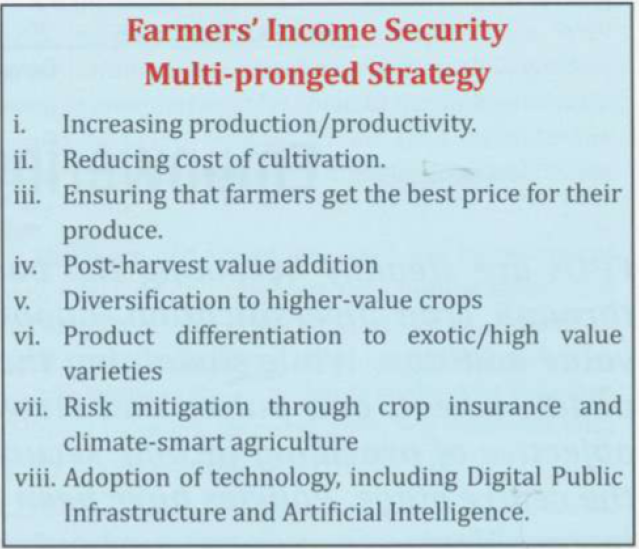
- A multi-pronged strategy is being pursued: enhancing productivity, reducing cost of cultivation, ensuring MSP and fair prices, promoting post-harvest value addition, diversifying towards high-value crops, and advancing climate-smart, risk-mitigated farming.
Key Interventions
- Research & Seeds: Indian Council of Agricultural Research (ICAR)–State collaborations promote climate-resilient, biofortified, high-yielding variety (HYV) seeds under National Food Security Mission (NFSM) and National Mission on Edible Oils (NMEO).
- Credit Support: Kisan Credit Card (KCC) provides concessional loans up to Rs 3 lakh @4% interest (with interest subvention + prompt repayment incentive). Agricultural credit reached Rs 10.2 lakh crore in 2025.
- Input Subsidy, Mechanisation & Minimum Support Price (MSP): Subsidised Urea & Diammonium Phosphate (DAP); Sub-Mission on Agricultural Mechanisation and Farm Machinery Banks promote mechanisation for small farmers. MSP fixed at 1.5× cost of production (22 crops) with robust procurement to prevent distress sales.
- Infrastructure: Agriculture Infrastructure Fund (AIF) – Rs 1.5 lakh crore corpus for post-harvest infrastructure (cold storages, grading units, pack houses, ripening chambers). By May 2025, facilitated Rs 1.03 lakh crore investment across 1.09 lakh projects.
- Collectivisation & Farmer Producer Organisations (FPOs): Formation of 10,000 FPOs enabling clusterbased farming, direct market linkages, retail of seeds/fertilisers, promotion of organic farming, and value addition. Enhances bargaining power, economies of scale, and farm-gate sales.
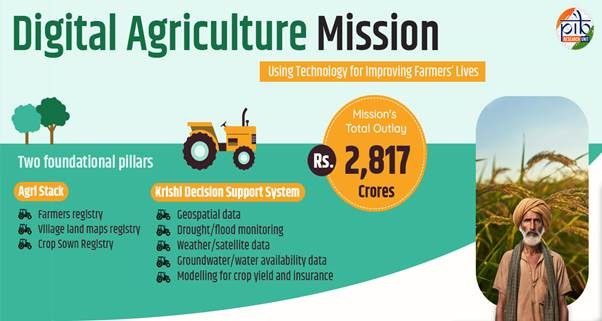
- Digital Agriculture Mission (Agri Stack): Creation of geo-referenced plot registry, unique Farmer ID, and digital crop survey to enable targeted schemes (KCC, MSP, subsidies). Aadhaar-linked Direct Benefit Transfer (DBT) ensures transparency.
- Seed Quality Assurance: SATHI (Seed Authentication, Traceability, and Holistic Inventory) Portal provides end-to-end traceability (from breeder to farmer), ensuring protection against spurious seeds.
- Technology Adoption: Use of Artificial Intelligence (AI), precision farming, remote sensing, and digital advisory systems for sowing, pest control, weather forecasting, and marketing → boosting productivity and efficiency.
Overall Impact
- Shift from food self-sufficiency → farmer income security.
- Strong focus on productivity, digital empowerment, post-harvest value addition, and sustainability.
- FPOs + DPI + MSP + infra creation = agricultural transformation.
- Lays foundation for Atmanirbhar Krishi and farmer empowerment.
UPSC MAINS PRACTICE QUESTIONS
Q1. India’s war against terrorism requires a multi-pronged strategy combining strong security mechanisms, international cooperation, and socio-economic measures.” Discuss with examples.
Q2. Despite constitutional guarantees and government programmes, India lags in health outcomes such as maternal mortality, child nutrition, and disease control. Critically analyse the gaps in achieving freedom of good health for all.
Q3. Critically examine the role of initiatives such as PM-KISAN, Kisan Credit Card, e-NAM, FPOs, and Digital Agriculture Mission in empowering Indian farmers economically and socially
QUICK LINKS

 Call
Call