 Gurukul
Kurukshetra September, 2025
The following topics are covered in the Kurukshetra September 2025:
Chapter 1- Fostering Jobs, Building Bharat: ELI Scheme as a Gamechanger
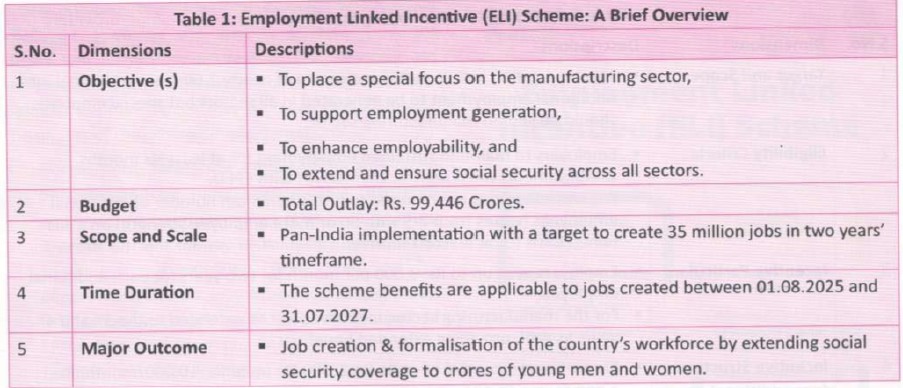
The Employment Linked Incentive (ELI) Scheme is a transformative initiative launched by the Government of India to bolster employment generation, enhance employability, and provide social security, with a special focus on the manufacturing sector.
- Announced as part of the Prime Minister’s package of five schemes in the Union Budget 2024-25, the ELI Scheme came into effect on 1st August 2025, with a projected outlay of Rs. 99,446 crore.
- Its primary objectives are to:
- Ensure equitable access to economic opportunities.
- Reduce unemployment and promote self-reliance.
- Strengthen the industry workforce and foster inclusive and sustainable economic growth.
Evolution of Employment and Skill Development Initiatives in India
Government employment programmes have evolved from broad-based initiatives to targeted, skill-focused approaches aimed at enhancing the employability of youth. Key programmes include:
- Skill India Mission (SIM) – Provides training, reskilling, and upskilling through schemes such as Pradhan Mantri Kaushal Vikas Yojana, National Apprenticeship Promotion Scheme, and Craftsman Training Scheme via Industrial Training Institutes (ITIs).
- Sector Skill Councils (SSCs) – 36 councils led by industry leaders identify skill requirements and competency standards across sectors.
- National Skill Development Corporation (NSDC) – Supports industry-aligned training providers.
- Skill India Digital Hub – Integrates skilling, education, employment, and entrepreneurship ecosystems.
- Deen Dayal Upadhyaya–Grameen Kaushal Yojana & Rural Self-Employment Training Institutes – Focus on skill development for rural youth in agriculture, handloom, tourism, etc.
Earlier schemes, such as Aatmanirbhar Bharat Rojgar Yojana (2020-22), incentivized job creation and restoration post-COVID-19, benefiting over 60 lakh individuals through 1.52 lakh establishments.
Why ELI Scheme is Distinct
Unlike traditional skill-development schemes, ELI focuses on:
- Skill-employment linkage: Training directly tied to sector-specific employment opportunities.
- Accountability: Employers, industries, and training entities are jointly responsible for actual job creation.
- Tailored training: Demand-driven courses mapped to industry requirements.
- Formal employment promotion: Encourages official job registration at government institutions.
The scheme is implemented in two parts:
- Incentives for first-time employees – Encouraging youth to join the formal workforce.
- Support for employers – Directed at generating additional employment, with particular emphasis on manufacturing.
Stakeholder Integration and Implementation
Effective execution of ELI requires multi-agency coordination, leveraging technology and regulatory compliance. Key activities include:
- Onboarding employers and employees on digital platforms.
- Monthly submission of Electronic Challan-cum-Return (ECR) with Aadhaar authentication.
- Cross-verification with IT/GST/PAN data.
- Real-time monitoring, performance dashboards, and retention tracking.
- Fraud detection, random audits, and enforcement of provisions.
Key stakeholders include the Ministries of Labour, Skill Development and Entrepreneurship, Finance, Revenue, EPFO, UIDAI, NPCI, employers, employees, auditors, and third-party monitoring agencies.
Addressing Challenges: Potential challenges and solutions include:
- Fake/ghost employee records: Cross-verification with EPFO, Aadhaar, PAN, GST, IT filings; biometric checks.
- Salary under-reporting: Comparison of ECR with bank transfers, salary slips, and IT returns; imposition of penalties for violations.
- Employee attrition: Employer sensitization on retention incentives.
- Low awareness: Outreach through state/district labour offices, MSME field offices, trade unions, and social media.
- Weak training delivery: Partnerships with NGOs, cooperatives, and Common Service Centres to enhance access.
- Monitoring and fraud detection: AI/ML integration for real-time alerts; targeted third-party audits.
Lessons from high-budget programmes like MGNREGA underline the need for robust grievance redressal mechanisms, data validation, and timely interventions.
Conclusion
The ELI Scheme represents a paradigm shift in India’s employment landscape, bridging the gap between skill development and actual employment. By offering monetary incentives linked to job creation and retention, the scheme not only enhances employability but also strengthens industry capacity, promotes selfreliance, and fosters inclusive economic growth.
Chapter 2- Unorganized Workers and Social Security Measures in India
The unorganized sector is a defining feature of the Indian economy, employing over 90% of the workforce and contributing around 50% to GDP.
- Despite their economic significance, unorganized workers remain marginalized, often living below the poverty line, facing exploitation, gender discrimination, and poor working conditions.
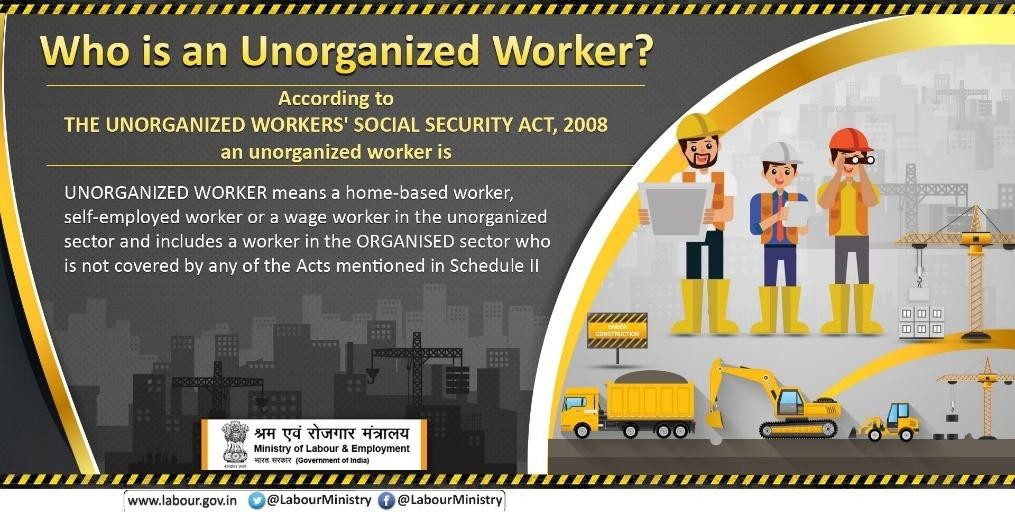
Classification of Unorganized Workers
The Ministry of Labor categorizes unorganized workers into four groups:
- Occupational: Agricultural laborers, small/marginal farmers, fishermen, beedi rollers, artisans, construction and brick workers, etc.
- Nature of Employment: Casual, migrant, contract, bonded laborers.
- Distressed Categories: Toddy tappers, scavengers, headload carriers, animal-driven transport workers.
- Service Categories: Domestic workers, midwives, barbers, vendors.
The National Commission on Labor (1969) defines unorganized workers as those unable to organize due to irregular employment, illiteracy, marginal establishments, and dispersed workplaces.
Challenges Faced by Unorganised Workers
- Low Wages: No equal pay, bonuses, or fringe benefits; widespread exploitation.
- Lack of Job Security: Casual, temporary, and seasonal work; absence of provident fund, pension, maternity or bonus provisions.
- Weak Legal Protection: Vulnerable to harassment, unsafe conditions, and discrimination.
- Deprivation of Basic Amenities: Poor sanitation, inadequate housing, lack of education and nutrition.
- Poverty and Indebtedness: Low earnings and lack of capital hinder entrepreneurship.
Legislative Measures
- Unorganized Workers’ Social Security Act, 2008 – Provides a legal framework for social security for informal workers.
- Code on Social Security, 2020 – Consolidates multiple labor laws; extends coverage to unorganized, gig, and platform workers.
- Labor Code Provisions – Focus on improving conditions, benefits, and welfare of informal workers.
Major Social Security Schemes
- Life and Disability Coverage
- PMJJBY & PMSBY: Life and accident insurance; over 23.6 crore enrolled as of April 2025.
- Retirement Security
- Atal Pension Yojana (APY): Encourages voluntary savings; over 7.65 crore subscribers with 48% women participation.
- PM Shram Yogi Maan-Dhan (PM-SYM): Monthly pension of Rs. 3,000 for unorganised workers earning ≤ Rs. 15,000/month; 30.51 crore enrolled.
- Health and Maternity Benefits
- Ayushman Bharat–PMJAY: Health insurance up to Rs. 5 lakh per family; covers senior citizens, ASHAs, and Anganwadi workers.
- Livelihood Support
- PM SVANidhi Yojana: Loans up to Rs. 30,000 for street vendors; over 68 lakh beneficiaries.
- Self-Employment Scheme for Rehabilitation of Manual Scavengers: Cash assistance, skill training, and monthly stipend.
- Food Security
- Public Distribution System (PDS) & PM Garib Kalyan Anna Yojana: One Nation One Ration Card (ONORC) enables food grain access for migrants; 81 crore beneficiaries.
- Artisan Support
- PM Vishwakarma Yojana: Financial and skill-building assistance; 2.37 million artisans registered.
Progress and Impact
- Social protection coverage doubled from 24.4% (2021) to 48.8% (2024), covering 920 million people (ILO World Social Protection Report 2024–26).
- Digitisation of schemes (PMJJBY, PMSBY, APY, PM-SYM) ensures ease of enrolment, claim settlement, and transparency.
- Gender inclusivity: Over 53% of E-Shram registrations are women.
- Financial inclusion, poverty alleviation, and formalisation of unorganised workforce are key outcomes.
Way Forward
To enhance the social security ecosystem for unorganised workers, strategic measures include:
- Universal registration linked to Aadhaar for identification and benefits delivery.
- Portable benefits to ensure coverage across jobs and locations.
- Simplified contribution mechanisms for irregular incomes.
- Public awareness campaigns to educate workers about entitlements.
- Multi-stakeholder funding models involving employers, workers, and government.
Chapter 3- Green Technology for Sustainable Rural Jobs in India
India’s push towards a clean and green economy is generating significant employment opportunities, especially in rural areas. Green technologies are not only addressing environmental concerns but also creating sustainable livelihoods.
Renewable Energy and Rural Employment
- India employed 1.1 million people in renewable energy (2025), ranking 4th globally.
- Key sectors include hydropower, solar PV, wind, biomass, biofuels, and emerging technologies like green hydrogen.
- Major initiatives:National Green Hydrogen Mission, PM-KUSUM, PM Surya Ghar, and Production Linked Incentives (PLI) for solar PV modules.
- Decentralised solutions like solar microgrids, solar-powered irrigation pumps, and bioenergy projects generate local employment and reduce rural migration.
- Skill development programs (e.g., Suryamitra, Vayumitra, Jal-Urjamitra) train youth, including women and marginalized communities, in renewable energy installation, operation, maintenance, and entrepreneurship.
- Employment potential: Solar 1 million FTE jobs, Wind ~183,500 FTE jobs, PM-KUSUM alone can create 7.55 lakh job-years.
Circular Economy and Waste Management
- Under Mission LiFE, India promotes reduce, reuse, recycle principles to turn waste into economic opportunities.
- Priority waste streams: solid waste, plastic, e-waste, battery, used oil, tyres, end-of-life vehicles, metal scrap, construction & demolition waste, hazardous waste.
- Advanced solutions like waste-to-energy plants, plastic-to-fuel conversion, e-waste recycling can be adapted in rural areas.
- Potential: 33 lakh additional jobs across skill levels in collection, segregation, recycling, and microenterprises.
- Regulatory support through Extended Producer Responsibility (EPR) framework ensures proper waste management and integration of informal sectors.
Green Healthcare in Rural Areas
- Healthcare sector growth: 7–10% annually, with rural areas facing a shortage of 2.7 million professionals.
- Green-tech solutions: solar-powered health centres, telemedicine, mobile clinics, AI diagnostics, providing local employment in operations, maintenance, and digital health services.
- Benefits: enhanced healthcare access, rural job creation, reduced migration, and improved productivity.
- Employment impact: expanding health workforce could generate 5.4 million additional jobs (2021– 25), contributing Rs. 3,429 billion annually to national income.
Skill Development Ecosystem
- Skill Council for Green Jobs (SCGJ) and Sector Skill Councils align training with market needs.
- SCGJ initiatives: 44 nationally approved qualifications, 500,000 trained candidates, including 100,000 in solar and renewable domains.
- State-level collaborations (e.g., Andhra Pradesh with Schneider Electric) equip youth with modern skills in automation, solar systems, AI, and machine learning.
- Focus: empower rural youth, women, and marginalized communities for green employment.
Green MSMEs and Smart Manufacturing
- MSMEs constitute 90% of manufacturing, key for sustainable industrial growth.
- Smart manufacturing integrates automation, analytics, data-driven decision-making, and ecoconscious production.
- Government initiatives: National Manufacturing Mission, Skill India Digital Hub, National Apprenticeship Promotion Scheme.
- Opportunities in clean-tech production, recycling, refurbishment, and repair sectors.
- Example: recycling 10,000 tonnes of waste generates ~115 jobs, highlighting circular economy employment potential.
Eco-Conscious Tourism
- Eco-tourism, rural tourism, wellness tourism generate direct and indirect employment in hospitality, guiding, handicrafts, and homestays.
- Examples: Himachal Pradesh, Kerala, Araku Valley’s eco-tents, Madhya Pradesh homestays.
- Skills developed: customer service, hospitality management, digital marketing—transferable across sectors.
Conclusion
- Green technologies integrate environmental protection, sustainable development, and rural employment.
- Key enablers: renewable energy, circular economy, green healthcare, skill development, MSMEs, eco-tourism.
- Challenges: skill gaps, financing, infrastructure, regulatory complexities, but government initiatives and PPP models are bridging these gaps.
- India’s green transition is not only an environmental imperative but also a people’s movement, fostering inclusive growth, resilient rural economies, and global leadership in sustainability.
Chapter 4- Digital India and Rural Transformation
Launched in 2015, the Digital India programme aims to transform India into a knowledge-based society, ensuring inclusive growth by providing digital access, improving connectivity, promoting innovation, and delivering government services online.
Key Achievements:
- Expanding Connectivity:
- BharatNet Project: Connected 2,18,000 Gram Panchayats with 6.92 lakh km optical fibre.
- 4G and 5G networks cover 99.6% of districts; rural internet users now form 55% of total users.
- National Broadband Mission 2.0, Wi-Fi hotspots, satellite internet, and fixed wireless technologies are bridging the urban-rural digital divide.
- Innovation and Technology Adoption:
- Villages are embracing AI, IoT, blockchain, and digital agriculture platforms.
- Startups and e-governance initiatives (UMANG, e-Panta, e-Sahmati) provide services like crop insurance, telemedicine, and market linkages.
- Regional language content constitutes 60% of internet content, promoting inclusivity.
- Examples: Yakten (Sikkim) – digital nomad village; Akodara (Gujarat) – fully digital transactions; Harisal (Maharashtra) – smart village with White-Fi technology
- Skill Development and Education:
- PMGDISHA: Trained 6.39 crore rural citizens in digital literacy.
- Online platforms (SWAYAM, PM e-Vidya, Digital India Bhashi) improve access to education and government services.
- Common Service Centres (CSCs) act as hubs for digital literacy, vocational training, and financial education.
- Employment Generation:
- New jobs in IT support, BPOs, content creation, digital services, and gig economy reduce ruralurban migration.
- Women’s participation in internet usage is now 47%, empowering rural women in entrepreneurship and digital employment.
- Promotion of Rural Entrepreneurship:
- E-commerce and digital payments enable rural artisans, farmers, and SHGs to access national markets.
- Government schemes like Start-up India, Make in India, PLI provide credit, marketing, and technological support.
- NASSCOM Foundation trained 1 lakh rural women, resulting in 83% independent women-led rural enterprises.
- Financial Inclusion and Governance:
- UPI transactions crossed 10 billion per month; 6.5 crore merchants enabled.
- Digitisation of government services (DigiLocker, Aadhaar, GST, pensions) ensures transparency and reduces corruption.
- CSCs: 78% of 5.6 lakh centres operate in villages, providing access to services and employment.
Policy Support and Vision:
- Initiatives like Digital Personal Data Protection Act, National AI Mission, National Broadband Mission provide policy clarity.
- India aims to leverage this Tech Decade to achieve a $5 trillion economy, with IT contributing 10-15% of GDP by 2025.
- Emphasis on public-private partnership, digital literacy, startup ecosystem, and skilled youth participation.
Conclusion:
Digital India has significantly transformed rural India, enhancing connectivity, promoting innovation, improving education and skills, generating employment, and fostering entrepreneurship. While challenges like the digital divide and skill gaps persist, continued efforts can make rural India an active participant in building a self-reliant, inclusive, and knowledge-based society, positioning India as a global IT and digital superpower.
Chapter 5- India-UK Free Trade Agreement (FTA) and Rural Economy
On July 24, 2025, India and the UK signed a Comprehensive Economic and Trade Agreement (CETA), marking India’s first major trade deal in a decade.
- The FTA aims to strengthen economic integration, enhance agri-exports, promote value addition, and generate rural employment. It also represents a strategic step for India to expand its global trade footprint post-Brexit.
Key Highlights:
- Boost to Bilateral Trade:
- Current India-UK trade: $56 billion, targeted to double by 2030.

- Duty-free access for 99% of India’s exports, covering labourintensive sectors (textiles, leather, footwear, gems & jewellery, toys, marine products) and high-value sectors (engineering goods, auto components, organic chemicals).
- Special focus on inclusive growth, benefiting farmers, women, youth entrepreneurs, MSMEs, startups, and artisans.
- Agriculture and Processed Food:
- Transition from volume to value in farm sector; 1,437 agricultural tariff lines (14.8% of total) and 985 processed food lines (10.1%) included.
- Expected increase in agri-exports by over 50% in three years.
- Key commodities: grapes, shrimps, onions, honey, processed foods, mango pulp, pickles, and spices.
- Preferential access benefits small and marginal farmers and promotes diversification.
- Sanitary & Phytosanitary (SPS) measures and simplified certification facilitate trade, including for e-commerce and small consignments.
- Marine & Plantation Sectors:
- Marine exports (shrimp, fish, cuttlefish) to UK poised to expand; higher procurement rates benefit coastal fisherfolk and women employees in processing plants.
- Duty-free access for coffee, tea, spices, and value-added products enhances global competitiveness.
- Textiles, Leather, Gems & Jewellery:
- Textiles, Leather, Gems & Jewellery:
- Gems, jewellery, sports goods, and furniture gain easier access to UK markets.
- Boosts employment in rural clusters (UP, Tamil Nadu, Gujarat, Punjab).
- Inclusive Rural Development:
- FTA aligns with India’s agri-export institutions (APEDA, MPEDA, Coffee & Spices Boards).
- Encourages quality production, packaging, certification, and sustainable practices.
- Ensures benefits reach small farmers, food producer organizations (FPOs), MSMEs, and rural artisans.
Conclusion
The India-UK FTA is a transformative milestone for India’s rural economy, particularly agriculture, marine, and labor-intensive sectors. By providing duty-free access, promoting value-added exports, and supporting inclusive growth, the FTA strengthens rural prosperity, incentivizes quality production, and enhances India’s competitiveness in global markets. It positions India to leverage its agrarian strengths, MSMEs, and rural workforce in building a sustainable and globally integrated economy.
UPSC Mains Practice Questions-(Around 250 words)
Q1. Discuss how the India-UK Free Trade Agreement (CETA) can act as a catalyst for rural prosperity and valueadded agricultural exports.
Q2. Digital India has transformed rural India by improving connectivity, skill development, and employment opportunities. Critically examine the role of the Digital India programme in promoting rural development and inclusive growth.
QUICK LINKS

 Call
Call