 Residential Course
Kurukshetra November, 2025
The following topics are covered in the Kurukshetra November 2025:
Chapter 1- Rural India as a Hub of Ecotourism
Ecotourism has emerged as a strategic instrument in India’s rural development agenda, offering a model that integrates economic diversification, environmental stewardship, and social inclusion.
- As defined by the International Ecotourism Society, it emphasizes responsible travel that conserves the environment, sustains local communities, and encourages interpretation and education.
- This aligns strongly with India’s rich biodiversity, cultural landscapes, and rural heritage, making ecotourism a natural fit for inclusive and sustainable development.
- With travelers increasingly seeking low-impact, authentic, and community-centric experiences, the demand for ecotourism has surged. Policymakers have also recognized its potential for conservation financing, rural livelihood generation, and green economic growth.
Current Status of Tourism Sector in India
- The tourism sector is witnessing strong post-pandemic recovery, led by domestic tourism, and India ranks 10th globally in travel and tourism GDP contribution.
- International tourist arrivals are expected to reach 30.5 million by 2028, with FTAs at 9.24 million in 2023 (up from 6.43 million in 2022), led by Bangladesh (24.5%), USA (20.4%), and UK (6.9%).
- The sector’s economic contribution stood at US$ 199.6 billion in 2022, projected to reach US$ 512 billion by 2028, growing at 7.1% annually, and expected to generate 53 million jobs by 2029, highlighting its role as a major employment provider.
Policy Landscape and Government Initiatives
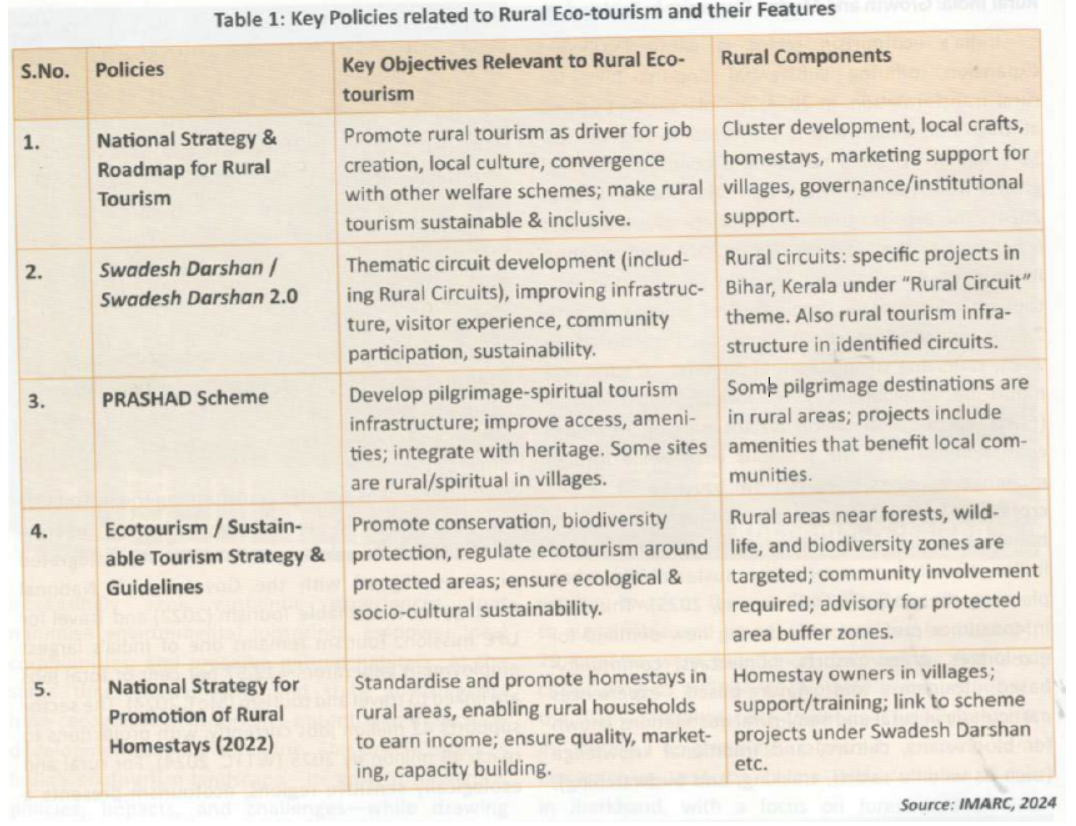
- National Strategy for Ecotourism (2022)- The strategy aligns the Ministry of Tourism with MoEFCC, emphasizing eco-certification, responsible tourism in fragile ecosystems, community participation, carrying-capacity assessment, and conservation-linked tourism.
- Swadesh Darshan Scheme & Swadesh Darshan 2.0- Since 2014–15, the scheme has sanctioned Rs 5,292.91 crore for 76 projects (with 75 completed by 2024), while SD 2.0 shifts towards sustainable and responsible tourism, including eco-circuits such as Pathanamthitta–Gavi–Vagamon–Thekkady (Kerala) for rainforest trekking and birdwatching, and Dalma–Betla–Netarhat (Jharkhand) for wildlife-focused forest tourism.
- PRASHAD Scheme- The scheme has sanctioned Rs 1,646.99 crore across 48 projects, supporting eco-spiritual circuits, heritage-linked tourism, and essential infrastructure upgrades.
- Capacity Building & Skill Development- A network of 56 IHMs and 13 Food Craft Institutes (2024) provides training in sustainable hospitality, thereby strengthening human capital for rural and ecotourism-based livelihoods.
- Travel for LiFE Mission & Dekho Apna Desh- These initiatives promote citizen engagement, responsible tourism behavior, and women- and youth-led rural tourism models aligned with sustainability principles.
Rural India: Market Dynamics & Emerging Opportunities
- Fast-growing sector: Ecotourism valued at USD 19.8 billion (2024), projected USD 50.4 billion (2033, CAGR 9.8%), contributing ~5% to GDP.
- Sustainability-driven demand: 82% of Indian travellers prioritise eco-lodges, homestays, trekking, birdwatching, agro-tourism (IMARC, 2025).
- Rural growth potential: 2,509 million domestic visits (2023); 9.66 million FTAs (2024, +19.8%).
- Employment & entrepreneurship: Tourism generates 12.57% of jobs (42 million in 2024, 48 million by 2025), enabling women-led microenterprises, youth employment, and diversified rural incomes.
Economic, Social & Environmental Impacts
- Economic: Increases household income 35–60%, promotes micro-entrepreneurship, e.g., Periyar Tiger Reserve (₹60–80 crore, 50% to locals) and Mawlynnong (+60% incomes).
- Social: Empowers women (18,000 in Kerala), reduces youth outmigration (Khonoma – 30%), and strengthens community ownership, cultural preservation, and inclusivity.
- Environmental: Revenues fund conservation, restoration, anti-poaching, e.g., tiger protection (MP), mangrove/coral restoration (Western Ghats, Sundarbans), creating self-sustaining biodiversity protection.
Key Challenges
- Over-commercialization & greenwashing dilutes sustainability standards.
- Carrying-capacity stress: Overcrowding in Ladakh, Jim Corbett, Kerala strains ecosystems, water, and waste management.
- Climate threats: Glacial retreat, sea-level rise, heatwaves, forest fires endanger eco-destinations.
- Regulatory gaps: Weak eco-certification, fragmented monitoring, poor enforcement.
- Infrastructure constraints: Limited sustainable transport, waste management, and climate-resilient facilities in rural areas.
Way Forward
- Strengthen eco-certification & standards: Mandatory audits, unified national eco-label.
- Carrying-capacity–based tourism: Visitor caps, zonation, differential pricing for fragile ecosystems.
- Diversified destinations: Promote lesser-known rural circuits to reduce pressure on flagship sites.
- Integrate with rural livelihoods: Link with organic farming, handicrafts, renewable energy, agro-forestry, tribal tourism.
- Community-led & climate-resilient development: Revenue-sharing, women/youth cooperatives, green infrastructure, and public–private–community partnerships for eco-lodges and conservation-linked enterprises.
Ecotourism represents a powerful lever for rural transformation, combining economic upliftment, environmental conservation, and social empowerment. With rising domestic demand, international visibility, and supportive policy frameworks, rural India is uniquely positioned to emerge as a global leader in inclusive, responsible, and regenerative tourism.
Chapter 2- Vibrant Villages Programme
The Vibrant Villages Programme (VVP), launched by the Government of India, aims at holistic development of border villages, focusing on tourism-driven economic growth, infrastructure, and livelihood generation.
- It promotes eco-tourism, agro-tourism, cultural tourism, and community participation, enhancing local entrepreneurship, showcasing indigenous arts, crafts, and cuisines, and helping curb outmigration by creating sustainable employment opportunities.
Phase I: Key Features and Achievements
- Scope and Implementation: Launched with a financial outlay of Rs. 4,800 crore (2022–23 to 2025–26), VVP-I targeted 663 villages across 19 districts and 46 border blocks in Arunachal Pradesh (455), Himachal Pradesh (75), Sikkim (46), Uttarakhand (51), and Ladakh (35).
- Village-level Action Plans were prepared in collaboration with Gram Panchayats and local institutions (SHGs, NGOs, cooperatives).
- Infrastructure and Connectivity: The programme strengthened road connectivity (113 roads, 8 low-suspension bridges, Rs. 2,400 crore), 4G telecom connectivity (342 villages), and electrification (474 on-grid, 127 off-grid; 43 power projects, Rs. 238 crore).
- Livelihood and Tourism Promotion: VVP supported community-managed homestays, local fairs, festivals, and the promotion of eco-resorts, adventure tourism, and tourist centres (102 projects, Rs. 48 crore). Agri-businesses under the One Village One Product model enhanced sustainable livelihoods.
- Comprehensive Development: Alongside tourism, Rs. 556 crore was allocated for agriculture, education, health, energy, cooperatives, and Khadi & Village Industries. The programme ensured inclusive participation of women and youth in economic activities.
- Recognition and Motivation: Villages under VVP-I were highlighted during Republic Day 2025 celebrations, showcasing successful community-led development models.
Phase II: Expansion and New Focus Areas
- Outlay and Coverage: VVP-II, approved in April 2025, continues until FY 2028–29 with Rs. 6,839 crore, expanding to border villages beyond the northern border in states and UTs including Assam, Bihar, Gujarat, Jammu & Kashmir, Manipur, Meghalaya, Mizoram, Nagaland, Punjab, Rajasthan, Sikkim, Tripura, Uttarakhand, Uttar Pradesh, and West Bengal.
- Tourism and Cultural Promotion: Emphasis is on village fairs, festivals, awareness camps, and national day celebrations, showcasing local culture, heritage, and indigenous products to attract tourists. Tourist circuits connecting border villages are being developed.
- Sustainable Livelihoods: Focus on agro-based value chains, branding of local agri-products and cuisines, and community-driven enterprises, creating employment and curbing youth migration.
- Infrastructure and Digital Integration: VVP-II targets all-weather roads, telecom, television connectivity, electrification, and education infrastructure, including SMART classrooms and leveraging digital tools like PM Gati Shakti for planning and implementation.
- Tourism Incentives and Competitions: The Best Tourism Village Competition (BTVC) motivates villages to adopt community-based sustainable practices. Inaugural edition (2023) saw 795 applications, with 35 villages recognized, while the second edition (2024) had 991 applications, with 36 winners across eight categories including Adventure, Agri, Community-Based, Craft, Heritage, Responsible, Spiritual/Wellness, and Vibrant Villages.
Significance and Outcomes
- Economic Growth: VVP promotes local entrepreneurship, agri-businesses, handicrafts, and village tourism, providing a sustainable source of income.
- Social Empowerment: Ensures inclusive development, with active participation of women, youth, and community institutions.
- Cultural and Ecological Preservation: Helps preserve heritage, customs, and ecological resources while fostering responsible tourism.
- Strategic and National Vision: Strengthens border development, security, and vibrancy, aligning with Viksit Bharat @2047 and the vision of Aatmanirbhar Bharat.
Conclusion
The Vibrant Villages Programme demonstrates a synergistic model of rural development, tourism promotion, and border prosperity. By integrating infrastructure development, community participation, skill enhancement, and sustainable livelihoods, VVP transforms border villages into self-reliant, vibrant, and economically secure communities, contributing to India’s vision of a prosperous, inclusive, and strategically strong nation.
Chapter 3- Agro-Tourism in India
India, the world’s 4th largest economy in 2025, with 15 agro-climatic zones and diverse cropping patterns, has significant potential to leverage agro-tourism as a driver of sustainable agriculture, rural livelihoods, and socio-economic growth, contributing to Viksit Bharat @2047.
- Agro-tourism integrates tourism with agriculture, providing additional income to farmers while promoting eco-friendly farming practices, cultural preservation, and environmental stewardship.
Significance of Agro-Tourism
- Economic Contribution and Employment:
- Agriculture employs 46.1% of India’s workforce and contributes 17.8% of GDP (FY 2023-24).
- Agro-tourism provides supplementary income to farmers, especially small and marginal farmers (~80%), while promoting micro-entrepreneurship and strengthening the rural economy.
- IMARC Group (2024): India’s agro-tourism market was USD 1,177.9 million (2024) and projected to reach USD 4,911.9 million by 2033, with a CAGR of 17.9% (2025-2033).
- Sustainable Agriculture and Environmental Benefits:
- Agro-tourism connects tourists with farming activities, promoting indigenous farming, organic agriculture, and environmental stewardship.
- Encourages income-centric farming strategies rather than mere production-centric approaches, enhancing long-term sustainability for small farms.
- Supports eco-friendly crop protection and sustainable farm management, as promoted under UNIDO-India FARM project (GEF-UNIDO, 2024) implemented by HIL (India) Ltd.
- State-Level Initiatives and Best Practices:
- Maharashtra: Agro Tourism Development Corporation (ATDC) established in 2005; covers 200+ villages, 1,000+ Agro Tourism Centres (ATCs), attracting over 80 lakh tourists, with 500 farms officially recognised.
- Kerala: Agri-Tourism Multi-State Co-operative Society Ltd (ATCOS) promotes farm stays, spices cultivation, organic farming, resorts, yoga, naturopathy, and backwater tourism.
- Sikkim: India’s first organic state, promotes agro-tourism, with increased participation of rural women.
- Karnataka: Coffee plantation stays in Coorg attract domestic and international tourists.
- Punjab: Farm Tourism Scheme exposes tourists to agrarian lifestyle, provides cultural experiences, and generates supplementary income for farmers.
- Agricultural Resilience and Growth:
- Agriculture sector showed consistent growth of ~5% annually (FY17-FY23); 3.5% growth in Q2 FY2024-25.
- India is the largest producer of milk, pulses, and spices, and second-largest producer of fruits, vegetables, tea, farmed fish, sugarcane, wheat, rice, cotton, and sugar.
- Foodgrain production rose from 265.05 million tonnes (2014-15) to an estimated 347.44 million tonnes (2024-25).
- Socio-Economic and Community Impact:
- Agro-tourism enables rural community participation, creates additional revenue for local businesses, and strengthens local economy through job and income generation.
- Promotes cultural preservation, traditional arts and crafts, and local cuisines.
- Encourages inclusive participation of women and youth, ensuring equitable benefits.
- Global and Policy Alignment:
- UNIDO and FAO promote agro-tourism for rural development aligned with UN-SDGs: poverty alleviation, food security, decent wages, and economic growth.
- Requires financial assistance, infrastructure development, awareness, and skill training to mobilize rural resources and ensure sustainability and remunerative returns.
Way Forward
- Formalization and Policy Support:
- Agro-tourism should be integrated into national and state-level schemes, providing capacity building, infrastructure, digital services, and skill development for farmers.
- Promote eco-friendly, income-centric farming models to ensure sustainability and enhanced rural livelihoods.
- Rural and Cultural Integration:
- Leverage India’s 6.65 lakh villages, diverse cropping patterns, and unique culture to create immersive tourism experiences.
- Develop tourist circuits, local fairs, festivals, and community-based initiatives.
- Economic and Agricultural Synergy:
- Agro-tourism can drive inclusive growth, empower farmers, promote sustainable practices, and help India achieve global food leadership.
- Encourage marketing and branding of local agricultural products, integrating tourism, hospitality, and rural economy.
Conclusion
Agro-tourism represents a convergence of agriculture, tourism, and rural development, fostering sustainable farming, rural livelihoods, cultural preservation, and economic growth. With policy support, capacity building, and strategic promotion, agro-tourism can contribute to India’s vision of Aatmanirbhar Bharat, Viksit Bharat @2047, while aligning with UN-SDGs and ensuring inclusive rural prosperity.
Chapter 4- Rural Festivals in India
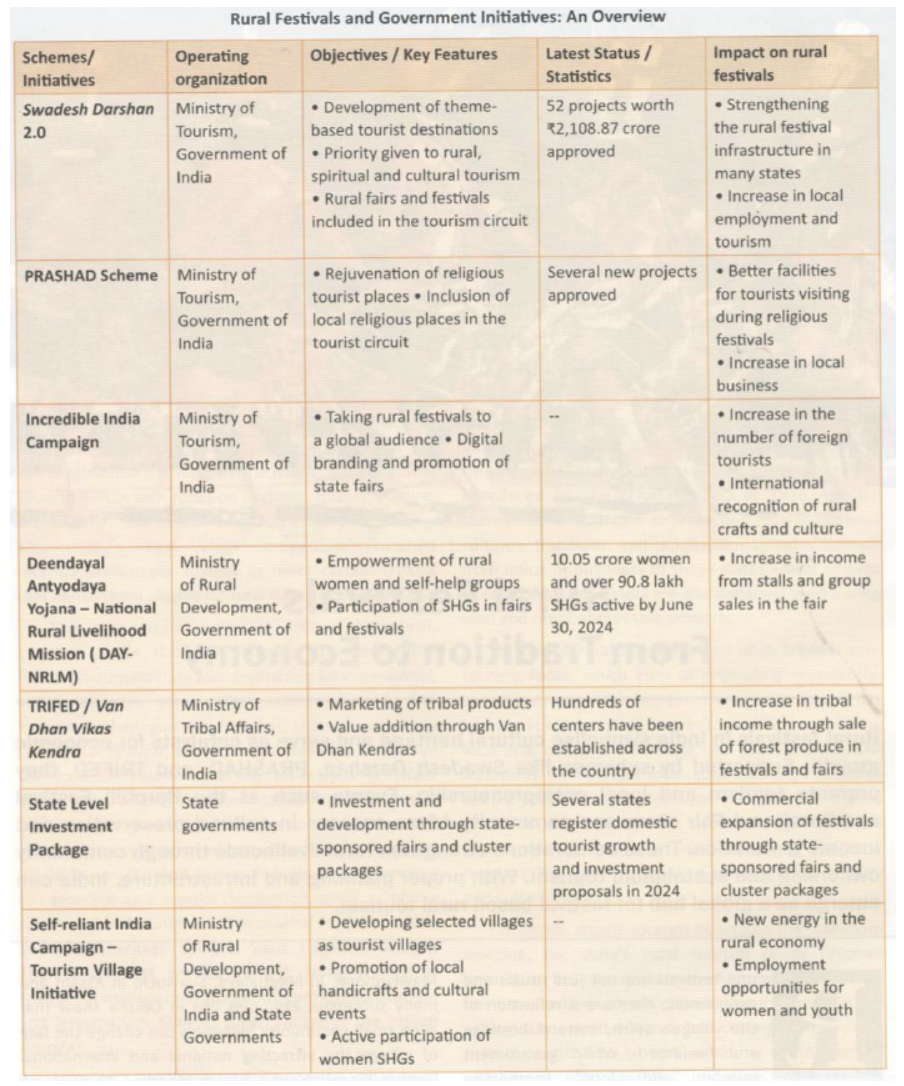
Rural festivals in India not only reflect cultural heritage but also serve as engines of economic growth and rural development. Supported by government schemes like Swadesh Darshan, PRASHAD, DAY-NRLM, and TRIFED, these festivals promote tourism, entrepreneurship, and local livelihoods, transforming traditional celebrations into sustainable economic opportunities.
Significance and Socio-Economic Role
- Cultural and Economic Integration:
- Festivals embody traditions, customs, and community spirit, while acting as platforms for tourism-driven income generation.
- Events like Mawlynnong (Meghalaya), Sualkuchi (Assam), and Odisha fairs demonstrate how community initiatives attract national and international visitors.
- Tourism Promotion and Employment Generation:
- Around 65% of India’s population lives in rural areas, where festivals provide seasonal employment for artisans, farmers, and small traders.
- Festivals encourage rural tourism, increasing demand for local accommodation, food, and transportation services, while boosting village cash flow.
- Festivals serve as platforms for local crafts, handlooms, folk music, and dance, promoting entrepreneurship.
- Tourism and Cultural Branding:
- States leverage festivals as tourism identities:
- 1. North East: Hornbill Festival (Nagaland)
- 2. North India: Surajkund Fair (Haryana), Pushkar Fair (Rajasthan)
- 3. East India: Chhath Puja (Bihar), Tusu Parva (Jharkhand)
- 4. South India: Pongal (Tamil Nadu), Thrissur Pooram (Kerala)
- Festivals help preserve folk culture, rituals, and heritage, while generating sustainable local income.
Challenges
- Environmental and Infrastructural Concerns:
- Environmental pressure, waste management, erosion of traditions due to overcrowding, and dependence on weather.
- Insufficient infrastructure (roads, toilets, accommodation) and lack of equitable economic distribution.
- Potential Solutions:
- Budget allocation for local infrastructure development.
- Enhanced community participation.
- Adoption of digital tools: e-ticketing, digital payments, crowd management systems.
Way Forward
- Rural festivals should be systematically integrated into tourism policy, linking digital promotion, infrastructure, and community ownership.
- Year-round activities beyond festivals can provide sustainable employment, increase village incomes, and promote cultural branding.
- Leveraging these festivals can establish India as a global hub for festival-based rural tourism, supporting inclusive rural development and socio-economic empowerment.
Conclusion
Rural festivals bridge cultural heritage and economic opportunity. Case studies like Hornbill and Surajkund illustrate their multiplier effect on the local economy. Systematic planning, community engagement, and sustainable practices can position India as a festival tourism destination, boosting livelihoods, preserving culture, and promoting rural prosperity.
Chapter 5- Vocal for Local
The ‘Vocal for Local’ initiative, launched by Prime Minister Narendra Modi in May 2020 under the broader Aatmanirbhar Bharat Abhiyaan, aims to promote self-reliance by encouraging the use of locally made products and services. It seeks to strengthen the domestic economy, empower artisans, MSMEs, and start-ups, and reduce dependency on imports, while preserving cultural heritage.
Key Components and Strategies
- Government Procurement and Local Prioritization
- The Public Procurement (Preference to Make in India) Order, 2017 (amended 2020) mandates preference to ‘Class-I Local Suppliers’ (products with >50% local content) in government procurement.
- Global tenders require special approval for projects up to ₹200 crore, ensuring fair opportunities for local suppliers.
- Support for Artisans, Handlooms, and MSMEs
- Financial assistance for equipment upgrades, design innovation, and marketing of handloom and handicraft products.
- Schemes include:
- 1. PM Employment Generation Programme (PMEGP): Subsidies for new micro-enterprises.
- 2. Credit Guarantee Fund Trust for Micro & Small Enterprises (CGTMSE): Collateral-free credit for MSMEs.
- 3. Scheme for Fund for Regeneration of Traditional Industries (SFURTI): Organises artisans into clusters for competitiveness.
- 4. Production Linked Incentive (PLI) Scheme: Financial incentives to boost domestic manufacturing in sectors like electronics, pharmaceuticals, and automobiles.
- Promotion of Grassroots Entrepreneurship
- NITI Aayog’s Aspirational Blocks Programme highlights local products through the ‘Aakanksha’ window on the Government e-Marketplace (GeM).
- Start-up Runway on GeM: Allows DPIIT-recognised start-ups to sell directly to government entities with relaxed procurement norms.
- Digital Enablement and Skill Development
- Partnerships with GeM and Open Network for Digital Commerce (ONDC) facilitate e-commerce onboarding, technical support, and financial literacy for local entrepreneurs.
- Skill training enhances operational capacities of artisans and MSMEs.
- Citizen Engagement and Marketing
- Campaigns encourage citizens to purchase locally made goods, particularly during festivals.
- The Ministry of Textiles organises exhibitions, social media campaigns, and celebrity endorsements to increase visibility and demand for indigenous products.
Economic and Strategic Significance
- Strengthens domestic industries and reduces import dependency.
- Creates employment opportunities and enhances rural and urban entrepreneurial capacities.
- Preserves and promotes cultural heritage and traditional crafts.
- Contributes to India’s vision of becoming a global manufacturing hub.
- Aligns with the ‘Atmanirbhar Bharat’ vision by fostering self-reliant, resilient local economies.
Challenges and Way Forward
- Maintaining competitiveness against cheaper foreign alternatives remains a challenge.
- Continued focus on capacity building, digital enablement, infrastructure support, and market access is essential to ensure sustainability and scalability.
UPSC Mains Practice Questions-(Around 250 words)
Q1. “The Vibrant Villages Programme seeks to transform border villages into self-reliant and vibrant communities through tourism, infrastructure, and livelihood interventions.” Discuss the objectives, key initiatives, and socio-economic impact of VVP in strengthening India’s border areas.
Q2. “Rural festivals are not only a reflection of India’s cultural heritage but also act as catalysts for rural economic growth.” Examine the socio-economic significance of rural festivals in promoting tourism, employment, and local entrepreneurship, with reference to case studies like Hornbill Festival and Surajkund Fair.
QUICK LINKS

 Call
Call