 Gurukul
Kurukshetra March, 2026
The following topics are covered in the Kurukshetra March, 2026:
Chapter 1- Accelerating Rural Transformation
India's rural transformation reflects a sustained policy push towards self-reliant, dignified village communities, aligned with Viksit Bharat 2047.
- Investments in physical infrastructure (roads, housing, electricity, digital connectivity) and social infrastructure (water, sanitation, education, healthcare) have enhanced mobility, service delivery, and economic opportunities, thereby reducing the rural–urban divide.
Rationale for Rural Transformation
Rural India remains central to inclusive growth as 54.6% of the workforce resides in 6.62 lakh villages under 2.57 lakh Gram Panchayats. Despite limited resource endowment (2.4% land, 4% water), India supports nearly 17% of global population and 15% livestock.
- Persistent issues such as low per capita income, human development gaps, and regional disparities make rural development a national imperative.
Key Drivers of Rural Transformation
Physical Infrastructure- Expansion of rural connectivity under PMGSY has connected 99.7% habitations, while PMGSY-IV targets 62,500 km roads (₹70,125 crore).
- Housing for All under PMAY-G aims to provide 4.95 crore pucca houses (₹54,916.7 crore). Rural electrification through Saubhagya has connected 2.86 crore households, increasing power supply by 39%. These measures enhance market access, service delivery, and quality of life.
Social Infrastructure- The Jal Jeevan Mission has expanded tap water coverage from 17% (2019) to 81.31% (15.74 crore households), improving public health outcomes.
- WHO estimates indicate savings of 5.5 crore hours and prevention of nearly 4 lakh deaths. Integration with sanitation, healthcare, and education strengthens human capital, especially benefiting women and children.
Digital and Emerging Infrastructure
Digital inclusion through Bharat Net has made 2.14 lakh villages service-ready, targeting 2.64 lakh Gram Panchayats. With tele-density (86.76%) and 5G in 99.9% districts, rural areas are integrating into the digital economy.
- Expansion of national waterways and coastal shipping will reduce logistics costs and enhance regional trade.
Agriculture and Allied Sectors
Rural transformation is anchored in agriculture and allied sectors, with improvements in irrigation, productivity, and value chains. Growth in fisheries, livestock, and rural industries has enabled livelihood diversification.
- India is now the largest rice producer and second-largest fish producer, indicating a shift from subsistence farming to market-oriented agriculture.
Budgetary Commitment
The Union Budget 2026–27 allocates ₹1.97 lakh crore to the Ministry of Rural Development (21% increase), while combined allocation for agriculture and rural development exceeds ₹4.35 lakh crore. This reflects strong policy prioritization of employment generation, asset creation, and infrastructure expansion.
Viksit Bharat Gram Rozgar Mission (VB-GRM)
The VB-GRM, building on MGNREGA (8.5 crore assets), focuses on durable rural infrastructure and livelihood generation.
- With over ₹1.51 lakh crore allocation (₹95,692 crore central share) and ₹30,000 crore for MGNREGA transition, it expands employment from 100 to 125 days, introduces unemployment allowance and wage delay compensation, and ensures decentralized implementation (50% via Gram Panchayats). The scheme covers infrastructure, livelihoods, and climate-resilient works, aiming at sustainable rural development.
Outcomes
Rural transformation has improved connectivity, agricultural productivity, and non-farm employment, while strengthened market integration and reducing the rural–urban gap. Villages are increasingly emerging as economic growth centers rather than subsistence units.
Challenges
Key challenges include regional disparities, income gaps, infrastructure maintenance issues, climate vulnerability, and implementation deficits. Addressing these is essential for achieving balanced and sustainable development.
Way Forward
Policy focus should be on climate-resilient infrastructure, diversification of rural livelihoods, strengthening decentralized governance, improving last-mile delivery, and enhancing digital literacy to ensure inclusive and sustainable rural transformation.
Conclusion
- Rural infrastructure serves as a bridge between aspiration and opportunity. With sustained investment, effective governance, and community participation, rural India can become a driver of national growth, playing a pivotal role in achieving Viksit Bharat 2047.
Chapter 2: Driving Growth in Agriculture and Allied Sectors
The Union Budget 2026–27 places agriculture and allied sectors at the center of rural transformation, signaling a strategic shift from a subsidy-driven approach towards productivity enhancement, infrastructure development, diversification, and climate resilience.
- While income support mechanisms continue, the policy emphasis is increasingly on long-term income stabilization, creation of durable assets, and integration of technology, thereby ensuring sustainable and resilient agricultural growth.
Importance of Agriculture
Agriculture remains a cornerstone of the Indian economy, contributing to food security, employment generation, and social stability.
- Nearly 43–45% of the workforce depends on agriculture, while the sector contributes only 15–16% to GDP, indicating low productivity and disguised unemployment. This structural imbalance necessitates reforms aimed at enhancing efficiency, value addition, and income diversification.
Budgetary Trends and Policy Shift
Over the past few years, allocations to agriculture have shown steady growth, with the Ministry of Agriculture budget increasing from ₹1.25 lakh crore (2024–25) to ₹1.41 lakh crore (2026–27). Simultaneously, Rural Development allocation has risen significantly from ₹2.05 lakh crore to ₹2.66 lakh crore, reflecting a strong focus on rural infrastructure. The overall allocation of ₹1.63 lakh crore for agriculture and allied sectors indicates continued policy commitment.
- However, after adjusting for inflation (around 5%), the real increase remains modest, suggesting that the Budget prioritizes efficiency, better targeting, and digital verification of beneficiaries rather than large fiscal expansion. A notable concern is the reduction in Department of Agricultural Research and Education (DARE) funding to ₹9,967 crore, which could impact long-term innovation and climate adaptation.
Anchoring Schemes and Structural Transition
Flagship schemes continue to form the backbone of agricultural policy, but their orientation is gradually shifting towards structural enablement:
- PM-KISAN (₹60,000 crore) ensures direct income support to farmers
- PMFBY (₹18,500 crore) strengthens crop insurance amid rising climate risks
- RKVY (₹12,000 crore) and PMKSY (₹11,500 crore) focus on infrastructure and irrigation
- Agriculture Infrastructure Fund (₹10,000 crore) promotes post-harvest infrastructure
- Fisheries and allied sectors (₹9,200 crore) support diversification
This indicates a transition from merely protecting farmers from distress to enabling them to generate higher and more stable incomes through asset creation and productivity gains.
Productivity Enhancement
India's agricultural productivity has historically grown at 2–2.5% annually, which is insufficient to meet rising demand and income expectations.
- With increased investment in climate-resilient seed varieties, soil health management, precision agriculture, and micro-irrigation, productivity growth is projected to increase to 3–3.5%, potentially adding 12–15 million tonnes of foodgrain by 2028.
- Economic estimates suggest that a 7% increase in capital investment could generate nearly 1.9% additional output growth, highlighting the importance of investment-led growth. Improved input efficiency will also reduce cultivation costs, thereby enhancing farm profitability and income stability.
Diversification and Horticulture
Agricultural diversification is emerging as a key strategy to enhance farmer incomes. Horticulture contributes about 33% of agricultural GVA and 38% of total output value, indicating its growing importance. However, post-harvest losses of 15–20% remain a major constraint.
- Investments in cold chains, storage, and processing infrastructure can reduce these losses and generate economic gains of ₹8,000–10,000 crore annually, along with 5–7 lakh rural jobs. Budgetary support includes ₹350 crore for high-value crops such as coconut, cocoa, sandalwood, cashew, and agarwood, along with ₹700 crore under Krishonnati Yojana.
- This shift towards high-value and export-oriented agriculture reduces dependence on traditional cereals and enhances income potential for small farmers.
Allied Sectors as Growth Engines
Allied sectors such as fisheries, dairy, and livestock are becoming critical drivers of rural income diversification.
- Fisheries sector is growing at 8–9% annually, expected to reach 10–11%, with potential to generate 8 lakh jobs and increase exports from ₹60,000 crore to ₹75,000 crore by 2028
- Dairy sector, contributing around 5% to GDP, is expected to witness 4–5% growth in productivity
The extension of Kisan Credit Cards to fisheries and dairy improves access to institutional credit. These sectors provide regular cash flow, thereby reducing dependence on seasonal agriculture and acting as a buffer against crop failures.
Irrigation and Infrastructure
Irrigation remains a critical determinant of agricultural productivity. Currently, only about 52% of net sown area is irrigated. Expansion under PMKSY is expected to add 2–3 million hectares, increasing cropping intensity from 142% to 148%.
The adoption of micro-irrigation systems can improve water-use efficiency by 30–40% and increase yields by 15–20%.
- Such investments are particularly important for rainfed and drought-prone regions, where yield variability is high. Infrastructure development in irrigation and watershed management thus plays a crucial role in climate resilience and income stability.
Credit and Insurance
Access to timely and affordable credit is essential for agricultural growth. The agricultural credit target for 2026–27 is ₹22 lakh crore, with a focus on small and marginal farmers.
- Insurance coverage under PMFBY is expected to increase from 30% to 38–40% of cropped area. The use of remote sensing and satellite technology is likely to reduce claim settlement delays by 25–30%, making insurance more effective. These measures reduce farmers' vulnerability to climate shocks and price fluctuations.
Digital Agriculture
Digital technologies are transforming agriculture through improved efficiency and transparency. Initiatives such as digital farmer databases, digitized land records, and e-NAM platforms are expected to reduce transaction costs by 10–12% and improve price realization by 5–8%.
- India's agri-startup ecosystem, currently comprising over 2,500 enterprises, is projected to grow to 4,000 by 2028, supported by increased investments. AI-driven platforms like Bharat-VISTAAR provide real-time, location-specific advisory services, empowering farmers with better decision-making tools.
Sustainability and Climate Resilience
Climate change poses significant risks to agriculture, making sustainability a central policy priority. Measures such as climate-resilient seeds, improved irrigation, and expanded insurance coverage can reduce crop loss variability by 1.5–2 percentage points.
- Promotion of natural farming aims to reduce chemical fertiliser usage by 8–10%, improve soil health, and enhance export competitiveness. Sustainability is thus integrated into the broader goal of long-term productivity and resilience.
Regional Focus: North-Eastern Region
The Budget recognizes the need for region-specific interventions, particularly in the North-Eastern Region (NER). Targeted investments in irrigation and infrastructure can increase yield growth by 4–5% and boost regional GSDP by up to 1%.
- The region has strong potential in horticulture, spices, livestock, and fisheries, with products like Tripura's GI-tagged Queen Pineapple offering export opportunities. However, challenges such as limited processing infrastructure, storage facilities, and reduced research funding (DARE) need to be addressed.
Growth Outlook
Agricultural investments have a multiplier effect of 1.6–1.8, meaning that an additional ₹15,000 crore investment could generate ₹24,000–27,000 crore in GDP gains.
- Agricultural GVA growth is projected at 3.5% under normal conditions and 4.5–5% under favourable conditions, indicating moderate but stable growth prospects.
Conclusion
- The Union Budget 2026–27 reflects a mature and forward-looking agricultural strategy, focusing on productivity, diversification, infrastructure, digitalization, and sustainability. By combining income support with structural reforms, it aims to reduce uncertainty, improve farm incomes, and ensure resilient and inclusive rural development.
Chapter 3: Building a Stronger and More Inclusive Healthcare System.
The Union Budget 2026–27 marks a significant transition towards a comprehensive, system-oriented healthcare approach, with an allocation of ₹1,06,530.42 crore (around 10% increase). This reflects sustained public investment, with health expenditure rising by over 194% since 2014–15.
- The Budget focuses on accessibility, affordability, quality, and resilience, with key thrust areas including primary healthcare strengthening (NHM), financial protection (PM-JAY), infrastructure expansion (PM-ABHIM), medical education, digital health, and biopharmaceutical innovation (Bio-Pharma Shakti).
Shift in Healthcare Approach
The Budget reflects a shift from fragmented schemes to an integrated health systems approach, recognizing health as influenced by nutrition, environment, infrastructure, workforce, surveillance, and technology.
It adopts a life-cycle approach, addressing:
- Communicable diseases and maternal-child health
- Rising burden of Non-Communicable Diseases (NCDs)
- Workforce shortages and health infrastructure gaps
Budgetary Priorities and Trends
- Total allocation: ₹1.06 lakh crore+
- Health research: ₹4,821 crore
- Balanced focus on scheme and non-scheme expenditure
The emphasis is not only on increasing expenditure but also on efficient utilisation, capacity building, and long-term system strengthening.
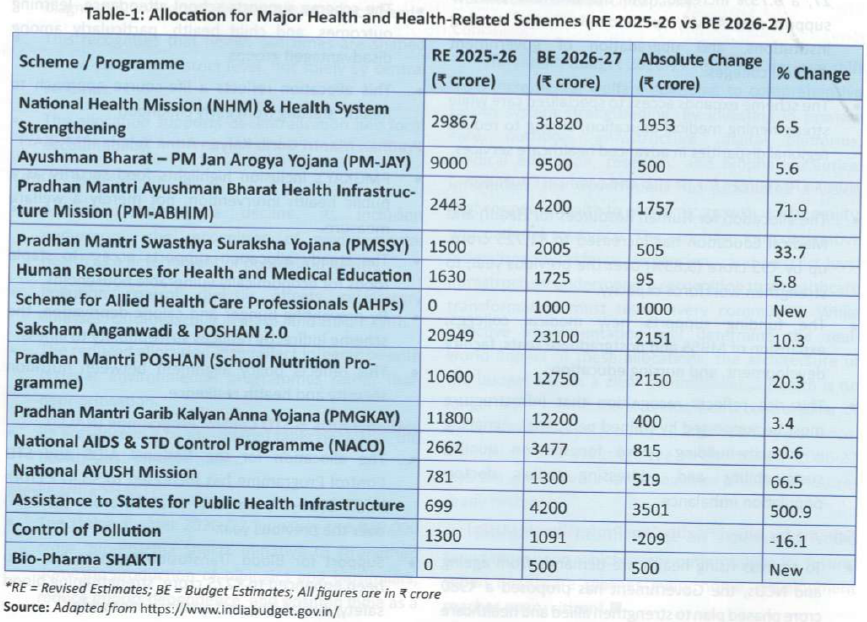
Key Pillars of Healthcare Strengthening
Primary Healthcare and Public Health Delivery
- National Health Mission (NHM): ₹39,390 crore (increased by 6.17%)
- Focus on primary healthcare, maternal and child health, immunization, disease surveillance, and ASHA workers
NHM remains the backbone of India's health system, reinforcing the principle that primary healthcare is the most equitable and cost-effective model for improving health outcomes.
2. Financial Protection and Universal Health Coverage
- PM-JAY (Ayushman Bharat) strengthens health insurance coverage
- Focus on quality of care, timely reimbursements, and hospital network stability
The scheme reduces catastrophic out-of-pocket expenditure, ensuring financial risk protection for vulnerable populations and moving towards Universal Health Coverage (UHC).
3. Healthcare Infrastructure and System Resilience
- PM-ABHIM: ₹4,770 crore (increased by 67.66%)
- Focus on critical care blocks, district laboratories, emergency preparedness, and hospital capacity expansion
This reflects post-pandemic priorities, aiming to build a resilient and self-sufficient district-level healthcare system.
4. Medical Education and Human Resources
- PMSSY: ₹11,307 crore → Expansion of AIIMS and upgradation of medical colleges
- HRH allocation: ₹1,725 crore (↑5.83%)
Focus areas include:
- Expansion of MBBS and PG seats
- Faculty development and nursing education
This addresses the doctor-population ratio imbalance and ensures that infrastructure is supported by skilled human resources.
5. Allied Healthcare Workforce
- ₹980 crore plan for allied health education
- Target: 1 lakh professionals + 1.5 lakh geriatric caregivers
This reflects a shift towards team-based healthcare delivery, recognizing the importance of paramedics and allied professionals, especially in managing ageing population and NCDs.
6. Nutrition as Public Health Priority
- Saksham Anganwadi & POSHAN 2.0 integrates maternal, child, and adolescent nutrition
- PM POSHAN (Mid-Day Meal) links nutrition with education outcomes
- PMGKAY ensures food security, reducing vulnerability to disease
This highlights a preventive healthcare approach, where nutrition is seen as foundational to immunity, cognitive development, and productivity.
7. Communicable Disease Control and Surveillance
- NACO allocation: ₹3,477 crore (increased by 30.64%)
- Strengthening HIV/AIDS control, STD prevention, and blood safety services
Despite rising NCDs, the Budget ensures continued focus on communicable diseases, reinforcing surveillance and response systems.
8. Digital Health and Technology Integration
- Ayushman Bharat Digital Mission: ₹350 crore (increased by 7.94%)
- Focus on digital health records, telemedicine, and interoperability
Digital platforms improve efficiency, transparency, and access, enabling citizen-centric healthcare delivery.
9. AYUSH and Preventive Healthcare
- Increased support for AYUSH systems
- Focus on wellness, preventive care, and integrative medicine
This diversifies healthcare delivery and promotes holistic health approaches.
10. Cooperative Federalism and State Support
- Increased assistance to states for public health infrastructure
- Enables context-specific healthcare solutions
This recognizes that health is a state subject, requiring decentralized planning and implementation.
11. Environmental Health Linkages
- Inclusion of pollution control measures highlights the health-environment nexus
- Pollution impacts respiratory diseases, cardiovascular conditions, and child health
12. Bio-Pharma Shakti Initiative
- ₹10,000 crore initiative to boost biologics and biosimilars production
- Creation of 1,000 clinical trial sites
- Strengthening NIPERs and innovation ecosystem
This integrates health policy with industrial policy, positioning India as a global biopharma hub.
13. Cost Reduction and Advanced Healthcare
- Custom duty exemption on 17 life-saving drugs
- Support for rare disease treatment
- Expansion of mental healthcare institutions
- Establishment of trauma centres in district hospitals
Focus on affordability, access to specialised care, and advanced medical services.
Outcomes and Significance
- Improved access and affordability through expanded health coverage, along with strengthening of primary and tertiary healthcare systems
- Enhanced human resource capacity supported by digital health, AI, and innovation, improving efficiency and service delivery
- Transition towards a resilient, inclusive, and future-ready healthcare system
Challenges
- Implementation gaps and regional disparities due to variations in state capacity and infrastructure
- Rising burden of Non-Communicable Diseases (NCDs) and pressure on sustained health financing
- Concerns over quality of care, regulatory oversight, and efficient resource utilization
Way Forward
- Strengthening primary healthcare systems and expanding preventive care and nutrition interventions
- Improving public health expenditure efficiency along with digital integration and data governance
- Promoting research, innovation, and workforce capacity building for a resilient healthcare system
Conclusion
- The Health Budget 2026–27 reflects a paradigm shift from incremental welfare spending to holistic health system strengthening. By integrating infrastructure, workforce, digital health, nutrition, and innovation, it positions healthcare as a central pillar of inclusive and sustainable development.
- A robust healthcare system not only improves human capital but also strengthens economic growth, social equity, and national resilience, making it indispensable for achieving Viksit Bharat 2047.
Chapter 4: Empowering Youth and Enterprise for Viksit Bharat
The Union Budget 2026–27 places Yuva Shakti (youth power) and enterprise development at the centre of India's journey towards Viksit Bharat 2047. It reflects a strategic shift from access-driven policies to a focus on quality education, employability, innovation, and entrepreneurship, integrating education, skills, technology, and enterprise ecosystems to create a future-ready workforce and job creators.
1. Education, Skills and Human Capital Development
The Budget strengthens the education ecosystem with an allocation of ₹1.39 lakh crore, aligned with NEP 2020 principles (Access, Equity, Quality, Affordability, Accountability). It promotes multidisciplinary learning, critical thinking, and industry-integrated education.
Key initiatives include:
- Expansion of Atal Tinkering Labs (10,000 existing; 50,000 proposed) and AICTE IDEA Labs to foster innovation and design thinking
- Establishment of Centres of Excellence in AI, PM Research Chairs, and PM One Nation One Subscription
- Development of 5 university townships near industrial corridors, strengthening industry–academia linkages
The focus is on creating skilled, adaptable, and innovation-oriented human capital, shifting education from degree-oriented to outcome-oriented learning.
2. Skill Development, Employment and New-Age Sectors
The Budget adopts an integrated "Education to Employment and Enterprise" approach, aligning skills with market demand and emerging sectors.
Major measures include:
- Establishment of AVGC labs in 15,000 schools and 500 colleges, targeting 2 million jobs by 2030 and promoting the creative (orange) economy
- Skill expansion in healthcare (1 lakh allied professionals), tourism (10,000 trained guides), and digital economy sectors
- Focus on AI, IT services, gaming, design, and content creation as future employment drivers
This reflects a transition from job-seeking mindset to job creation and entrepreneurship, preparing youth for a technology-driven global economy.
3. MSMEs and Enterprise Ecosystem: Drivers of Growth
The Budget identifies MSMEs as the engine of growth and employment, with an allocation of ₹24,566 crore and creation of a ₹10,000 crore SME Development Fund to build Champion MSMEs.
Key interventions include:
- Corporate Mitra initiative to provide affordable compliance and advisory support in Tier-2 and Tier-3 cities
- Revival of 200 heritage industrial clusters and strengthening of Atmanirbhar Bharat Fund (₹2,000 crore)
- Integration with GeM and digital platforms to improve market access and transparency
Additionally, promotion of Khadi, handloom, handicrafts, and ODOP strengthens rural enterprises, generating local employment and reducing migration pressures.
4. Inclusive and Regional Development
The Budget emphasises inclusive growth by targeting rural youth, women, farmers, and lagging regions (North-East and Purvodaya states).
Key measures include:
- Bharat VISTAAR (AI-based agricultural advisory tool) to enhance productivity and farmer incomes
- Expansion of Lakhpati Didi and SHG-based enterprise models, promoting women-led development
- Development of industrial corridors, tourism circuits (Buddhist circuit), and regional infrastructure
This approach promotes balanced regional development, strengthens grassroots entrepreneurship, and integrates rural areas into national growth processes.
5. Innovation, Digital Economy and Global Competitiveness
The Budget reinforces India's transition to a knowledge-driven and innovation-led economy through:
- National missions such as AI Mission, Quantum Mission, and Anusandhan NRF
- Bio-Pharma Shakti (₹10,000 crore) and India Semiconductor Mission (ISM 2.0) for technology self-reliance
- Promotion of startups, patents, research ecosystems, and industry-led innovation
Reforms in IT services (safe harbour norms, increased thresholds) and digital infrastructure enhance global competitiveness and expand employment opportunities.
Conclusion
- The Budget 2026–27 presents a holistic framework linking education, skills, enterprise, and innovation, with youth at its core. By fostering human capital development, MSME growth, digital transformation, and inclusive regional development, it aims to create a self-reliant, entrepreneurial, and globally competitive economy.
- If implemented effectively, this integrated approach can transform India into a job-creating economy, where Yuva Shakti and enterprise ecosystems act as twin engines of growth, driving the vision of Viksit Bharat 2047.
Chapter 5: Women in India: Policy, Power, and Possibility
The Union Budget 2026–27 marks a significant shift by placing women at the center of national development, aligning with the broader vision of inclusive growth and Viksit Bharat 2047.
- With a Gender Budget of ₹5.01 lakh crore (increased by 11.55%; 9.37% of total expenditure) and participation of 53 ministries, gender equity is being integrated into mainstream governance and fiscal policy, moving beyond symbolic commitments to structural transformation.
1. Gender-Responsive Governance and Institutional Expansion
The Budget reflects a transition from women-centric schemes to gender-responsive governance, where multiple sectors—health, education, rural development, skill development, infrastructure, and sanitation—incorporate gender priorities.
Key features include:
- Cross-ministerial gender budgeting (53 ministries) ensuring mainstreaming of gender concerns
- Integration of women's needs in infrastructure planning, education access, skill participation, and rural leadership
- Strengthening of Mission Shakti (₹3,605 crore), providing One Stop Centres, safety mechanisms, and institutional support systems
This indicates a systemic shift in policy design, embedding gender equity into the architecture of the State.
2. Economic Empowerment and Education Access
The Budget emphasizes women as economic agents and growth drivers, moving beyond welfare to enterprise-led empowerment.
Key initiatives include:
- Establishment of girls' hostels in every district, addressing mobility, safety, and access barriers in higher education, especially in STEM and professional courses
- Launch of SHE-Marts, enabling market access, branding, and value chain integration for women entrepreneurs, promoting transition from micro-enterprises to scalable businesses
- Expansion of enterprise ecosystems (SHGs, ODOP, rural industries) to generate employment and income opportunities
These measures enhance female labour force participation (FLFP) and strengthen women's role in the formal economy.
3. Women as Drivers of Inclusive Growth
The Budget recognizes women not merely as beneficiaries but as key drivers of economic and social transformation.
Core focus areas include:
- Investment in education, enterprise, and leadership opportunities
- Strengthening safety, institutional support, and social protection frameworks
- Promoting market integration and financial inclusion
This reflects a shift from welfare-based approach → capability and productivity-based approach, positioning women as central stakeholders in India's growth trajectory.
Conclusion
- The Budget 2026–27 represents a paradigm shift in gender policy, combining fiscal commitment, institutional reform, and economic empowerment. By mainstreaming gender across sectors and investing in education, enterprise, and safety, it lays the foundation for inclusive, equitable, and sustainable development.
- Effective implementation and monitoring will be crucial, but the policy direction clearly positions women as agents of change, essential for achieving Viksit Bharat 2047.
Chapter 6: Seed Act 2026
The Seed Act 2026 represents a major reform in India's agricultural regulatory framework, aimed at addressing the long-standing issue of fake and substandard seeds. It seeks to ensure quality assurance, transparency, and farmer protection, thereby strengthening the foundation of agricultural productivity and rural livelihoods.
1. Regulatory Reforms: Transparency, Accountability and Deterrence
The Act introduces a modernised regulatory framework to address gaps in the earlier Seeds Act, 1966, which had become inadequate due to expansion of private seed markets, hybrid seeds, and complex supply chains.
Key provisions include:
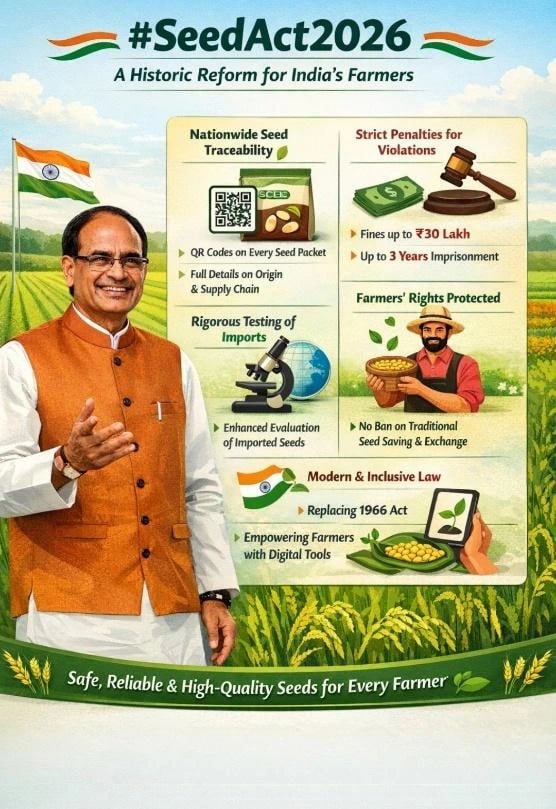
- QR-based seed traceability system, enabling farmers to verify origin, quality, and seller credentials, and allowing authorities to track defective batches
- Mandatory registration of all seed producers, dealers, and sellers, ensuring formalisation and accountability in the seed market
- Stricter penalties, including fines up to ₹30 lakh and imprisonment up to 3 years, treating seed fraud as a serious economic offence
These measures aim to transform the seed sector from an opaque and unregulated system to a transparent, traceable, and accountable market.
2. Quality Assurance, Institutional Oversight and Farmer Empowerment
The Act strengthens scientific evaluation and institutional oversight, with greater roles for ICAR, agricultural universities, and Krishi Vigyan Kendras (KVKs) in ensuring seed quality, adaptability, and performance across agro-climatic zones.
Simultaneously, it emphasises farmer empowerment and awareness, including:
- Training farmers to use QR verification systems and understand quality parameters
- Establishment of grievance redressal mechanisms for reporting substandard seeds
- Promotion of extension services for informed decision-making
Importantly, the Act protects farmers' traditional rights to save, use, exchange, and share seeds, balancing modern regulation with cultural practices.
3. Significance for Agriculture and Rural Economy
The Seed Act 2026 has far-reaching implications for:
- Reducing crop losses and income risks caused by poor-quality seeds
- Enhancing agricultural productivity and yield stability
- Building trust in input markets, encouraging responsible private sector participation
- Supporting sustainable and resilient agriculture, especially in diverse agro-climatic regions
Overall, it strengthens the input ecosystem, which is critical for achieving food security, farmer welfare, and rural development.
Conclusion
- The Seed Act 2026 marks a structural shift in agricultural governance, combining digital traceability, regulatory enforcement, scientific validation, and farmer awareness. If effectively implemented, it can curb malpractices, enhance market integrity, and ensure that farmers receive reliable, high-quality inputs, thereby contributing to inclusive and sustainable agricultural growth.
UPSC Mains Practice Questions-(Around 250 words)
Q1. Discuss how the shift from welfare-driven policies to empowerment-based approaches is reflected in recent budgetary measures for inclusive development.
Q2. Discuss the significance of allied sectors and digital agriculture in ensuring income stability for farmers.
Q3. Analyse the role of MSMEs and new-age sectors in transforming India from a job-seeking to a job-creating economy.
Q4. Discuss how initiatives such as SHE-Marts and Mission Shakti contribute to enhancing women's economic participation.
QUICK LINKS

 Call
Call