 Residential Course
Kurukshetra January, 2026
The following topics are covered in the Kurukshetra January, 2026:
Chapter 1- Start-ups Transforming Education and Skill Development
India has emerged as the third-largest startup ecosystem globally, with over 1.4 lakh registered startups and 118 unicorns by mid-2025. Driven by the Start-up India Initiative and the National Education Policy (NEP) 2020, startups are reshaping education and skill development through digital platforms, artificial intelligence (AI), personalized learning, and industry-linked skilling.
- This transformation is crucial for converting India’s demographic dividend into productive human capital, aligning education with employability, and realizing the vision of Viksit Bharat@2047.
Evolution of Start-up Culture in India
India’s startup journey began with the rise of IT giants such as Infosys, Wipro and TCS in the late 1990s, which laid the technological and entrepreneurial foundation. The spread of the internet, mobile technology, and a young tech-savvy population further accelerated innovation.
- The success of startups such as Flipkart, MakeMyTrip and Zomato normalized risk-taking and entrepreneurship, paving the way for India’s vibrant startup culture.
- As highlighted by the Prime Minister, startups are job creators, not job seekers, redefining India’s growth narrative.
Start-up India Initiative: Building an Innovation Ecosystem-Launched in 2016, the Start-up India Initiative aims to foster a robust, inclusive and scalable innovation ecosystem through:
- Tax incentives and simplified compliance
- Funding support and incubation
- Ease of entry and exit for startups
It is supported by a strong Digital Public Infrastructure (DPI)—including Aadhaar, UPI, Bharat Net and Digital India—which has lowered entry barriers, reduced transaction costs, and enabled startups to scale rapidly.
Key Outcomes
- Unicorns increased from 4 (2014) to 118 (2025)
- Over 12 lakh direct jobs created, with millions of indirect opportunities
- Strengthened exports, reduced import dependence, and enhanced India’s global economic footprint
- A new unicorn emerging roughly every 20 days
Start-ups and Education
Role of NEP 2020- The National Education Policy 2020 marks a paradigm shift:
- From rote learning to competency-based, multidisciplinary education
- Emphasis on innovation, entrepreneurship and skill orientation
- Flexible entry–exit options to remove stigma around dropouts
- Integration of technology, vocational education and experiential learning
NEP 2020 seeks to correct the long-standing disconnect between education and employability, creating fertile ground for education-focused startups.
EdTech Startups: Transforming Learning Delivery- The COVID-19 pandemic accelerated innovation in education delivery, and startups played a transformative role across school, higher education and research.
Key Contributions
- Digital platforms with multimedia content, gamification and interactive tools
- AI-driven personalized learning, catering to diverse learning paces
- Affordable online courses, democratizing access for disadvantaged groups
- Hands-on learning through robotics, coding camps and maker labs
- Industry mentoring and curriculum integration
Major Domains
- School & Test Preparation: BYJU’S, Physics Wallah, Vedantu
- STEM & Math Learning: Cuemath, robotics and coding platforms
- Early Childhood Education: Play-based, experiential models
- Inclusive Education: Assistive technologies for Children with Special Needs (CwSN)
- Immersive Learning: Gamification and simulation-based platforms
These innovations promote scientific temper, critical thinking and creativity, aligning with constitutional values.
Personalized and Inclusive Learning- NEP 2020 recognizes that every learner is unique. EdTech startups use:
- Adaptive algorithms and AI
- Real-time feedback mechanisms
- Self-paced and modular learning
This enhances student engagement, retention and learning outcomes, while targeted programmes promote gender inclusion, marginalized communities and rural learners, contributing to social equity.
Start-ups in Skill Development
- Under the Skill India Mission, the government implements large-scale skilling through programmes such as PMKVY, Jan Shikshan Sansthan (JSS), National Apprenticeship Promotion Scheme (NAPS) and the Craftsman Training Scheme (CTS) via ITIs.
- These initiatives focus on expanding access, standardization and certification, particularly for youth and informal-sector workers.
- Skilling start-ups complement public programmes by addressing gaps in employability and industry relevance. They offer future-oriented courses in AI–ML, data science, coding, digital marketing and communication skills, using micro-credentials, live classes and project-based learning.
- Through internships, apprenticeships and job-linked programmes, often in collaboration with corporates, start-ups enable early workforce integration and readiness for an economy shaped by automation and rapid technological change.
- Further, education and skilling start-ups promote lifelong learning by enabling continuous upskilling and reskilling through online courses, micro-learning modules and professional development platforms.
- This supports the creation of a learning society, which is critical for sustained economic growth, demographic dividend realization and long-term competitiveness.
Way Forward: Strengthening the EdTech and Skilling Ecosystem
- Teacher training and capacity building to effectively integrate technology
- Public–private collaboration for scaling and sustainability
- Addressing challenges of infrastructure, finance and regulation
- Co-creation of solutions with educators and institutions
- Integrating Indian Knowledge Systems with modern pedagogy
- Ensuring equitable access to digital infrastructure and funding
Conclusion
Startups in education and skill development are central to India’s economic and social transformation. By leveraging AI, digital platforms and industry collaboration, they bridge skill gaps, enhance employability and improve productivity.
Chapter 2- India’s Startup Revolution
India has firmly emerged as the third-largest startup ecosystem in the world, reflecting the country’s growing entrepreneurial dynamism. As of 31 December 2024, over 1.57 lakh startups have been recognized by the Department for Promotion of Industry and Internal Trade (DPIIT).
- With more than 100 unicorns, India’s startup ecosystem is redefining innovation, generating employment, and expanding economic opportunities across sectors.
- While Bengaluru, Hyderabad, Mumbai and Delhi-NCR remain leading hubs, the ecosystem is becoming increasingly geographically inclusive, with over 51% of startups originating from Tier-I and Tier-II cities, signaling the democratization of entrepreneurship.
Role of Government: Startup India as the Flagship Driver
- Launched on 16 January 2016, Startup India is the government’s flagship initiative to promote innovation, entrepreneurship and employment generation.
- The programme focuses on improving the ease of doing business through simplified compliance and self-certification, providing tax incentives including income tax exemption for three years, and strengthening access to funding, incubation and mentoring support.
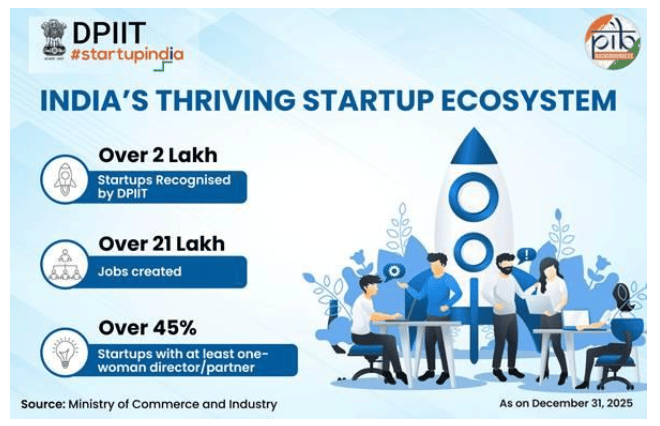
Impact of Startup India
- Impact of Startup India has been significant. As of 31 December 2024, recognized startups have generated over 17.28 lakh direct jobs.
- Sector-wise, IT services account for 2.10 lakh jobs, followed by healthcare and life sciences (1.51 lakh) and professional and commercial services (96,474), reflecting diversification of employment beyond traditional sectors.
- The initiative has also advanced women entrepreneurship, with 75,935 recognized startups having at least one-woman director, indicating improved gender inclusion and a more inclusive startup ecosystem aligned with India’s development goals.
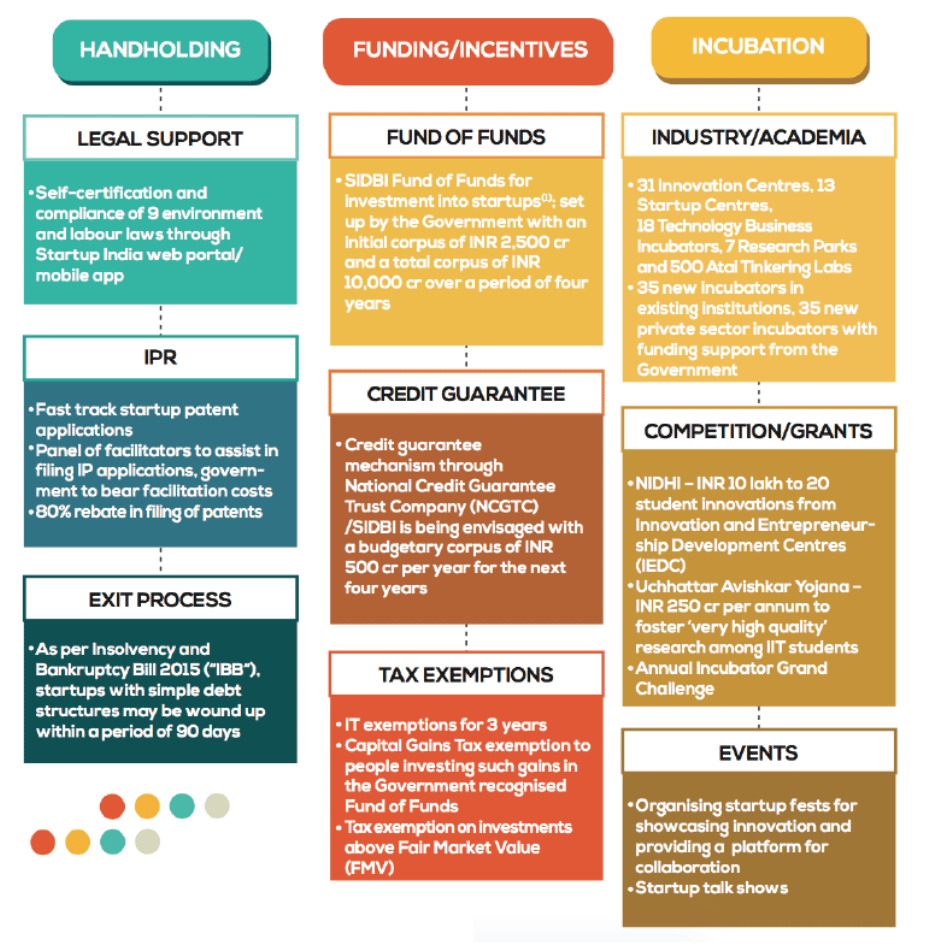
Access to Early-Stage Capital: Startup India Seed Fund Scheme (SISFS)
- The Startup India Seed Fund Scheme, launched in 2021 with a corpus of ₹945 crore, aims to improve access to early-stage capital for startups at critical phases such as proof of concept, prototype development, product trials, and market entry/commercialization.
- Operational since 1 April 2021, the scheme is overseen by an Experts Advisory Committee (EAC) to ensure transparent and need-based allocation.
- As of December 2024, 213 incubators have been approved, 2,622 startups supported, and ₹467.75 crore disbursed, highlighting its role in strengthening India’s innovation-driven startup ecosystem.
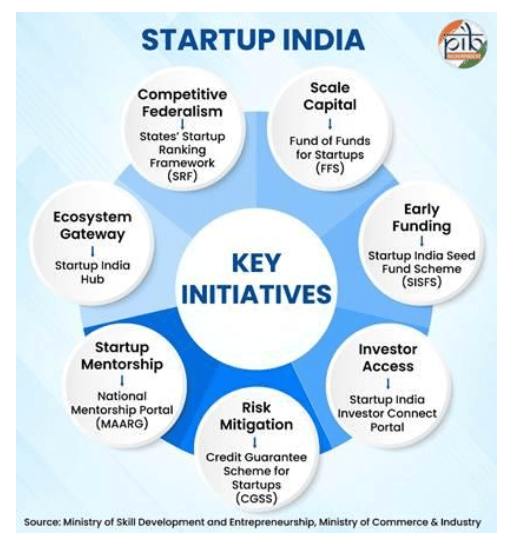
Scaling Startups through Domestic Capital: Fund of Funds for Startups (FFS)
Launched in June 2016 with a corpus of ₹10,000 crore, the Fund of Funds for Startups (FFS) aims to enhance access to domestic risk capital. Managed by SIDBI, the fund invests in SEBI-registered Alternative Investment Funds (AIFs), which in turn invest in startups.
Progress
- ₹6,886 crore committed by DPIIT to SIDBI
- ₹11,687 crore committed by SIDBI to AIFs (as of December 2024)
- Catalyzed ₹21,276 crore of investment in 1,173 startups
Improving Credit Access: Credit Guarantee Scheme for Startups (CGSS)
- The Credit Guarantee Scheme for Startups (CGSS) improves credit access for DPIIT-recognised startups by providing guarantees on loans extended by scheduled commercial banks, NBFCs and venture debt funds.
- Implemented by the National Credit Guarantee Trustee Company Limited, the scheme reduces lenders’ risk perception and facilitates greater institutional credit flow to startups.
- As of 3 January 2025, 260 loans amounting to ₹604.16 crore have been guaranteed, including ₹27.04 crore for 17 women-led startups, supporting inclusive and innovation-driven entrepreneurship.
Promoting Grassroots Innovation: Atal Innovation Mission (AIM)
- The Atal Innovation Mission (AIM), launched in 2016 by NITI Aayog, promotes grassroots innovation and entrepreneurship through a multi-tier ecosystem comprising Atal Tinkering Labs (ATLs) in schools, Atal Incubation Centres (AICs), Atal Community Innovation Centres (ACICs), and Atal New India Challenges focused on nationally relevant problem-solving.
- The mission is supported by real-time MIS monitoring and third-party evaluations to ensure accountability and outcomes.
- As of 18 December 2024, 10,000 ATLs have been established nationwide, 3,556 startups incubated across 72 AICs, and 41,965 jobs created, underscoring AIM’s role in building an innovation-driven, employment-generating ecosystem.
Technology-Led Entrepreneurship: MeitY Startup Hub (MSH)
- The MeitY Startup Hub (MSH) promotes technology-led entrepreneurship by integrating incubation centres, Centres of Excellence and emerging technology labs, and enabling collaboration and innovation in electronics, IT and frontier technologies.
- Under its ecosystem, 5,310+ startups, 495+ incubators and 328+ labs are supported, reinforcing India’s role as a global technology innovation hub.
Broader Significance of India’s Startup Revolution
- Employment generation and absorption of skilled youth
- Innovation-led economic growth
- Reduced import dependence and improved export competitiveness
- Rise of women-led and regionally diverse startups
- Strengthening India’s position in global value chains
Conclusion
India’s startup ecosystem has undergone a structural transformation over the last decade, emerging as the third-largest globally. Government initiatives such as Startup India, Startup India Seed Fund Scheme, Fund of Funds for Startups, Credit Guarantee Scheme for Startups, Atal Innovation Mission and the MeitY Startup Hub have played a catalytic role in fostering innovation, finance access and job creation.
Going forward, continued policy support, deeper capital markets and inclusive innovation will further strengthen the ecosystem, positioning startups as a key driver of economic growth and Viksit Bharat@2047.
Chapter 3- New Labor Laws 2025
India’s labor ecosystem is undergoing a major structural reform through the New Labor Codes, 2025, which consolidate 29 labor laws into four codes. The reforms aim to create a simplified, inclusive and future-ready framework, balancing worker welfare with enterprise flexibility, expanding social security coverage, and improving ease of compliance.
- By aligning with global labor standards, the codes support employment formalization, productivity enhancement, and the vision of Aatmanirbhar Bharat and sustainable economic growth
Four Labor Codes
- Code on Wages, 2019
- Industrial Relations Code, 2020
- Code on Social Security, 2020
- Occupational Safety, Health and Working Conditions (OSHWC) Code, 2020
Together, these codes provide a cohesive and uniform labor framework, replacing a regime characterized by overlapping compliances, inspector raj, legal ambiguity, and poor adaptability to new forms of work.
Why Were New Labor Codes Necessary?
- Structural and Regulatory Deficiencies: India’s earlier labor regime, largely inherited from the colonial period and 1950s–80s, was marked by fragmentation across Central and State laws, inconsistent definitions, and complex compliance requirements, resulting in high transaction costs and prolonged litigation.
- Changing Nature of Work: Traditional labor laws were ill-suited to address emerging employment forms such as gig, platform and fixed-term work, leading to regulatory gaps, limited social security coverage, and worker vulnerability in the new economy.
- Worker Safety and Equity Concerns: Global evidence highlights systemic labor challenges—International Labor Organization estimates 2.78 million annual worker deaths due to occupational accidents and diseases, alongside persistent gender wage gaps, underscoring the need for stronger, harmonized labor protections.
- Alignment with Global Labor Standards: With the ILO’s June 2025 move towards binding standards for platform workers, India’s labor reforms are progressive and anticipatory, aligning domestic regulations with evolving global norms and recognizing new forms of work in a future-ready manner.
Twelve Game-Changing Reforms under New Labor Codes
- Minimum wages for all workers through a National Floor Wage
- Uniform definition of wages for transparency
- Social security coverage for gig and platform workers
- Gratuity eligibility after one year for fixed-term employees
- Mandatory appointment letters for all employees
- Double wages for overtime work
- Reduced eligibility period for leave
- Permission for women to work night shifts with safety and consent
- Formal recognition of work-from-home and flexible work
- Free annual health check-ups for employees above 40
- Mandatory timely wage payments
- Compensation for certain commuting accidents

Key Structural Shifts in the Labor Market
- Formal recognition of gig, platform and fixed-term employment
- Single registration and licensing with an inspector-cum-facilitator regime
- Predictable wage structures reducing inter-state uncertainty
- Digitized compliance systems lowering administrative burden
- Complementarity with digital initiatives such as EPFO 3.0
These reforms strengthen investor confidence, reduce litigation risks, and promote employment formalization.
Sector-wise Impact of Labor Reforms
- Fixed-Term Employees: Fixed-term workers are accorded parity with permanent employees in terms of leave, medical and social security benefits, with gratuity eligibility reduced to one year, encouraging direct hiring and discouraging excessive contractualization.
- Gig and Platform Workers: For the first time, gig work, platform work and aggregators are legally defined. Aggregators must contribute 1–2% of annual turnover (capped at 5%) towards social security, while Aadhaar-linked Universal Account Numbers ensure portability of benefits across states.
- Contract Workers: Contract workers are brought under health and social security coverage, with the principal employer made accountable for welfare provisions, strengthening responsibility and enforcement.
- Women Workers: The reforms enforce legal prohibition of gender discrimination and equal pay for equal work, allow night shifts and all occupations with safeguards, mandate women’s representation in grievance redressal committees, and expand the definition of dependents to include parents-in-law.
- MSME Workers: Workers in MSMEs are covered under universal minimum wages, with safeguards relating to standard working hours, overtime payments and paid leave, improving basic labor standards.
- Plantation Workers: Plantation labor is covered under the Occupational Safety, Health and Working Conditions (OSHWC) Code and Social Security Code, mandating safety training, protective equipment, ESI medical facilities, and educational support for workers’ children.
- Mine Workers: The reforms recognize certain commuting accidents as employment-related and cap working hours at 48 hours per week, improving occupational safety and work-life balance.
- Hazardous Industry Workers: Enhanced protections include free annual health check-ups, mandatory safety committees at worksites, and national safety standards for hazardous chemicals, strengthening preventive regulation.
- Textile Workers: Textile workers, including migrants, receive equal wages and welfare benefits, PDS portability, extended claims period of up to three years, and double wages for overtime, addressing sector-specific vulnerabilities.
- Dock Workers: Employers are mandated to provide medical, sanitation and welfare facilities, ensuring safer and humane working conditions.
- Media and Creative Workers: Journalists, OTT workers and digital creators are entitled to formal appointment letters clearly specifying wages, terms of employment and entitlements, enhancing job security and transparency.
Challenges & Way Forward
| Challenges and Transitional Issues | Way Forward |
|---|---|
|
|
Conclusion
By consolidating 29 labor laws into four codes, the New Labor Laws, 2025 address regulatory fragmentation and establish a transparent, inclusive and investment-friendly labor regime. By recognizing modern work arrangements, ensuring minimum national standards, and simplifying compliance, the reforms aim to balance worker protection with productivity. Their success will depend on effective enforcement and adaptive implementation, and if executed well, the codes can underpin sustainable growth, social justice, and Aatmanirbhar Bharat.
Chapter 4- Waste Management Innovations in Himalayan States
Waste management in the Himalayan region is shaped by fragile ecosystems, high-altitude settlements, limited land, difficult terrain and seasonal tourism pressures. These constraints make centralized models unviable, necessitating locally adapted and decentralized solutions.
- Accordingly, Himalayan states have strengthened waste governance under Swachh Bharat Mission–Urban 2.0, focusing on source segregation, scientific processing, legacy waste remediation and citizen participation.
Why Waste Management Is Critical in Himalayan States
Waste management is critical in Himalayan states due to ecological fragility, disaster vulnerability, limited landfill space, high tourism-induced waste, and transport constraints.
- The region also faces a high risk of plastic pollution in rivers and glaciers, threatening downstream ecosystems. Hence, centralized waste models are unsuitable, making technology-enabled, community-driven and circular economy–based approaches essential.
Innovative Practices Across Himalayan States
Kedarnath (Uttarakhand): Digital Deposit Refund System (DRS)- To manage pilgrimage-related plastic waste, Uttarakhand introduced the Digital Deposit Refund System (DRS) in Kedarnath in May 2022.
- Plastic bottles and MLPs tagged with QR-coded USI carry a ₹10 refundable deposit, returned digitally via UPI through collection centers and Reverse Vending Machines.
- Expanded across all Char Dham sites, the initiative has recycled over 20 lakh bottles, avoided 66 MT of CO₂ emissions, and created 110+ green jobs, exemplifying digital governance, behavioral nudges and circular economy practices.
Jammu & Kashmir: Green Campus Framework- The Green Campus Framework, led by the Housing & Urban Development Department, institutionalized waste management across educational and public institutions.
- Using a three-stage process—identification, preparation and declaration, it focused on source segregation, on-site composting, reduction of single-use plastics and behavioral change.
- Anantnag became the first ULB to declare all campuses Green, demonstrating institutional accountability and behavior-led environmental governance.
Dharamshala (Himachal Pradesh): Collaborative Urban Waste Model- Since 2021, Dharamshala Municipal Corporation has implemented a collaborative, multi-stakeholder waste management model.
- Initiatives such as the Clean Business Programme, Model Ward Programme, decentralized MRFs, and the “Waste Under Arrest” initiative have led to a 25% rise in segregation, 30% reduction in road littering, and 40% cut in landfill waste.
- The model uniquely integrates urban governance, social rehabilitation and circular economy principles.
Leh (Ladakh): Solar-Powered Circular Waste Management- In Leh (Ladakh), the LAHDC launched a solar-powered waste management facility (2020) suited to high-altitude conditions, with a capacity of 30 tonnes/day.
- It targets 100% source segregation and 90% material recovery, converting waste into compost and pavement tiles while generating revenue.
- The model is distinct for its use of renewable energy, circular economy principles, and integration of recycling, composting and reuse in an extreme climatic setting.
Key Governance Lessons from Himalayan States
- Decentralized waste management is essential in fragile regions
- Technology + behavior change delivers sustainable outcomes
- Community participation, especially women-led models, strengthens service delivery
- Renewable energy integration enhances resilience
- Circular economy practices reduce landfill dependence
Conclusion- Waste management innovations in Himalayan states demonstrate the importance of context-sensitive governance in ecologically fragile regions. By combining community participation, institutional accountability, digital tools, renewable energy and circular economy principles, these initiatives advance sustainable urbanization and environmental stewardship.
- Anchored under Swachh Bharat Mission–Urban 2.0, they show that citizen-led, decentralized and technology-enabled approaches can protect fragile ecosystems while supporting a developed and sustainable India.
UPSC Mains Practice Questions-(Around 250 words)
Q1. Discuss how technology-enabled and community-driven waste management models can address the challenges of plastic pollution in mountain ecosystems. Illustrate with suitable examples.
Q2. Examine the contribution of digital governance and behavioral nudges in improving environmental governance in India’s hill states.
Essay-Type Questions (1000-1200 words)
- “Sustainable waste management in fragile ecosystems is as much a governance challenge as it is an environmental one.” Discuss in the context of innovative waste management practices in Himalayan states.
QUICK LINKS

 Call
Call