 Residential Course
Kurukshetra February, 2026
The following topics are covered in the Kurukshetra February, 2026:
Chapter 1- Khelo Bharat Niti 2025 (National Sports Policy 2025)
India, with nearly 65% of its population below 35 years, possesses a major demographic dividend. To convert this into productive national capacity, the Government introduced Khelo Bharat Niti – 2025 as a comprehensive, reform-oriented sports ecosystem framework.
Vision and Core Objectives
- Universal Access & Mass Participation: Ensure universal access to sports across age groups and regions by promoting mass participation and institutionalizing competitive structures from district to national levels, thereby creating a broad-based sporting culture.
- Excellence & Career Development: Enhance India’s performance in the Olympic, Asian and Commonwealth Games through scientific talent identification, structured athlete development pathways, integration of sports science and innovation, and promotion of sports as a viable career avenue.
- Inclusive & Integrated Development: Integrate sports with the education system (NEP 2020) and public health framework, ensure equitable infrastructure access, reform sports governance, and promote inclusion of women, SC/STs, tribal communities and persons with disabilities.
- Economic Growth & Ecosystem Expansion: Develop a comprehensive sports ecosystem by expanding the sports economy, encouraging innovation and entrepreneurship, and positioning sports as a driver of economic growth and employment generation.
Strategic Framework:
- Governance Reforms: Establishment of a robust legal and regulatory framework to ensure transparency, accountability and good governance in sports administration.
- Private Sector Participation: Mobilization of resources through Public–Private Partnerships (PPPs), Corporate Social Responsibility (CSR) contributions and innovative financing mechanisms to strengthen infrastructure and athlete support.
- Technology & Innovation: Integration of Artificial Intelligence (AI), data analytics and emerging technologies for talent identification, performance monitoring and efficient programme delivery.
- Monitoring & Evaluation: Creation of a structured national framework with clearly defined Key Performance Indicators (KPIs) and time-bound targets for regular assessment and outcome-based implementation.
- Model Policy for States: Provision of a guiding framework for States and Union Territories to formulate or revise their sports policies in alignment with national goals and standards.
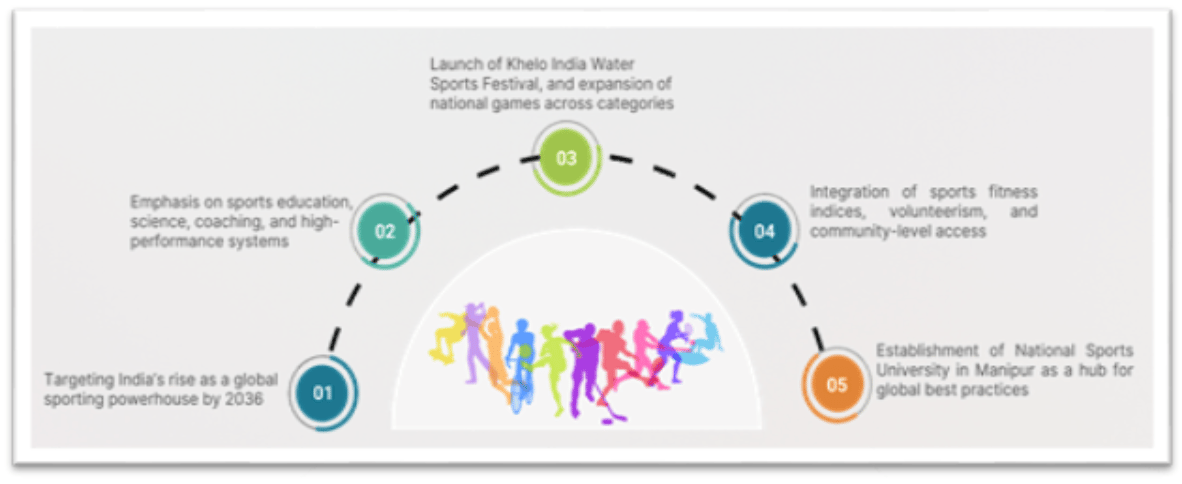
Five Pillars of Khelo Bharat Niti – 2025
- Excellence on the Global Stage- Strengthening NSFs, establishing high-performance centers, creating grassroots-to-elite pathways, integrating sports science & analytics, promoting Para-sports, and hosting global events to enhance soft power and sports tourism.
- Sports for Economic Development- Promoting Make in India sports manufacturing, supporting sports-tech startups, leveraging PPP & asset monetization, and positioning India as a sports tourism hub for employment, exports and service sector growth.
- Sports for Social Development & Inclusion- Ensuring participation of women, EWS, SC/STs, tribals and PwDs, promoting indigenous games, institutionalizing district leagues, and strengthening anti-doping & ethical governance for social mobility and integration.
- Sports as a People’s Movement- Institutionalizing Fitness Ranking System, aligning with Fit India, integrating sports under NEP 2020, promoting workplace wellness and district sports hubs to address lifestyle diseases & sedentary behavior.
- Governance, Technology & Institutional Reforms- Implementing governance reforms in NSFs, introducing KPIs, promoting data-driven monitoring & digital talent tracking, and ensuring coordination between Centre, States and private sector.
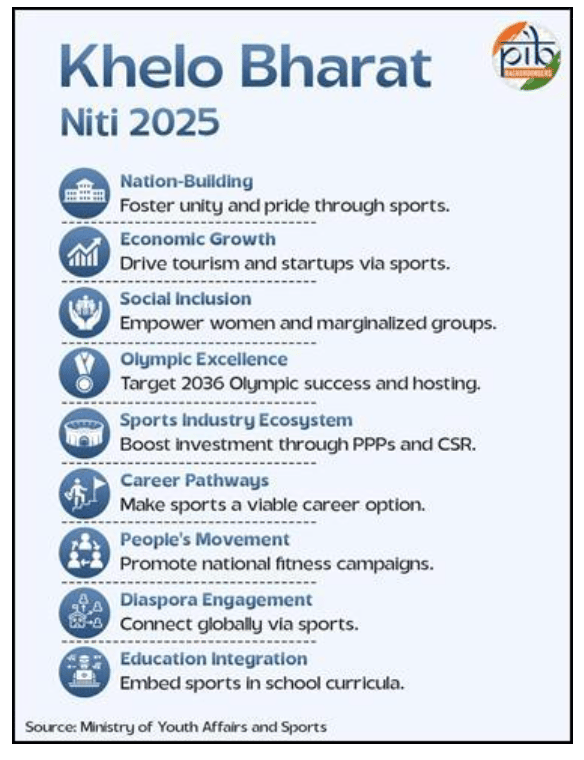
Alignment with National Initiatives
- NEP 2020 – Integration of sports into curriculum
- Fit India Movement – Physical literacy & wellness
- Skill India – Coaching & sports skill development
- Make in India – Sports manufacturing ecosystem
- Digital India – Technology-enabled monitoring
Challenges
- Federal Coordination and Institutional Overlap- Sports being a state subject often leads to coordination gaps between the Centre, States and National Sports Federations (NSFs). Overlapping roles, fragmented implementation and weak accountability reduce policy effectiveness.
- Infrastructure Imbalance and Financial Sustainability- There is uneven regional distribution of sports infrastructure, particularly in rural and backward areas. Additionally, poor maintenance, underutilization of stadiums and limited revenue generation affect long-term financial sustainability.
- Governance Deficits and Transparency Issues- Several NSFs face concerns related to lack of transparency, weak internal democracy and compliance gaps. Inadequate regulatory oversight and anti-doping enforcement undermine credibility.
- Athlete Welfare Amid Commercialization- Increasing commercialization of sports risks neglecting grassroots athletes, equitable access and long-term welfare, including post-retirement security and mental health support.
Way Forward
- Establish a legally backed sports governance framework with independent regulatory oversight.
- Create a dedicated Sports Infrastructure & High-Performance Fund with PPP incentives.
- Develop a National Sports Development Index for states with performance-based funding.
- Strengthen grassroots leagues, talent mapping and sports science integration through digital monitoring systems.
Conclusion
- Khelo Bharat Niti – 2025 represents a shift from a scheme-based approach to a system-based sports ecosystem model. By integrating excellence, inclusion, economic growth, governance reform and technological innovation, it positions sports as a pillar of nation-building, public health, economic expansion and global soft power. Its success will depend on effective implementation and cooperative federalism
Chapter 2- Evolution of Sports Governance and Policy in India
After Independence, India signaled its regional sporting ambition by hosting the first Asian Games in 1951. In 1954, the All-India Council of Sports (AICS) was established to advise the government and support elite athletes.
- However, due to limited public funding, Indian athletes often missed international competitions because of financial constraints. Despite weak institutional backing, athletes like Milkha Singh, Gurbachan Singh, Praveen Kumar Sobti and Kamaljeet Sandhu brought recognition to India in athletics.
- Simultaneously, the Indian men’s hockey team dominated the Olympics from the 1920s to the 1980s, marking India’s golden era in team sports.
Institutionalization of Sports Policy (1980s–2000)
A major structural shift occurred in 1982, when the Department of Sports was created during the IX Asian Games in New Delhi. In 1985, it was renamed the Department of Youth Affairs & Sports during the International Youth Year, and in 2000, it was elevated to a full-fledged Ministry of Youth Affairs & Sports (MYAS), later bifurcated into separate Youth Affairs and Sports Departments.
- India introduced its first National Sports Policy (1984), focusing on infrastructure development, mass participation and elite excellence. It also advocated integration of sports with education, later formalized under the National Policy on Education (1986).
- To implement sports programmes, the Sports Authority of India (SAI) was established in 1986.
- However, between 1986 and 2000, implementation remained uneven because sports were treated as a State subject, budgets were low, and there was limited public and private sector engagement.
Impact of Economic Liberalization (1991 onwards)
The 1991 economic reforms and the expansion of cable television significantly increased sports visibility, especially among the urban middle class. Public interest widened beyond cricket to other sports disciplines.
- In response, the Draft Sports Policy (1997) proposed a division of responsibilities—States focusing on mass participation and the Centre concentrating on elite athletes—but the draft was never enacted.
Challenges in India’s Sports Ecosystem
- Governance Deficits and Institutional Weaknesses- India’s sports governance is affected by politicization, red tape and lack of professionalism in National Sports Federations (NSFs).
- Incidents such as the Wrestling Federation of India controversy (2023) and the Indian Olympic Association’s suspension by the International Olympic Committee (2022) reflect systemic failures. Poor athlete management, as seen in Vinesh Phogat missing Olympic qualification over a minor weight issue, highlights gaps in scientific coaching, planning and accountability.
- Skewed Sports Economy and Infrastructure Gaps- Cricket accounted for 87% of India’s sports market in 2023, leaving only 13% for all other sports, limiting funding and media visibility for disciplines like athletics, hockey and wrestling.
- Additionally, sports infrastructure remains unevenly distributed, with rural and backward regions lacking access, affecting broad-based participation.
- Weak Grassroots Talent Identification and Limited Athlete Base- Despite sending its largest-ever Olympic contingent of 117 athletes to Paris 2024, India’s participation remains far below the U.S. (594), France (572) and Australia (460).
- This highlights structural weaknesses in grassroots scouting and early athlete development, with rural and tribal talent often going unnoticed due to the absence of a streamlined identification system.
- Gender Disparity and Socio-Cultural Barriers- Nearly 49% of girls drop out of sports, six times higher than boys, due to safety concerns, lack of role models and social stigma. Further, 21% of women athletes report childhood abuse (UNESCO, 2024).
- Cultural overemphasis on academics also discourages sports participation, as it is often treated as extracurricular rather than essential for holistic development.
Way Forward
- Reform Governance and Ensure Accountability- Strengthen autonomy and professionalism in NSFs through transparent appointments and compliance standards.
- Implement independent oversight, improve anti-doping enforcement, and institutionalize measurable Key Performance Indicators (KPIs) under frameworks such as NSP 2025.
- Strengthen Grassroots Talent and Infrastructure- Launch structured scouting programmes in rural and tribal areas through initiatives like Khelo India and Fit India Movement, drawing lessons from Australia’s Talent Search Programme.
- Expand inclusive sports infrastructure at district and university levels, including integration under PM-USPY.
- Diversify Sports Economy and Leverage Technology- Reduce overdependence on cricket by promoting balanced sponsorship and media support for other sports.
- Expand the use of AI, wearables and data analytics across disciplines and establish zonal and national sports science centers for nutrition, psychology and biomechanics support, as seen in countries like China and the UK.
- Promote Gender Equity and Sports Culture- Ensure safe and inclusive sporting spaces through gender audits, grievance redressal systems and equal pay policies.
- Align with UNESCO’s “Sport and Gender Equality Game Plan” (2024) to eliminate violence in sports. Promote sports as a viable career through school leagues, community festivals and mass awareness campaigns to reduce academic-centric bias.
Chapter 3- National Sports Governance Act, 2025
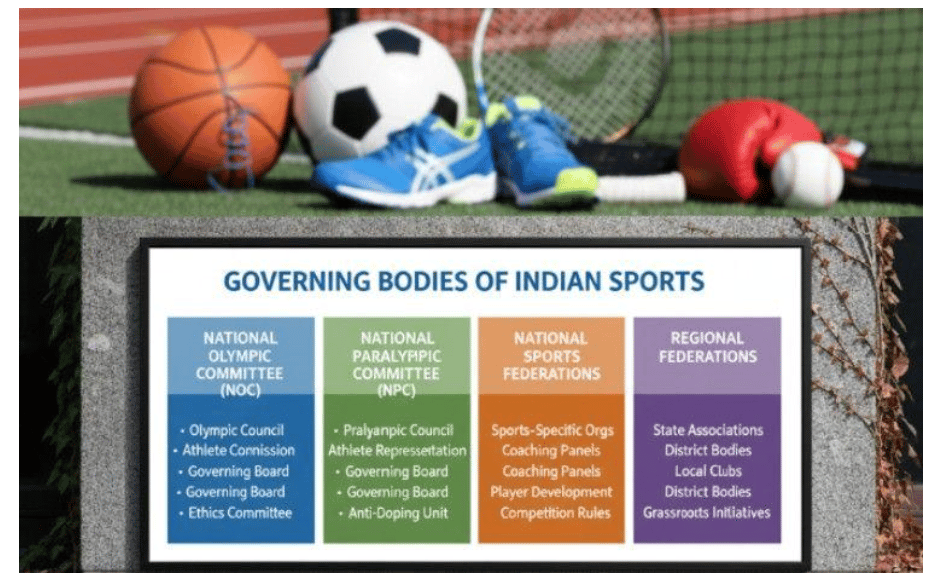
The Union Government notified the National Sports Governance (National Sports Bodies) Rules, 2026 under the National Sports Governance Act, 2025, establishing a statutory framework for transparent and accountable functioning of National Sports Bodies (NSBs) and Regional Sports Federations.
Sports Governance Structure in India
- Ministry of Youth Affairs & Sports (MYAS)- The Ministry of Youth Affairs & Sports (MYAS) functions as the apex policy-making authority for sports in India.
- It formulates national sports policies, recognizes and regulates National Sports Federations (NSFs), and allocates financial assistance. Since sports fall under Entry 33 of the State List, effective implementation requires strong Centre–State coordination.
- Sports Authority of India (SAI)- Established in 1984, the Sports Authority of India (SAI) is responsible for implementing sports development programmes.
- It manages national training centers, sports infrastructure and elite athlete preparation through schemes such as the Target Olympic Podium Scheme (TOPS) and Khelo India.
- Indian Olympic Association (IOA)- The Indian Olympic Association (IOA) is an autonomous body recognized by the International Olympic Committee (IOC).
- It oversees India’s participation in the Olympic Games and other multi-sport international events, and affiliates NSFs governing Olympic disciplines.
- National Sports Federations (NSFs) and State Bodies- More than 50 National Sports Federations regulate individual sports disciplines at the national level.
- At the state level, State Sports Authorities and State Olympic Associations are responsible for grassroots development, talent identification and organization of state-level competitions.
Key Provisions of NSG Act, 2025 and Rules, 2026
- Institutional Structure and Recognition Framework- The Act provides for establishment and recognition of National Olympic Committee, National Paralympic Committee, National and Regional Sports Federations for each designated sport, affiliated with respective international bodies and having state and district-level units.
- The National Sports Board (NSB) grants recognition and registers affiliate units; only recognized bodies are eligible for Central Government funding. Recognized organizations are deemed public authorities under the RTI Act, 2005, ensuring transparency.
- Representation, Inclusion and Ethical Governance- General Bodies of National Sports Federations must include at least four Sportspersons of Outstanding Merit (SOMs), with 50% being women. Executive Committees must include at least four women members.
- SOMs must be minimum 25 years old, retired from active sports for at least one year, and are classified under a 10-tier achievement system prioritizing Olympic and international medalists. Every National Sports Body must adopt a Code of Ethics to ensure minimum standards of professional and ethical conduct.
- Electoral Reforms, Oversight and Disqualification- The Act mandates creation of a National Sports Election Panel to oversee free and fair elections.
- Each National Sports Body must also constitute an electoral panel for its affiliates. Persons convicted by a court and sentenced to imprisonment are disqualified from contesting elections or holding office. Detailed election procedures and timelines are prescribed to ensure transparency and prevent manipulation.
- Dispute Resolution, Compliance and Government Powers- A National Sports Tribunal is established to adjudicate sports-related disputes, except those relating to international competitions or internal disputes of national bodies.
- All National Sports Bodies must amend their constitutions/bye-laws within six months to comply with the Act.
- The Central Government may grant exemptions from specific provisions in public interest for promotion of sport, and appoint NSB members through a search-cum-selection committee, requiring expertise in sports governance, law or public administration.
Chapter 4- Government Initiatives for the Sports
Khelo India Programme
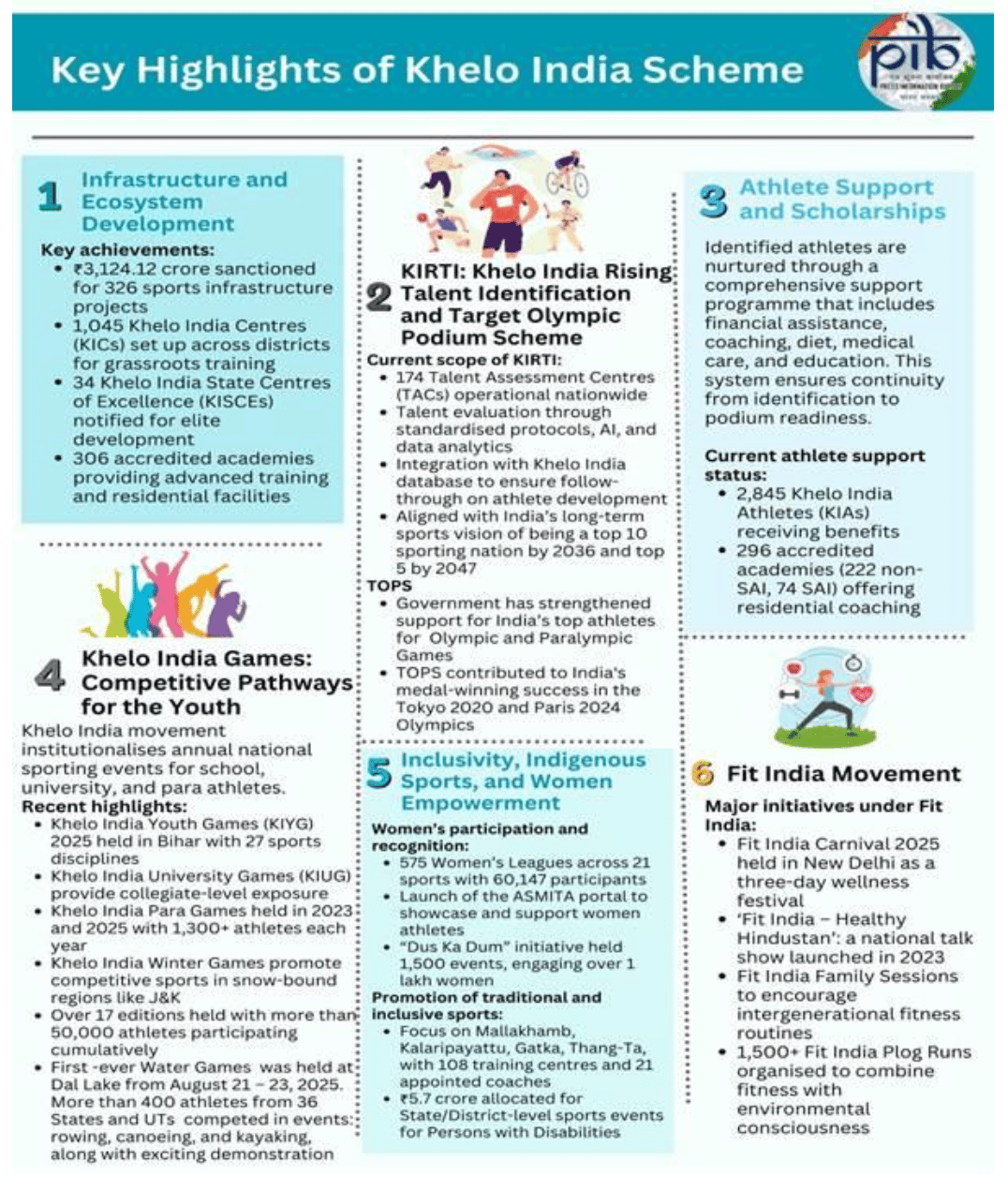
The Khelo India Programme is the flagship scheme for promoting mass participation and grassroots talent development. It received around ₹1,000 crore allocation in FY 2025–26. The scheme provides long-term support to nearly 3,000 Khelo India Athletes (KIAs), each receiving an annual scholarship of about ₹6.28 lakh, including a ₹10,000 monthly out-of-pocket allowance.
- Over 1,045 Khelo India Centres (KICs) and 34 State Centres of Excellence have been established across the country. The programme bridges the gap between rural talent and professional training infrastructure, forming the foundation of India’s emerging international sports performance.
Target Olympic Podium Scheme (TOPS)
Launched in 2014, TOPS provides customised support to India’s top Olympic and Paralympic medal prospects. Funded mainly through the National Sports Development Fund (NSDF), it covers international training, specialised equipment and elite coaching.
Athletes are divided into:
- Core Group – receiving about ₹50,000 per month as out-of-pocket allowance.
- Development Group (junior athletes) – receiving about ₹25,000 per month.
Supporting around 250–350 athletes annually, TOPS has played a key role in improving India’s Olympic medal performance by removing financial barriers for elite athletes.
National Sports Development Fund (NSDF)
- Established in 1998 under the Charitable Endowments Act, 1890, the NSDF mobilises extra-budgetary resources from the government, PSUs, private companies and individuals. The government provides matching grants to donations received.
- The fund is used for customized training of elite athletes and development of specialized sports infrastructure. It promotes a public–private partnership (PPP) model, and there have been recommendations to increase CSR contributions to ensure long-term financial sustainability in sports.
Fit India Movement
Launched in August 2019, the Fit India Movement aims to promote fitness as a lifestyle and address rising non-communicable diseases (NCDs) and obesity. According to NFHS-5, nearly 24% of Indian adults are overweight, highlighting the need for preventive action.
- The initiative promotes behavioral change through mass campaigns, the Fit India Mobile App and community programmes such as “Sundays on Cycle.” Over 23 lakh school children have undergone fitness assessments. The movement links physical activity with preventive healthcare and improved productivity.
Khelo India Rising Talent Identification (KIRTI) Programme
The KIRTI Programme is a technology-driven talent identification initiative targeting children aged 9–18 years. It uses the MyBharat portal, artificial intelligence and data analytics to conduct transparent assessments through Talent Assessment Centres across 11 sports disciplines.
- The programme set a target of conducting 20 lakh physical assessments in FY 2024–25. By scientifically identifying talent at an early stage, KIRTI aims to build a strong athlete pipeline and support India’s goal of becoming a top-10 sporting nation by 2036.
National Sports Awards
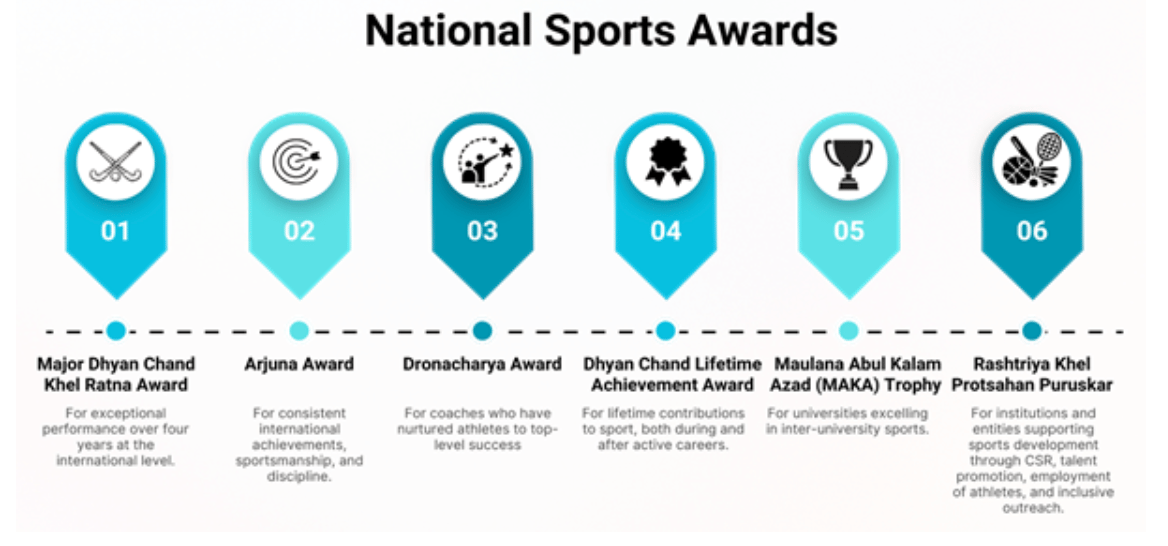
The National Sports Awards are conferred annually by the President of India on National Sports Day (29 August) to recognise excellence in sports. These awards honour sportspersons, coaches and institutions that have made outstanding contributions to Indian sports at national and international levels. They promote merit, inspire youth participation and reinforce excellence in the sports ecosystem.
Pension to Meritorious Sportspersons
This scheme provides financial security to retired international medal-winning athletes. Eligible sportspersons, after retirement and upon attaining 30 years of age, receive a lifelong monthly pension ranging from ₹12,000 to ₹20,000, depending on achievements. The scheme ensures post-retirement dignity and social security for athletes who have represented India.
Pandit Deendayal Upadhyay National Welfare Programme for Sportspersons
This welfare scheme offers financial assistance up to ₹10 lakh to distinguished former athletes facing financial hardship or medical emergencies. Assistance may cover medical treatment, participation in sporting events, or purchase of sports equipment. It serves as a safety net for former athletes who have contributed to national prestige.
National Centre of Sports Sciences and Research (NCSSR)
Launched in 2017, the NCSSR strengthens scientific support for athletes through sports science and medicine. With an allocation of about ₹260 crore up to 2025–26, it includes a central hub and supports six university-based Sports Science Departments and five Sports Medicine Departments in medical institutions. The initiative focuses on injury prevention, rehabilitation, performance enhancement and advanced research, integrating science into athlete preparation.
UPSC Mains Practice Questions-(Around 250 words)
Q1. “Sports governance in India has undergone significant statutory and institutional reforms in recent years.” Discuss the key features of the National Sports Governance Act, 2025 and evaluate how welfare and recognition schemes such as National Sports Awards and pension schemes contribute to strengthening accountability and athlete-centric governance.
Q2. Examine the role of government initiatives such as Khelo India, TOPS, NSDF and NCSSR in creating a comprehensive sports ecosystem in India. How do these schemes address grassroots participation, elite performance and financial sustainability?
QUICK LINKS

 Call
Call