 Gurukul
Kurukshetra December, 2025
The following topics are covered in the Kurukshetra December, 2025:
Chapter 1- Khadi: Innovation, Sustainability and India’s Textile Renaissance
Khadi—India’s iconic hand-spun and handwoven fabric—symbolizes the convergence of heritage, sustainability, and rural livelihoods.
- From its ancient civilizational origins and central role in the freedom struggle to its contemporary revival as a premium, eco-conscious textile, Khadi reflects India’s evolving development narrative.
- In the context of climate change, ethical consumption, and inclusive growth, Khadi has re-emerged as a pillar of sustainable development.
Khadi: Concept and Significance
Khadi (khaddar) is a hand-spun and handwoven fabric made from natural fibres such as cotton, silk, wool, or blends. Originating in eastern and north-eastern regions of the Indian subcontinent, including present-day Bangladesh, Khadi is characterised by:
- Breathability and comfort
- Thermal versatility (cool in summer, warm in winter)
- Extremely low carbon footprint
- Decentralised, village-based production
Beyond being a textile, Khadi generates rural employment, empowers women artisans, and offers a sustainable alternative to resource-intensive fast fashion.
Historical Evolution of Khadi
- Ancient and Medieval Roots- Archaeological findings from Mohenjo-Daro suggest the presence of handwoven textiles resembling Khadi.
- During the Mauryan period, Khadi-like cotton fabrics held economic importance, with Chanakya’s Arthashastra referencing organised textile production.
- Depictions in the Ajanta Caves further establish India’s long tradition of hand-spun and handwoven garments.
- Khadi and the Freedom Movement- Khadi gained modern political significance in 1918, when Mahatma Gandhi launched the Khadi Movement to address rural poverty and resist colonial economic exploitation.
- The charkha became a symbol of Swadeshi, self-reliance, and national resistance, with Khadi embodying Gandhian values of simplicity, discipline, and dignity of labour.
Post-Independence Institutional Support
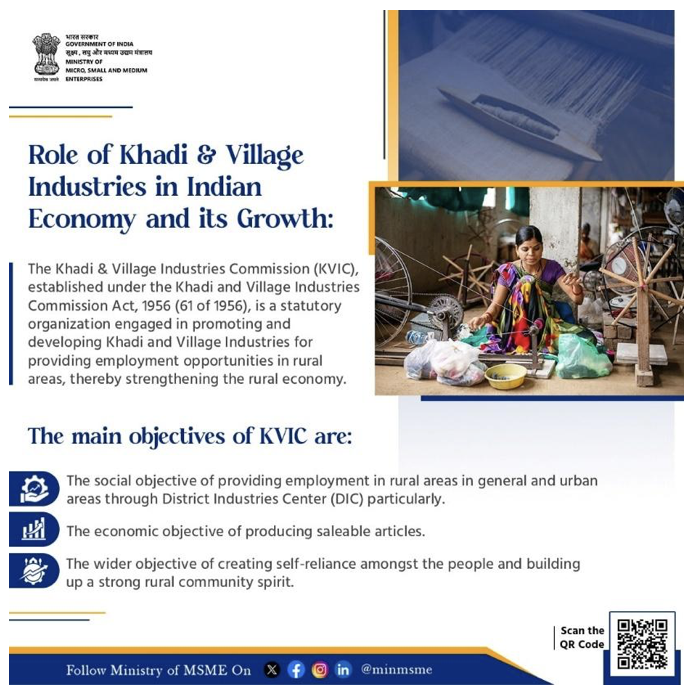
- Post-Independence, the sector was institutionalised through the Khadi and Village Industries Commission (KVIC), 1957. KVIC’s mandate includes:
- Supplying raw materials
- Improving production techniques
- Ensuring quality control
- Marketing and sales promotion
- Generating sustainable rural employment
Despite this, Khadi gradually lost mainstream appeal and became associated with political attire and outdated fashion, remaining largely outside contemporary fashion until the late 1980s.
Designer-Led Revival
- The late 1980s–1990s marked a revival phase. Designers such as Devika Bhojwani (1989) and Ritu Kumar (1990) introduced:
- Innovative textures and dyeing techniques
- Contemporary patterns and silhouettes
- Fashion-forward interpretations
Though initial impact was limited, these efforts repositioned Khadi as a premium, artisanal, and sustainable fabric, aligning it with rising demand for authenticity and eco-conscious fashion.
Material and Technological Innovations
Recent resurgence is driven by material and process innovation:
- Blending with linen, bamboo, hemp, Tencel, and silk to improve durability, drape, and functionality
- Use of low-impact dyes and eco-friendly finishing techniques
Key technological interventions include:
- Improved charkhas and ergonomic looms
- Solar-powered dyeing units
- Pre-processing and quality enhancement tools
These measures reduce drudgery, enhance productivity, and preserve the handmade character while enabling scalability.
Khadi in the Context of Global Fashion and Sustainability
The global fashion industry is valued at approximately USD 1.3 trillion, employs over 300 million people, and is one of the world’s most polluting industries. By 2030, the sector’s:
- Water consumption is expected to rise by 50%
- Carbon emissions by 63%
- Waste generation to 148 million tonnes
India’s apparel market, projected at USD 59.3 billion (2022), is the sixth-largest globally, driven by rapid urbanization, rising incomes, digital retail, and demand for affordable aspirational fashion.
In this context, Khadi offers a compelling alternative:
- Minimal electricity usage
- Extremely low carbon footprint
- Natural fibres and dyes
- Artisan-centric supply chain
Growth of the Khadi Market: Key Data
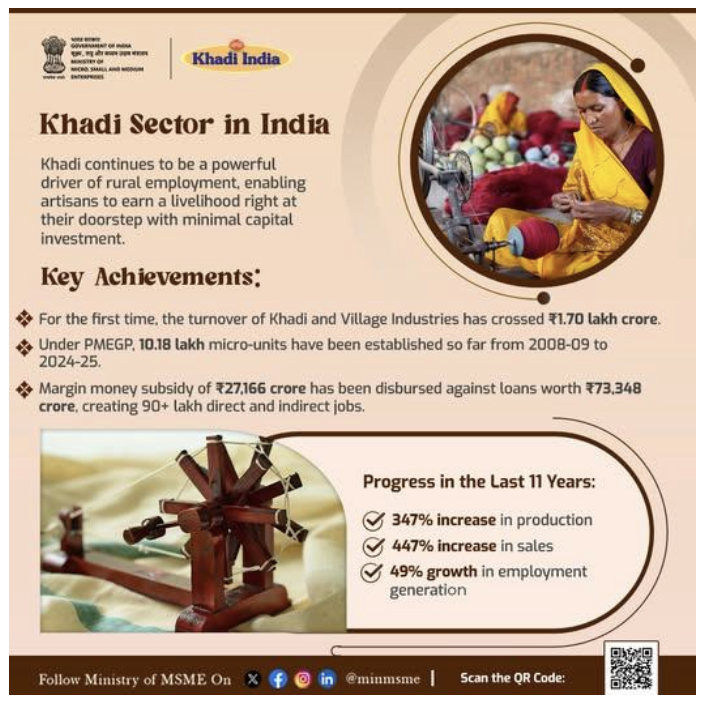
Khadi and Village Industries achieved a historic milestone in 2024–25 with a turnover of Rs. 1.70 lakh crore.
- Production increased from Rs. 26,109.07 crore (2013–14) to Rs. 1,16,599.75 crore (2024–25) – 347% growth
- Sales rose from Rs. 31,154.19 crore to Rs. 1,70,551.37 crore – 447% growth
- Employment increased by 49.23%, supporting 1.94 crore people
- Khadi garment production rose 366% to Rs. 3,783.36 crore
- Khadi garment sales increased six-fold to Rs. 7,145.61 crore
- Khadi Gramodyog Bhavan, New Delhi achieved Rs. 110.01 crore turnover
- PMEGP facilitated over 10 lakh units, generating employment for 90 lakh individuals
Women Empowerment
- 57.45% of 7.43 lakh trainees were women
- Women constitute 80% of Khadi artisans
- Artisan wages increased by 275% in 11 years
Challenges Facing & the Way Forward for Khadi Sector
| Challenges | Way Forward |
|---|---|
| Competition from cheap, machine-made fabrics | Innovation without loss of authenticity |
| High production costs and limited scalability | Design modernization with cultural integrity |
| Inadequate branding, marketing, and infrastructure | Market expansion with artisan welfare at the core |
| Seasonal demand patterns | Alignment with initiatives such as Make in India, Skill India, and Vocal for Local strengthens Khadi’s relevance in India’s development discourse. |
| Rapidly changing fashion preferences | - |
| Global competition and supply chain limitations | - |
Conclusion- Once a symbol of resistance and rural empowerment, Khadi has re-emerged as a pillar of sustainable development, inclusive growth, and cultural identity. Backed by policy support, design innovation, and environmental awareness, it bridges tradition and modernity. With continued reforms and market integration, Khadi can both preserve India’s textile heritage and lead the future of ethical and sustainable fashion.
Chapter 2- Khadi: Strengthening the Rural Economy and India’s Journey towards Self-Reliance
Khadi exemplifies India’s model of grassroots-led, inclusive development. From a symbol of resistance during the freedom struggle, it has evolved into a modern economic driver under Aatmanirbhar Bharat, integrating self-reliance, sustainability, and cultural identity.
The Khadi and Village Industries Commission Act, 1956 defines Khadi as cloth hand-spun and handwoven from cotton, silk, or wool in India.
- Echoing Mahatma Gandhi’s vision, Khadi represents Swaraj, dignity of labour, and freedom from economic dependence. During the freedom movement, household-level Khadi production unified communities and fostered self-reliance.
From Freedom Struggle to Institutional Support
Post-Independence, the Khadi and Village Industries Commission (KVIC) under the Ministry of MSME institutionalised Khadi’s promotion through:
- Skill development and technology transfer
- Raw material and credit support
- R&D and marketing
- Rural and semi-urban employment generation
Khadi sustains a broad value chain beyond spinners and weavers, including suppliers, entrepreneurs, marketers, and logistics providers.
Growth and Economic Impact
Between 2013–14 and 2024–25:
- Production rose from Rs. 811 crore to over Rs. 3,700 crore (≈4.5×)
- Sales increased from Rs. 1,081 crore to over Rs. 7,000 crore (≈6.5×)
- Employment: ~5 lakh artisans, 80% women
As per MSME Annual Report 2024–25, Khadi sales (including polyvastra and solarvastra) reached Rs. 5,352 crore (till Dec 2024), generating 4.99 lakh jobs.
In the North-Eastern Region, FY 2024–25 (till Dec) sales touched Rs. 1,247.93 lakh, with production of Rs. 1,313.89 lakh.
Modernization, Global Reach and Artisan Support
KVIC is modernizing Khadi through 24 retail centers, including India’s first Khadi Mall at Connaught Place (20,000 sq. ft.), which uses AI-based virtual try-ons and records an annual turnover of over Rs. 100 crore.
- Khadi’s global presence has expanded via the 2017 KVIC–Arvind Mills agreement. Patagonia placed orders worth Rs. 1.88 crore, while Khadi trademarks are registered in 15 countries and logos in 31 countries. Exports stood at Rs. 37.88 crore in 2023–24, with markets such as China, Russia and Tanzania, and overseas retail is being explored, including Thailand.
- To strengthen the artisan base, spinning wages increased from Rs. 10 to Rs. 12.50 per hank, weaving wages rose by 7%, and Market Development Assistance offers 35% incentive (cotton, wool, polyvastra) and 30% (silk). Workshed Scheme, ISEC (4% interest) and Rs. 15 lakh support per weak sales centre further improve livelihoods.
- Digital and skill initiatives include eKhadiIndia.com (2021), KIMIS, and the Centre of Excellence for Khadi (CoEK) at NIFT and regional centres, with CoEK 2.0 focusing on design innovation and product diversification.
Protect, Promote and Propel: Three P’s of Khadi
The Ministry of MSME supports Khadi through a comprehensive “3P approach” – Protect, Promote and Propel, aimed at modernising production, strengthening infrastructure, diversifying products, and expanding market access to sustain Khadi’s relevance in an Aatmanirbhar Bharat. Key schemes supporting Khadi include:
- Khadi Gramodyog Vikas Yojana (KGVY): Umbrella scheme comprising Khadi Vikas Yojana (KVY) and Gramodyog Vikas Yojana (GVY); provides budgetary support for Khadi and village industries.
- Modified Market Development Assistance (MMDA): Deregulates Khadi pricing, enabling market-based competitiveness.
- Interest Subsidy Eligibility Certificate (ISEC): Concessional loans for working capital and capital expenditure.
- Workshed Scheme: Financial support for individual and group work sheds to improve productivity and working conditions.
- Khadi Reform and Development Programme (KRDP): Renovation and modernization of Khadi sales outlets to increase incomes and employment for spinners and weavers.
- Prime Minister’s Employment Generation Programme (PMEGP): Promotes self-employment through micro-enterprises for individuals aged 18+, strengthening the rural MSME ecosystem.
- Entrepreneurship and Skill Development Programmes (ESDPs): Capacity-building for youth and artisans; promotion through exhibitions, trade fairs, fashion shows, dedicated outlets, and digital platforms.
- Digital Outreach: eKhadiIndia.com enhances market access by integrating Khadi producers with e-commerce and wider stakeholders.
Conclusion
In today’s Aatmanirbhar Bharat era, Khadi is far more than a fabric—it is a quiet movement of self-respect, self-reliance, sustainability, and inclusive growth. By combining tradition with technology, local livelihoods with global markets, and heritage with innovation, Khadi strengthens India’s rural economy while reinforcing national identity. With sustained policy support, market integration, and citizen participation, Khadi can continue to empower artisans, preserve cultural heritage, and contribute meaningfully to India’s long-term development vision.
Chapter 3- Khadi as a Driver of Sustainable Agriculture
Khadi, rooted in Gandhian ideals of Swadeshi and Gram Swaraj, represents far more than hand-spun fabric. It embodies self-reliance, dignity of labor, sustainable livelihoods, and rural resilience.
- In the contemporary context of Aatmanirbhar Bharat, climate action, and inclusive growth, Khadi has re-emerged as a strategic instrument linking agriculture, cottage industries, sustainability, and rural employment.
Gandhian Philosophy and Rural Self-Reliance
Mahatma Gandhi envisioned Khadi as a means to achieve economic Swaraj, enabling villages to become self-sufficient units of production and consumption.
- Spinning and wearing Khadi symbolized resistance to colonial exploitation while ensuring household-level livelihoods, especially during agricultural off-seasons. This philosophy laid the foundation for Khadi’s role in strengthening rural economies and reducing dependence on external markets.
Institutionalization and Farm-to-Fabric Linkages
Post-Independence, the establishment of the Khadi and Village Industries Commission (KVIC) in 1957 transformed Khadi into a structured rural development instrument. Khadi’s value chain directly links agriculture with cottage industries, sourcing raw materials such as:
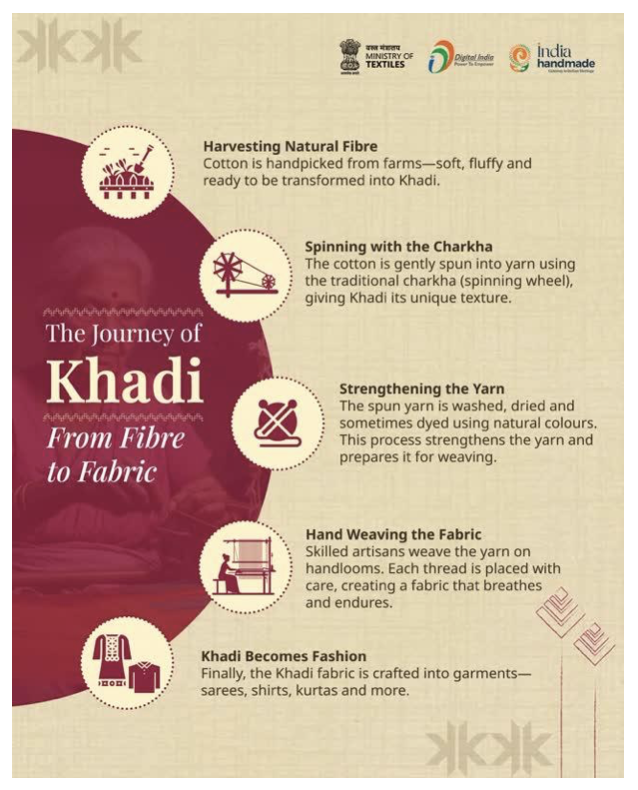
- Cotton from farms
- Silk from sericulture
- Wool from sheep rearing
- Jute from agro-based cultivation
This farm-to-fabric ecosystem generates employment for farmers, spinners, weavers, and allied workers, maximizing local resource utilization and preserving traditional skills.
Khadi–Agriculture Symbiosis and Livelihood Security
Khadi provides income diversification for small and marginal farmers, especially during lean agricultural periods. By offering off-season employment, it enhances livelihood security and reduces vulnerability to climatic shocks and crop failures.
- Women benefit significantly through home-based spinning and weaving, promoting economic independence and social empowerment without requiring large capital or migration.
Economic Contribution and Rural Employment
Khadi and Village Industries have emerged as a major rural economic engine:
- Turnover (FY 2024–25): Rs. 1.70 lakh crore
- Employment: ~1.94 crore people (up from 1.30 crore in 2013–14)
- KVIC turnover (FY 2023–24): Rs. 1.55 lakh crore
- Sales growth: 400% and production growth: 315% since 2013–14
- New jobs created (last decade): 10.17 lakh, reflecting 81% employment growth
By reducing distress migration and strengthening village economies, Khadi contributes to GDP growth, rural industrialization, and the goal of Doubling Farmers’ Income.
Policy Support and Government Initiatives- Khadi’s integration with agriculture and rural livelihoods is reinforced through flagship schemes:
- Honey Mission: Beekeeping for supplementary income and improved pollination
- Kumhar Sashaktikaran Yojana: Electric wheels and training for potters
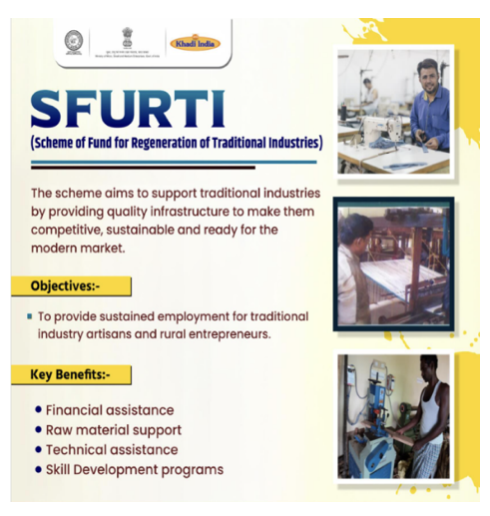
- SFURTI: Cluster-based development for infrastructure, skills, and marketing
- PMEGP: Micro-enterprise promotion for self-employment
- Alignment with Aatmanirbhar Bharat, Make in India, and Vocal for Local
These initiatives position Khadi as a bridge between traditional livelihoods and modern rural entrepreneurship.
Sustainability and Green Economy Role- Khadi supports sustainable agriculture and climate action through:
- Use of organic cotton and natural fibres
- Eco-friendly practices such as natural dyes, minimal water use, and low chemical input
- Hand-spinning and hand-weaving, resulting in negligible carbon emissions
- Minimal electricity dependence, supporting low-carbon and circular economy models
Khadi aligns with India’s Net Zero 2070 commitment and demonstrates how traditional industries can advance green development.
Integration with the Millet Mission (Shree Anna) further strengthens climate-smart livelihoods, as millets require less water, enhance nutrition, and are suitable for dry regions.
Innovation, Digitalization, and Market Expansion- To remain relevant, Khadi has embraced modernization:
- e-Khadi platforms enable direct artisan-to-consumer sales
- Solar Charkha Mission promotes solar-powered spinning
- Design interventions attract youth and urban markets
- Branding through Khadi India and Vocal for Local
- Events such as Khadi Mahotsav and digital outreach enhance visibility
Globally, Khadi is gaining recognition as a sustainable and ethical textile, aligning with international demand for eco-conscious fashion.
Conclusion
Khadi continues to embody simplicity, dignity of labor, and economic independence, while evolving into a symbol of sustainable living and inclusive growth. Deeply intertwined with agriculture, it strengthens rural resilience through local production, employment generation, and environmental stewardship.
As India moves towards Amrit Kaal and India@2047, Khadi can emerge as a flagship of green, inclusive, and self-reliant development, positioning India as a global leader in ethical and sustainable production.
Chapter 4- Khadi: Eco-Friendly Textile and Living Cultural Heritage
Khadi occupies a unique space at the intersection of environmental sustainability, cultural heritage, and rural livelihoods. Long before sustainability became a global concern, Khadi exemplified low-energy production, decentralized craftsmanship, and ethical consumption. Rooted in the freedom movement and Gandhian philosophy, Khadi today stands reimagined as both a climate-smart textile and a living heritage craft, central to India’s inclusive and green development pathway.
Eco-Friendly Production and Climate Relevance
Khadi is among the world’s most environmentally responsible textiles due to its production process:
- Low energy and low carbon footprint: Manual spinning and weaving eliminate dependence on heavy machinery and electricity, unlike mill-made textiles.
- Natural and biodegradable fibres: Cotton, silk, and wool decompose naturally, avoiding microplastic pollution caused by synthetic fabrics.
- Chemical-free and water-efficient dyeing: Use of natural dyes (indigo, herbal dyes) minimises water pollution and toxic discharge.
- Zero-waste craftsmanship: Fabric scraps are reused for accessories, quilts, and paper, reflecting circular economy principles.
In contrast to the fast fashion industry—which contributes nearly 10% of global carbon emissions—Khadi offers a climate-conscious, low-impact alternative, aligning with India’s Net Zero 2070 commitment.
Sustainable Rural Livelihoods and Social Impact
Khadi’s sustainability extends beyond ecology to social and economic dimensions. Its labor-intensive nature generates high employment per unit of investment, especially for rural women, through home-based spinning and weaving. This:
- Reduces distress migration
- Strengthens village economies
- Preserves traditional skills
- Promotes dignified livelihoods
By linking farming with cloth-making, Khadi integrates agriculture, cottage industries, and rural entrepreneurship, making it a cornerstone of inclusive growth.
Institutional Support and Heritage Governance
Post-Independence, the Khadi and Village Industries Commission (KVIC) was established to institutionalise Khadi as a rural development and heritage instrument. Government support recognises Khadi’s dual role—economic and cultural—through schemes such as:
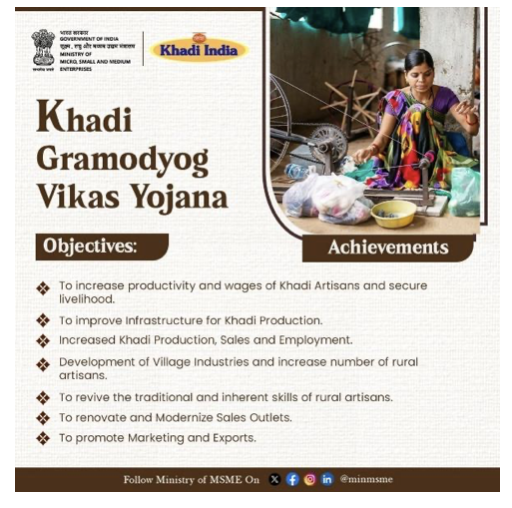
- Khadi Gramodyog Vikas Yojana (KGVY): Support to Khadi institutions, artisan training, and production infrastructure
- SFURTI: Cluster-based regeneration of traditional industries, including Khadi
- Khadi Mark certification: Ensures authenticity and protects heritage value
- State Khadi Boards: Local-level promotion, awareness, and employment generation
- Centre of Excellence for Khadi (CoEK): Design innovation linking heritage craft with contemporary markets
Museums like the National Charkha Museum and branding campaigns further strengthen Khadi’s cultural narrative.
Modernization, Innovation, and Global Appeal
To remain relevant, Khadi is integrating tradition with innovation:
- Solar-powered charkhas reduce drudgery and emissions
- Digital platforms (eKhadiIndia) expand market access
- Designer interventions blend rustic aesthetics with modern silhouettes
- Eco-conscious global fashion increasingly values Khadi’s traceability and ethical origins
Khadi today features in luxury fashion, home décor, and lifestyle products, appealing to global consumers seeking sustainable and slow fashion.
Challenges & Way Forward in Sustainability and Heritage Preservation
| Challenges in Sustainability and Heritage Preservation | Way Forward |
|---|---|
| Ensuring authenticity and quality control amid machine-made imitations | Strengthen heritage-focused clusters under SFURTI |
| Competition from cheaper, mass-produced textiles | Enhance Khadi Mark traceability and certification |
| Skill transmission gaps as youth move away from manual crafts | Expand skill development and youth engagement through apprenticeships |
| Balancing small-scale heritage production with economic viability | Integrate Khadi craft villages into heritage tourism circuits |
| Need for stronger branding, tourism linkage, and infrastructure | Promote global outreach via e-commerce, exports, and fashion collaborations |
| Highlight Khadi’s eco-friendly narrative in climate and sustainability discourse |
Conclusion
Khadi represents a rare convergence of ecology, economy, culture, and ethics. It is not merely a fabric but a living heritage, a sustainable livelihood system, and a philosophy of harmony between nature, craft, and community.
As India advances towards Amrit Kaal and India@2047, Khadi can serve as a flagship of green development, cultural preservation, and self-reliant rural transformation, demonstrating that the solutions to modern challenges often lie in time-tested indigenous wisdom.
UPSC Mains Practice Questions-(Around 250 words)
Q1. Discuss how Khadi reflects Mahatma Gandhi’s ideas of Swadeshi, Gram Swaraj, and dignity of labor. How are these ideas relevant in contemporary India?
Q2. Examine the contribution of Khadi to India’s circular economy and Net Zero 2070 commitments
Essay-Type Questions (1000-1200 words)
- Khadi: Where heritage meets sustainability in India’s development journey.
- From charkha to climate action: Reimagining Khadi for a green and inclusive future.
- Sustainability does not always require innovation; sometimes it requires rediscovery. Examine this statement with reference to Khadi.
QUICK LINKS

 Call
Call