 Residential Course
Kurukshetra August, 2025
The following topics are covered in the Kurukshetra August 2025:
Chapter 1- Agriculture 4.0: Towards Agri-Tech Revolution
Agriculture continues to be the backbone of India’s economy, employing 42.3% of the workforce and contributing 18.2% to GDP.
- Yet, it suffers from low productivity, high climate dependence, small landholdings, post-harvest losses, and volatility in farm incomes.
- With 89.4% of farmers owning <2 ha of land, India’s yields remain 20–60% lower than global averages (e.g., rice yield 3.85 t/ha vs. China’s 6.57 t/ha).
- Agriculture 4.0, driven by digital technologies (AI, IoT, blockchain, drones, big data, robotics), offers a pathway to enhance productivity, ensure food security, and boost farmer incomes.
Idea of Digital Agriculture
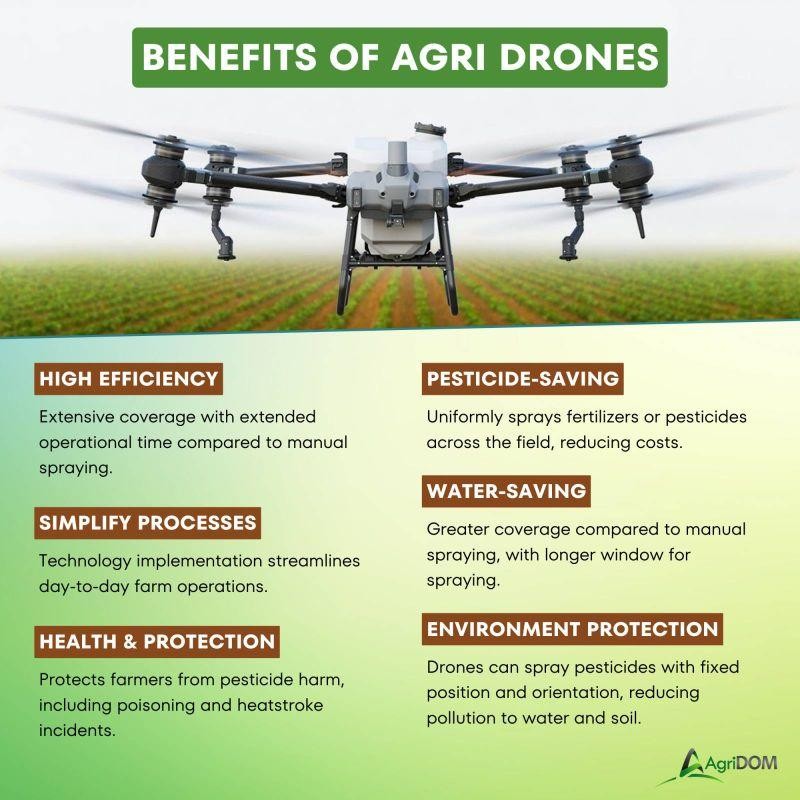
Digital agriculture refers to the use of connected tools, data, and digital platforms to improve productivity, sustainability, and efficiency. It works on two paradigms:
- SmartFarm Digitisation (On-farm technologies):
- IoT soil & crop sensors, drones, automated irrigation, smartphone-based farm management.
- Benefits: precision farming, reduced input use, climate resilience, labour substitution.
- SmartAgriSphere Digitisation (Ecosystem-level technologies):
- Remote sensing, weather forecasting, blockchain-enabled supply chains, digital marketplaces, credit & insurance platforms.
- Benefits: transparency, better market linkages, risk management, and institutional strengthening.
Challenges in Indian Agriculture
- Low productivity: 20–60% lower yields than global peers.
- Climate vulnerability: 52% of farming rainfall-dependent; pest losses may rise 10–25% with each 1°C increase.
- Resource stress: 17% groundwater blocks overexploited.
- Post-harvest losses: 0.9–15.8% depending on crop.
- Labour shortages: 90% of farmers cite labour availability as a challenge.
- Low adoption of technology: Drone use remains far behind countries like China, Japan, S. Korea.
- Digital divide: Weak internet and affordability issues in rural areas.
Opportunities through Agriculture 4.0
- Precision Farming: IoT sensors reduce irrigation needs by up to 50%; drones enable targeted spraying.
- Climate Resilience: Real-time pest/disease monitoring, weather-linked advisories.
- Supply Chain Transparency: Blockchain ensures farm-to-fork traceability, boosting exports.
- Market Linkages: Digital platforms reduce middlemen, ensure fair pricing.
- Livestock & Fisheries Digitisation: Animal health tracking, smart dairies, mapping fishing zones.
- Agri Stack (Comprehensive Agriculture Management System – CAMS): Aadhaar-linked farmer IDs, land records, crop data, credit-insurance linkages, scheme monitoring → ensures evidence-based policy planning.
Government Initiatives
- Digital India programme: broadband to 2.5 lakh villages.
- PM-KISAN, PMFBY, Kisan Credit Cards, Soil Health Cards.
- National e-Governance Plan in Agriculture (NeGPA).
- Support to FPOs & Cooperatives: 8,875 FPOs, 1.01 lakh PACS → UN’s 2025 Year of Cooperatives gives new push.
- ICAR institutes, Agricultural Universities, KVKs: crucial for lab-to-land transfer.
Way Forward
- Strengthen digital infrastructure: high-speed internet, renewable energy-based power supply in rural areas.
- Inclusive adoption: subsidies & affordability for smallholders, special focus on women, tribal farmers, and landless workers.
- Capacity Building: digital literacy, farmer training, skilling of agri-labour.
- Policy & Regulation: clear norms on drones, AI, cybersecurity safeguards.
- Scale-up through cooperatives & FPOs: economies of scale for digital agriculture.
- Public-Private Partnerships: for affordable agri-tech innovations and customised solutions.
Conclusion
Agriculture 4.0 is not just about adopting digital tools—it is about reshaping rural economies, enhancing resilience, and ensuring inclusive growth. By aligning with national missions like Digital India, Atmanirbhar Bharat, and Make in India, India can position itself as a global leader in Agri-Tech. The true measure of success will be when every farmer, irrespective of land size, thrives in the digital age.
Chapter 2- Conservation Agriculture: Practices and Perspectives
Introduction
The Green Revolution of the 1960s transformed Indian agriculture from subsistence to intensive farming, ensuring food security.
- However, it also led to soil degradation, groundwater depletion, air pollution, and unsustainable resource use. To address these concerns, scientists promoted Conservation Agriculture (CA) — a sustainable, resource-efficient, and eco-friendly farming practice.
What is Conservation Agriculture (CA)?
According to FAO, CA is a system of managing agro-ecosystems that ensures:
- Food security,
- Profitability,
- Natural resource conservation.
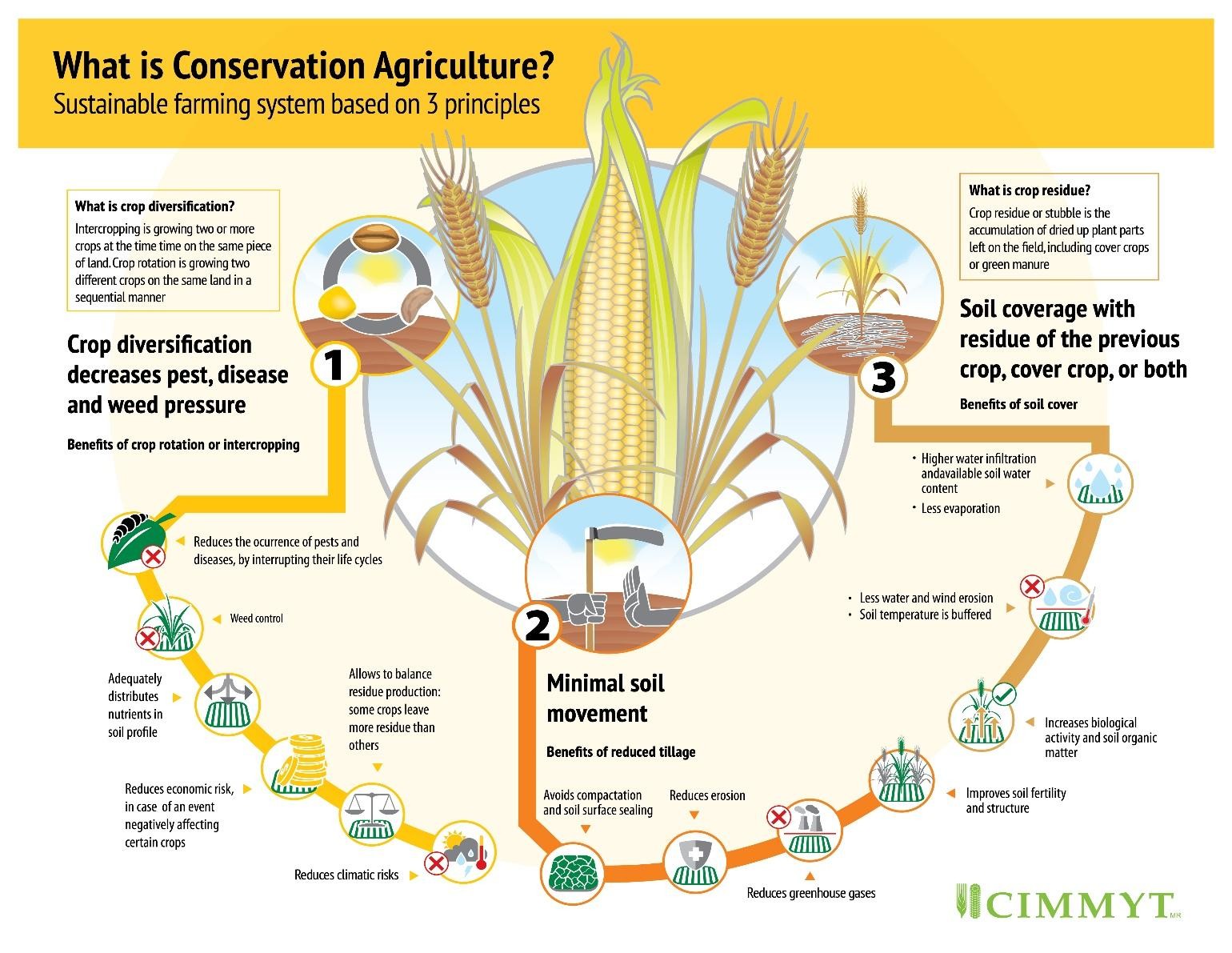
It is based on three core principles:
- Minimal soil disturbance (Zero/Reduced tillage),
- Permanent soil cover (crop residues/mulching),
- Crop diversification (rotations, intercropping).
Significance of CA
- Economic Benefits
- Reduces cost of cultivation by saving fuel, labour, and inputs.
- Enhances farm income through higher yields.
- Zero-tillage saves 60 litres of fuel per hectare and reduces costs by ₹2,000–3,000/ha.
- Environmental Benefits
- Reduces greenhouse gas emissions and enhances carbon sequestration (up to 3,667 kg CO₂ per hectare/year).
- Prevents soil erosion, conserves soil moisture, and improves fertility.
- Avoids stubble burning, thus mitigating air pollution.
- Social Benefits
- Reduces drudgery, particularly for women farmers.
- Improves resilience of small and marginal farmers against climate variability.
Success Story – Zero Tillage in Bihar: In Rajapur village of Buxar, Bihar, farmers achieved 100% adoption of zero-tillage in wheat cultivation, leading to remarkable outcomes.
- Yields rose from 3.5 tonnes per hectare in 2014 to 5.5 tonnes per hectare in 2023, while soil health improved, labour costs declined, and timely sowing ensured better harvests.
- The practice also enhanced food security and reduced emissions, showcasing that Conservation Agriculture (CA) can be a transformative model for Indian farming.
Research, Support and Adoption in India
- Institutional Support:
- ICAR, State Agricultural Universities, and international organisations (CIMMYT, IRRI, BISA, etc.) promoting CA.
- National programs: NICRA, NATP, NAIP.
- Government Schemes:
- Sub-Mission on Agricultural Mechanisation, support for Zero-Till Seed Drills, Happy Seeder, Laser Land Leveller.
- Initiatives like Namo Drone Didi Yojana support women farmers through agri-drones.
- Currently, 2.5–3 million hectares are under CA, practiced by over 7 lakh farmers, mostly in IndoGangetic plains.
Challenges in Adoption
- Technical & Financial Constraints
- High cost and limited availability of zero-till machinery
- Fragmented landholdings restrict large-scale adoption.
- Awareness Issues
- Lack of knowledge about long-term benefits among farmers.
- Social reluctance due to dependence on conventional tillage.
- Policy Gaps
- No dedicated national policy for CA.
- Need for subsidies, mechanisation hubs, and assured crop residue management.
Way Forward
- Strengthening Mechanisation – Establish CA hubs at village level with affordable access to machinery.
- Policy Interventions – Dedicated schemes promoting CA, crop residue management, and carbon credit incentives.
- Capacity Building – Farmer training, field demonstrations, participatory research, and awareness campaigns.
- Scaling Up Practices – Expand CA beyond Indo-Gangetic plains to pulses, oilseeds, and coarse cereals in drylands.
- Climate Resilience – Integrate CA with climate-smart agriculture for long-term sustainability.
Conclusion
Conservation Agriculture offers a sustainable pathway for Indian agriculture by reconciling productivity, profitability, and environmental conservation. With proper policy support, mechanisation, and farmer awareness, CA can enhance farm incomes, ensure food security, reduce emissions, and help India meet its SDG and climate commitments.
Chapter 3- Gene Editing Technology
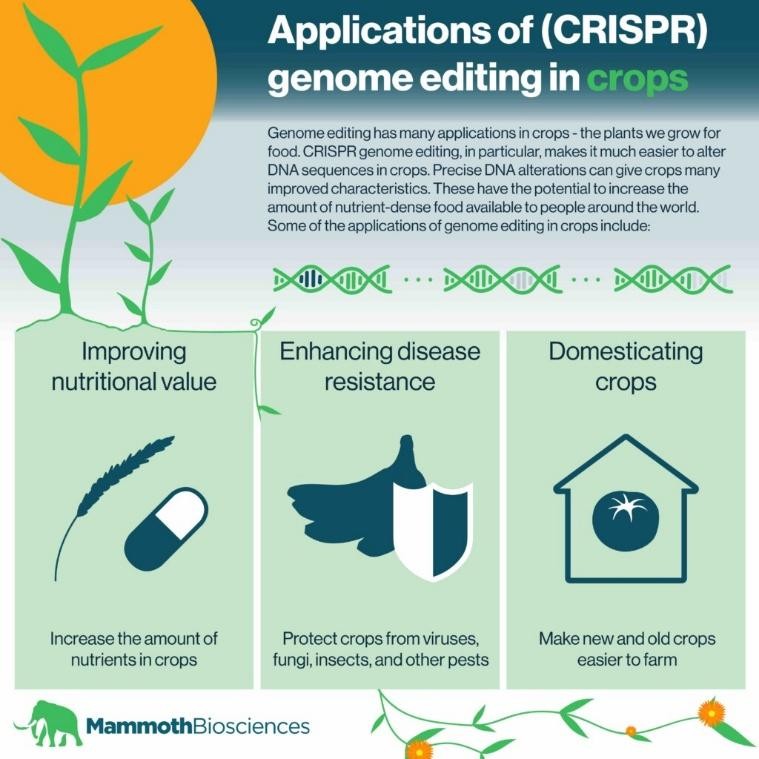
Gene editing is a path-breaking biotechnology that enables precise modification of DNA without introducing foreign genetic material. The most powerful tool, CRISPR-Cas9, discovered by Jennifer Doudna & Emmanuelle Charpentier (Nobel Prize 2020), revolutionized genetic science. In agriculture, it promises higher productivity, nutritional security, climate resilience, and sustainability.
Scientific Basis & Evolution
Gene editing uses Site-Directed Nucleases (SDNs) for targeted deletions, substitutions, or insertions. CRISPR originated from the bacterial immune system (Francis Mojica, 1990s). Recent innovations like the all-in-one CRISPR toolbox (University of Maryland) extend applications across monocots (rice) and dicots (tomato).
Applications in Agriculture
- Productivity & Yield: Rice genes OsAPL and OsSXKk1 edited for higher yield and photosynthesis; Wheat asparagine synthetase knockout reduces carcinogenic acrylamide; Potato gbss gene modified for amylose-free starch with industrial value.
- Nutritional Security: Golden Rice & Golden Maize enriched with Vitamin A; Rice/Wheat OsNAS gene edits increase iron & zinc, reducing anaemia & malnutrition; Soybean with reduced phytic acid for mineral absorption; Japan’s High-GABA Tomato for heart health.
- Biotic & Abiotic Stress: Maize ZmHDT103 and Wheat TaRPK1 for drought tolerance; Rice OSERF922 knockout for blast resistance; Banana DMR gene edit for wilt resistance; Citrus LOB promoter edit against canker. Pest control via CRISPR knockouts in moths & armyworms.
- Climate Change Mitigation: Methane-free cows (AI + CRISPR, conceptual); drought, salinity, floodtolerant crops; enhanced carbon sequestration through improved photosynthesis.
Indian Initiatives
India is a global pioneer in gene-edited crops. In May 2025, ICAR released:
- DRR Rice 100 (Kamla): 20% higher yield, matures 20 days earlier, saves water/fertilizer, lowers methane emissions (9 tonnes/ha).
- Pusa DST Rice 1: Suited to saline/alkaline soils, promises 19% yield increase, 7,500 MCM water savings, 20% lower GHG emissions.
Other initiatives: Delhi University’s low-glucosinolate mustard; SKUAST-Kashmir’s first Indian geneedited sheep (30% higher muscle mass via myostatin gene).
- Government support: ₹500 crore (Budget 2023–24); ICAR working on 24 field crops & 15 horticultural crops; CSIR-NBRI developing edited tomato, cotton, chickpea, Brassica.
- 209 Indian agri-biotech startups, supported by BIRAC and its Biotechnology Ignition Grant (₹50 lakh).
Regulatory Framework
Unlike GM crops (with foreign DNA), gene-edited crops mimic natural mutations. India’s 2022 Guidelines for Safety Assessment of Genome Edited Plants exempt SDN 1 & 2 edits from stringent GM rules under Environment Protection Act.
- Oversight: Institutional Biosafety Committees (IBSCs); Approvals from MoA&FW and FSSAI required. Globally, ~30 countries treat them as equivalent to conventionally bred crops, aiding faster adoption.
Economic & Commercial Potential
- Global Agri-Genomics Market: USD 4.32 bn (2024) → USD 10.32 bn (2035).
- India’s genomics market: USD 2.2 bn (2024, including healthcare).
- Seed industry: USD 3.61 bn (2024) → USD 5.01 bn (2030).
- Global seed market: USD 88.82 bn (2024) → USD 99.94 bn (2030).
- Private players dominate India’s seed sector (65% share). Companies like Bayer, Mahyco, Syngenta, Benson Hill investing heavily. Example: Bayer + G+FLAS (South Korea) developing Vitamin D3- enriched tomato to fight global deficiency (1 billion people affected).
Concerns & Risks
- Scientific: Off-target mutations, unintended traits.
- Environmental: Gene flow into wild relatives, biodiversity loss.
- Ethical: Germline editing, corporate monopolies.
- Socio-economic: Small farmer access, regulatory harmonization.
Way Forward
India must expand ICAR & DBT research into pulses, oilseeds, millets; ensure equitable seed access to smallholders; promote PPP models; strengthen biosafety monitoring; launch awareness campaigns to build trust; and harmonize global standards for trade compatibility.
Conclusion
Gene editing with CRISPR-Cas9 is a revolution in plant genetics, echoing Norman Borlaug’s vision that only genetic advances can meet future food needs. India’s pioneering work in genome-edited rice, mustard, and livestock offers hope for higher yields, better nutrition, resource efficiency, and climate resilience. Balancing innovation with ethics, biosafety, and inclusivity will enable gene editing to become a cornerstone of sustainable agriculture and food security in the 21st century.
Chapter 4- Carbon Farming for Climate-Smart Agriculture
Agriculture, directly linked to multiple Sustainable Development Goals (SDGs), faces compounded challenges from climate change—declining yields, soil erosion, and rising GHG emissions (20% globally, FAO 2020).
- Yet, it holds dual potential: both a major emitter and a carbon sink. Carbon farming, through sequestration practices, can convert farms into net absorbers of CO₂, ensuring food security, resilience, and farmer incomes via carbon credits.
Concept and Potential
Carbon farming involves agricultural practices that enhance soil organic carbon (SOC) and vegetative carbon storage using natural processes like photosynthesis and soil organic matter build-up.
- In India, with 85% smallholder farmers (GoI 2021), it remains underutilised. One carbon credit = 1 tonne CO₂ removal. India’s 170 million hectares of arable land has a potential worth $63 billion, with soils capable of storing 3–8 billion tonnes CO₂ annually for 20–30 years, linking farmers to voluntary carbon markets.
Core Carbon Farming Practices
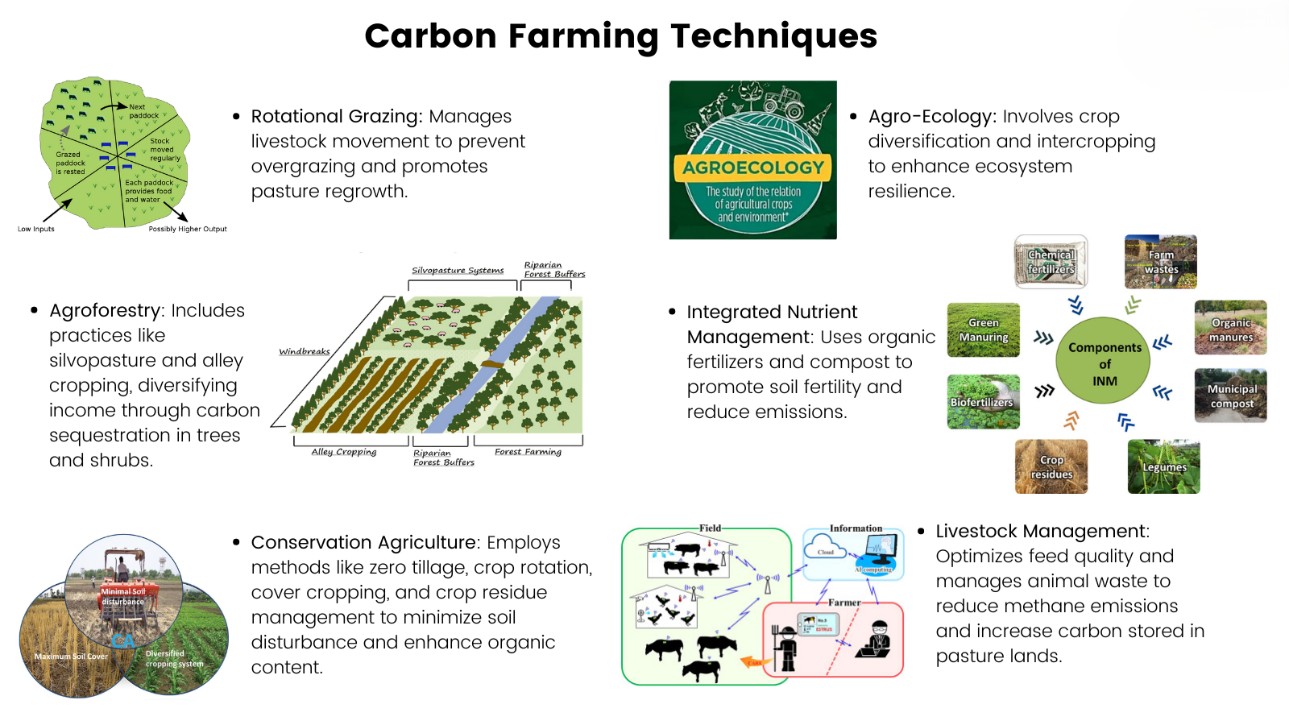
- Forest Management & Agroforestry: Afforestation, reforestation, agroforestry integrate trees into farms, enhancing carbon sequestration, biodiversity, and income diversification.
- Grassland Conservation: Protecting native vegetation avoids carbon losses.
- Reduced Fertiliser Use: Precision farming, controlled-release fertilisers, fertigation cut emissions, lower costs, and improve soil carbon retention.
- Biochar: Long-term carbon sink, improves soil fertility, water retention, and lowers fertiliser needs.
- Reduced/No Tillage: Prevents CO₂ release, conserves soil structure, enhances soil organic matter (SOM).
- Cover Cropping: Prevents erosion, fixes nitrogen, retains moisture, increases SOC (e.g. Dhaincha in rice–wheat systems).
- Crop Rotation & Companion Planting: Enhances soil health, nutrient cycling, pest management.
- 4Rs Nutrient Management: Right time, rate, source, place improves efficiency, lowers emissions.
- Eliminating Bare Fallows: Continuous cover with nitrogen-fixing crops prevents carbon losses.
- Rotational Grazing & Silvopasture: Combines livestock + forestry, boosting sequestration, soil health, and productivity.
- Residue Management: Retaining crop residues as mulch increases soil carbon and fertility.
- Water Management: Efficient irrigation reduces erosion and nutrient loss.
- Digital Tools: Data-driven Decision Support Systems ensure precision in fertiliser, irrigation, and pest control.
Carbon Markets and Incentives
The Carbon Market allows trade of carbon credits (1 credit = 1 tonne CO₂ reduced/removed, UNFCCC 2021). Emerging from the Kyoto Protocol (1997) and strengthened by the Paris Agreement (2015, Article 6.4), it monetises emission reductions. India, with the second-highest CDM projects globally, amended the Energy Conservation Act (2001) in 2022 to establish an Indian Carbon Market. Farmers adopting practices like zero tillage, agroforestry, manure management can earn credits, selling them to industries seeking offsets. This provides new revenue streams while incentivising sustainable agriculture.
Challenges in India
- High costs of CSA technologies (precision farming, improved irrigation).
- Limited awareness and technical knowledge among smallholders.
- Weak infrastructure for MRV (Measuring, Reporting, Verification) of carbon credits.
- Cultural resistance to shifting from traditional methods.
- Voluntary carbon markets lack regulation and transparency.
Way Forward
- Policy Strengthening: Launch a National Carbon Farming Mission, aligning with Soil Health Card Scheme and National Mission on Sustainable Agriculture.
- R&D Investments: Develop low-cost carbon measurement tools, crop-specific sequestration innovations under NICRA.
- Capacity Building: Use KVKs for farmer training, demonstrations, and awareness.
- Market Mechanisms: Develop transparent carbon trading platforms, support Carbon Farmer Producer Organisations (CFPOs) for credit aggregation.
- Monitoring & Accountability: District-level carbon targets, annual reporting aligned with Net Zero 2070.
Conclusion
Carbon farming is a game-changer that transforms agriculture from a GHG emitter to a carbon sink, ensuring climate resilience, farmer incomes, and food security. With robust policies, technological innovation, credible carbon markets, and farmer participation, India can lead a farmer-centric, climate-smart agricultural revolution. As a convergence of sustainability and economics, carbon farming will be pivotal in meeting India’s SDGs and Net Zero commitments, while safeguarding livelihoods for future generations.
Chapter 5-Ploughs to Precision: Digital Revolution in Agriculture
Agriculture has been the backbone of Indian economy for millennia, contributing ~18% of GVA (2023–24) and providing livelihoods to 46% population.
- Sectoral GVA rose from ₹15.02 lakh crore (2011–12) to ₹48.78 lakh crore (2023–24), but its relative share in total GVA declined due to faster growth in industry & services.
- Modernisation via digital technologies—AI, IoT, drones, satellite imagery, blockchain, and mobile apps— marks a shift from subsistence farming → precision farming, enhancing food security, resilience, and rural incomes.
Transition: From Tradition to Technology
- Earlier: Reliance on manual labour, wooden ploughs, monsoon dependency.
- Now: Precision Agriculture using AI, drones, IoT, GPS, and data-driven decision-making.
- Benefits: Real-time crop & soil monitoring, weather forecasting, reduced input waste, increased productivity, resilience against climate risks.
Key Digital Interventions in Agriculture
(a) Precision Farming & IoT
- IoT devices enable real-time monitoring of soil, crop health, water, fertiliser use.
- Improves irrigation scheduling, pest control, fertiliser delivery.
- Reduces waste, costs, environmental runoff.
(b) Artificial Intelligence (AI)
- Analyses satellite data, weather patterns, crop yields.
- Enhances soil health monitoring, pest detection, yield forecasting.
- Example: Microsoft’s AI-based Farm Vibes (Maharashtra) → 40% increase in yields, 50% less water use.
(c) Satellite & Remote Sensing
- Used for large-scale monitoring of soil moisture, pest outbreaks, and drought prediction.
- Govt initiatives: FASAL, Agro-meteorology & ISRO collaborations for accurate crop forecasting.
(d) Digital Marketplaces & e-Governance
- e-NAM (National Agriculture Market): 1.79 crore farmers, 2.67 lakh traders, 1,522 mandis integrated. Ensures fair pricing, reduced middlemen dependence.
- SmartGaon, ONDC, e-Choupal: democratise access to supply chains.
- Private platforms like DeHaat, AgroStar, AgriBazaar link farmers to inputs & buyers.
(e) Blockchain
- Ensures traceability & transparency from farm to fork.
- Builds consumer confidence, reduces post-harvest losses, enables farmers to access premium markets.
(f) Hardware Automation
- Tools: Automated irrigation, drone sprayers, remote-operated transplanters, Nano Ganesh pumps.
- Reduces manual labour, improves efficiency, esp. for small/marginal farmers.
Government Initiatives in Digital Agriculture
- Digital Agriculture Mission (2024): Budget ₹2,817 crore for 2025–26. Focus: AI, drones, IoT, blockchain, farmer registries, geo-tagged village maps, crop-sown registry.
- AgriStack Project: Unified digital database of 11 crore farmers (Aadhaar-linked). Enables access to credit, insurance, subsidies, procurement.
- Kisan Suvidha App (2016): Provides weather, crop prices, input dealers, plant protection advisories. SMS-based m-Kisan service: reached 8.93 crore farmers.
- Common Service Centres (CSCs): 5.6 lakh centres (77% rural) provide soil testing, insurance, agriadvisories.
- Sub-Mission on Agricultural Mechanization (SMAM): Supports Custom Hiring Centres (CHCs) & Farm Machinery Banks (FMBs).
- Women-led Agri-Tech: Namo Drone Didi Scheme (2023) → ₹1,261 crore to train 15,000 women SHGs in drone usage for fertiliser/pesticide spraying.
- Soil Health Card Scheme (2015): Over 24.74 crore cards issued; now GIS & QR code enabled.
Benefits to Farmers
- Productivity: Higher yields with less input.
- Cost Efficiency: Reduced fertiliser, pesticide, and water use.
- Market Access: Transparent prices, reduced middlemen.
- Resilience: Climate adaptation, timely advisories.
- Inclusivity: Women’s empowerment, small farmer participation, rural digital inclusion.
Challenges Ahead
- Digital divide: Poor internet connectivity, low digital literacy in rural areas.
- High cost: Digital tools often unaffordable for smallholders.
- Infrastructure gaps: Limited rural ICT, unreliable power supply.
- Adoption barriers: Trust deficit, privacy concerns, resistance to new tech.
Way Forward
- Invest in rural digital infrastructure (internet, power, storage).
- Localized training in vernacular languages for farmers.
- Strengthen public–private partnerships with agri-startups & FPOs.
- Develop affordable, farmer-centric technologies (low-cost IoT devices, mobile apps).
- Enhance digital inclusion via women SHGs, CSCs, and cooperatives.
Conclusion
Indian agriculture is shifting from age-old traditional practices to data-driven precision farming. Technologies like AI, IoT, drones, blockchain, and digital platforms are making farming more productive, sustainable, and profitable. With flagship programmes such as Digital Agriculture Mission, e-NAM, AgriStack, and Drone Didi, India is laying the foundation for a resilient, climate-smart agricultural ecosystem. Sustained investment, inclusive policies, and farmer empowerment will ensure that the benefits of digital agriculture reach every corner of rural India, securing both food security and rural livelihoods.
UPSC Mains Practice Questions-(Around 250 words)
Q1. Discuss how the integration of Artificial Intelligence, Internet of Things, and Blockchain is transforming Indian agriculture from subsistence farming to precision farming. Highlight the opportunities and challenges in this transition.
Q2. Carbon farming can provide India’s smallholder farmers with additional revenue through carbon credits, but scaling adoption remains a challenge. Critically analyse.
QUICK LINKS

 Call
Call