 Gurukul
Down To Earth (16-31 March 2026)
Human–Wildlife Conflict and Agrarian Distress in India
Context
- Human–wildlife conflict has emerged as a critical yet under-discussed challenge in India's agrarian landscape. The growing distress among farmers demands urgent policy attention and balanced solutions, while conservation discourse often places responsibility on human encroachment.
Extent of the Problem
- A Gokhale Institute report (2025) estimates annual agricultural losses in Maharashtra between ₹10,000–40,000 crore, calling it a gross underestimate.
- 62% of farmers reported reducing cultivated area due to animal attacks.
- A 2021 study (UBC & Centre for Wildlife Studies, India) found farmers in Karnataka lose 1–3 months of income annually, with a single elephant encounter causing up to 20% loss.
- A Kodagu study (2025) revealed nearly 50% of farmers losing ₹90,000 annually, pushing many into debt.
- Himachal Pradesh reports ₹500 crore direct losses, rising to ₹1,500 crore including preventive costs.
- A Western Ghats (Tamil Nadu) study (2026) found 90% of farmers identified wildlife conflict as their primary risk, with 50–60% crop damage.
Causes of Rising Conflict
- Habitat Loss and Fragmentation: Deforestation, infrastructure expansion, and agricultural encroachment have reduced natural habitats, forcing animals into farmlands in search of food.
- Conservation Success: Effective wildlife protection has increased populations of certain species (e.g., elephants, wild boars), intensifying human–animal interactions.
- Changing Cropping Patterns: High-value crops attract animals, increasing vulnerability of farmers.
- Ineffective Population Control: Measures like sterilisation (e.g., for monkeys) have shown limited success.
Socio-Economic Impacts
- Income Loss & Indebtedness: Frequent crop damage leads to unstable incomes and rising debt.
- Reduced Cultivation: Farmers abandon or reduce cropped areas, affecting food security.
- Psychological Stress: Constant threat from wildlife creates fear and uncertainty.
- Inequality: The burden disproportionately affects small and marginal farmers.
Policy and Institutional Response
- Crop Insurance Inclusion: The inclusion of wildlife damage under Pradhan Mantri Fasal Bima Yojana (PMFBY) (2026) is a positive step.
- Farmers must report losses within 72 hours, verified via drones.
- However, implementation challenges remain due to procedural complexity.
- Compensation Mechanisms: Despite schemes, only 1–2% of affected farmers receive adequate compensation.
- Lack of awareness and bureaucratic hurdles limit effectiveness.
- Legal and Governance Challenges: Under Section 62 of the Wildlife Protection Act, only the Centre can declare animals as 'vermin'.
- States like Kerala have attempted legislative workarounds (e.g., wild boar classification), leading to Centre–State tensions.
- Conservation vs Livelihood Debate: Decisions such as granting higher protection to species like rhesus macaques overlook ground realities.
- It creates friction between conservation goals and farmer welfare.
Way Forward
- Landscape-Level Planning: Integrate wildlife corridors, buffer zones, and land-use planning to minimize conflict.
- Community-Based Solutions: Empower local communities in wildlife management and compensation processes.
- Technology Integration: Use drones, AI-based monitoring, and early warning systems to prevent crop damage.
- Rational Wildlife Management: Adopt region-specific population control measures, including scientific culling where necessary.
- Simplified Compensation Systems: Ensure timely, transparent, and adequate compensation through direct benefit transfers.
CO₂ Overload in Human Blood
Context
- A recent study analysing over two decades of US population data suggests that rising atmospheric carbon dioxide (CO₂) may be altering human blood chemistry, raising concerns about long-term physiological impacts.
CO₂ and Human Physiology
- Carbon dioxide in the human body is primarily transported in the form of bicarbonate ions (HCO₃⁻).
- It helps maintain the acid–base balance (pH) of blood.
- Any sustained increase in CO₂ exposure can influence this equilibrium.
- Bicarbonate levels are a key indicator of CO₂ retention in blood, reflecting respiratory and metabolic balance.
Key Findings of the Study
- Researchers analysed US population blood chemistry data (1999–present)
- Found a ~7% increase in serum bicarbonate levels
- Simultaneously observed a decline in calcium and phosphorus levels
- These trends closely mirror atmospheric CO₂ rise from ~369 ppm (2000) to 420+ ppm.
Scientific Basis of the Link
- CO₂ dissolves in blood to form carbonic acid, which converts to bicarbonate;
- Increased CO₂ exposure → higher bicarbonate accumulation;
- It acts as a buffer to maintain blood pH stability;
- Even small increases in ambient CO₂ can influence blood gas balance and bicarbonate concentration trends.
What Do These Changes Indicate?
- Shift in Acid–Base Balance: Rising bicarbonate suggests chronic compensation for elevated CO₂; Indicates subtle but long-term physiological adaptation.
- Decline in Calcium & Phosphorus: May affect bone health and cellular metabolism.
- Electrolyte shifts under varying CO₂ conditions are documented in experimental studies.
- Future Projections: If trends continue, bicarbonate levels may reach upper safe limits within 50 years; mineral imbalance may worsen significantly.
Bad Environment & Good Economics
Context
- The idea that environmental protection and economic growth are opposing goals is increasingly being challenged. Indian judiciary historically pioneered this approach by embedding sustainable development, precautionary principle, and polluter pays principle into environmental jurisprudence.
Understanding Sustainable Development
- Sustainable development implies that development today should not compromise the ability of future generations to meet their needs. Indian courts have interpreted it pragmatically:
- If environmental damage is irreversible or non-compensable, it is not sustainable.
- Economic gains that destroy ecosystems undermine long-term national welfare.
- Indian judiciary has played a key role in balancing competing rights, development vs environment through this doctrine.
Judiciary as Environmental Guardian: Then and Now
- Phase of Judicial Activism: India's Supreme Court once led global environmental jurisprudence by:
- Expanding Article 21 (Right to Life) to include the right to a healthy environment
- Encouraging Public Interest Litigation (PILs)
- Actively monitoring environmental compliance
- It helped institutionalize environmental governance.
Key Issues & Concerns
- Judicial Retreat: Courts increasingly emphasize procedural compliance over ecological outcomes.
- If due process is followed, courts often avoid intervention, even in environmentally harmful projects.
- It marks a departure from earlier jurisprudence where substance prevailed over procedure.
- Procedural Formalism vs Environmental Justice: Courts now ask: 'Was procedure followed?' But the real question should be: 'What is the environmental impact?'
- Excessive proceduralism weakens environmental rule of law.
- Compensatory Afforestation: Planting trees in Haryana/Rajasthan for forests lost in Nicobar/Andaman ignores ecological specificity.
- Ecosystems are location-specific and non-substitutable.
- It reflects a misunderstanding of ecological economics and biodiversity conservation.
- Development Bias in Key Cases:
- Great Nicobar Project: Raises concerns about large-scale deforestation; questions the validity of 'clearances' vs actual sustainability
- Great Indian Bustard Case: Preference for overhead transmission lines despite viable underground alternatives; indicates business interests overriding ecological concerns
- Vantara Case: Raises issues of judicial inconsistency and selective intervention
- Dilution of Eco-Sensitive Zones (ESZs): ESZs are based on scientific assessments; frequent rollbacks indicate weakening environmental safeguards.
Why 'Bad Environment = Bad Economics'
- This statement reflects core economic reasoning:
- Environmental degradation leads to loss of ecosystem services, public health costs, and climate vulnerability.
- Sustainable development ensures long-term productivity, resource security, and intergenerational equity.
- Thus, short-term business gains ≠ long-term economic growth.
Way Forward: Role of Judiciary
- Beyond Procedure: Courts need to evaluate substantive environmental outcomes, not just compliance with formalities.
- Policy Gap Filling: Judiciary can intervene where policy is absent (e.g., Rohtang Pass carrying capacity case); and set interim ecological limits.
- Strengthening Environmental Principles: Reinforce precautionary Principle, Polluter Pays Principle & Public Trust Doctrine.
- These remain central to Indian environmental law.
- Role of Media and Civil Society: Media acts as a watchdog and agenda-setter; sustained reporting ensures accountability and public awareness drives policy correction.
Water Scarcity in Sariska’s Critical Habitat
Context
- Water scarcity, human-wildlife coexistence, and conservation-induced displacement intersect sharply in India's protected areas.
- The case inside the Sariska Tiger Reserve (Rajasthan) highlights issues of basic human rights vs conservation priorities, gendered burden of resource scarcity, pastoral livelihoods under ecological stress, and challenges in relocation policies.
Scarcity at the Core of Conservation Landscapes
- Critical habitats such as Sariska and Ranthambore are semi-arid ecosystems with erratic rainfall, dependent on traditional water systems like johads, and characterised by limited state infrastructure.
- Johads (earthen check dams) store monsoon runoff and have historically sustained rural life. However:
- They are seasonal and unreliable
- Often contaminated due to shared use by wildlife and livestock;
- Despite revival efforts, these systems alone cannot meet rising water demand in protected areas.
Human-Wildlife Interface: Competing for Water
- Water scarcity intensifies resource competition:
- Villagers, livestock, and wildlife depend on the same water points
- Leads to increased encounters with wild animals
- Raises risks of disease transmission and conflict;
- Improving water availability in buffer zones can reduce conflict by spatially separating human and wildlife use.
Everyday Burden: Human Cost
- Gendered Impact: Women spend hours fetching water daily; physical strain leads to chronic health issues; limits participation in education and economic activities.
- Livelihood Stress: Pastoral communities depend on water for livestock; and seasonal drying of sources forces temporary migration.
- Public Health Risks: Use of untreated, contaminated water; and exposure to water-borne diseases.
- Water scarcity in rural India affects over 60,000 villages lacking safe drinking water, reflecting systemic gaps.
- Infrastructure Deficit in Protected Areas: Villages inside critical habitats often lack piped water supply; roads and electricity; healthcare and sanitation.
- It is partly due to restrictions on development within core zones, creating a paradox of areas meant for ecological protection becoming zones of human deprivation.
Relocation: Solution or New Problem?
- Arguments in Favour: Reduces anthropogenic pressure on ecosystems; Enables better wildlife conservation
- Challenges: Inadequate rehabilitation packages; loss of traditional livelihoods and cultural ties; uncertainty regarding land and water access post-relocation;
- Relocation is successful only when basic amenities and livelihood security are ensured
Traditional Knowledge vs Modern Policy
- Community-led water conservation, especially johad revival, has shown success in increased groundwater recharge, improved local water availability, and strengthened community participation.
- However, such efforts require institutional support; and integration with modern water supply schemes.
- Evidence suggests that community-based water governance is more sustainable than top-down interventions.
Governance Challenges
- Fragmented Policy Approach: Conservation and rural development operate in silos.
- Implementation Gaps: Schemes like Jal Jeevan Mission have limited reach in core areas.
- Equity Concerns: Marginal communities face disproportionate hardship.
Way Forward
- Integrated Solutions – Hybrid water systems: Johads + piped supply + filtration
- Decentralised water management in buffer zones
- Wildlife water provisioning to reduce conflict
- Inclusive Conservation: Participatory decision-making in relocation policies; and recognition of community rights and knowledge
- Interim Measures: Mobile health units; safe drinking water access points; and improved rural connectivity.
Conclusion
- Water scarcity in critical habitats exposes a fundamental contradiction in India's conservation model: protecting ecosystems while neglecting the people within them.
- Addressing this requires moving beyond the binary of "relocate or remain" toward a model that ensures ecological sustainability, human dignity, and equitable development.
- Only then can conservation truly be called sustainable.
Rising Pesticide Toxicity
Context
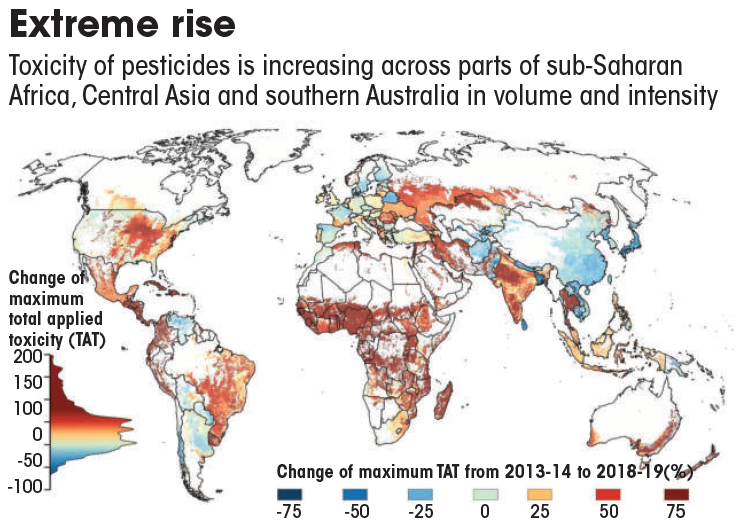
- A recent study published in Science highlights the rising global pesticide toxicity, with India emerging as a major contributor, particularly in the Indo-Gangetic plains.
Key Findings of the Study
- Shift from Volume to Toxicity: Pesticide use is increasing not just in quantity, but also in intensity and toxicity. The study introduces Total Applied Toxicity (TAT):
- Measures pesticide impact by combining volume used + toxicity to species.
- Adopted under CBD COP16 (2025).
- Major Global Contributors: India, China, Brazil, and the USA account for 53–68% of global pesticide toxicity.
- Only Chile is on track to meet the CBD target of halving pesticide risks by 2030.
- Ecological Impact: Despite stable or moderate increases in pesticide volumes, toxicity is rising for key ecological groups i.e. pollinators, aquatic organisms, soil organisms, and terrestrial arthropods (insects).
- Highest increases in terrestrial arthropods (+6.4% annually); and soil organisms (+4.6% annually)
- Toxicity Concentration: Only ~20 highly toxic pesticides contribute to 90% of toxicity burden. Major contributors:
- Neonicotinoids: Pollinator toxicity
- Organophosphates & Pyrethroids: Aquatic and insect toxicity
- Herbicides (Glyphosate, Paraquat, Acetochlor): Plant toxicity
- Fungicides: Soil degradation
India's Pesticide Burden
- Rising Usage: Increased from 57,353 tonnes (2014-15) to 67,221 tonnes (2024-25) (~20% rise).
- Large agricultural area → high cumulative ecological burden.
- Regional Hotspots: Above global average toxicity in Indo-Gangetic plains; Punjab, Haryana, Gujarat, Maharashtra, Telangana, and Karnataka.
- Crop-wise Contribution: Major contributors – rice (staple); cotton (high toxicity despite smaller area); and sugarcane.
Policy and Governance Issues
- Fragmented Legal Framework:
- Pesticide Management Bill, 2025: Focuses on risk minimisation but lacks strong biodiversity safeguards.
- Biological Diversity Act, 2002: Operates separately → policy disconnect
- Key Gaps: No mandatory biodiversity impact assessment. Weak integration between agriculture policy, and biodiversity conservation.
- Expert Recommendations: Adopt TAT framework in policymaking, involve National Biodiversity Authority (NBA) in pesticide regulation, and make biodiversity assessment mandatory for registration, renewal, and phase-out decisions.
Way Forward
- Systemic Agricultural Transformation Needed
- Integrated Pest Management (IPM)
- Biological alternatives
- Precision agriculture technologies
- Farmer awareness and training
- Stronger regulatory frameworks
Himalayan Fire Shift
Context
- Recent satellite-based evidence indicates a systematic upward shift of forest fires in the Himalayas, driven by climate change, altered precipitation patterns, and large-scale climatic oscillations like El Niño.
Changing Geography of Fires
- Forest fires in the Himalayas are no longer restricted to lower elevations. Historically, fires were concentrated below 2,000 m, where temperatures are higher and human activity is greater.
- Recent satellite observations show fires shifting upward to 2,000–4,000 m.
- In the western Himalayas, fire incidents quadrupled over a decade at elevations above 2,500 m.
- Similar upward trends have been observed across the Himalayan arc since the early 2000s.
Intensification and Scale
- Fire frequency and intensity are increasing alongside spatial expansion.
- Burned area has increased significantly:
- Western Himalayas: +73 sq km (2001–2019)
- Eastern Himalayas: ~3,100 sq km annual average burn area
- High-altitude fires tend to be high-energy events, due to accumulated dry biomass, limited fire management, and difficult terrain restricting suppression efforts.
Climatic Drivers
- El Niño Influence: Peak fire years often coincide with El Niño events, which bring hotter and drier conditions.
- Strong correlation between fire intensity and ENSO cycles.
- Warming Himalayas: Himalayas are warming faster than the Indian average. It leads to drying of forest fuels, and upward shift of vegetation zones.
- Decline in Snowfall & Western Disturbances: Reduced winter snowfall increased combustibility; and western disturbances shifted seasonally, producing less snow.
- Changing Rainfall Patterns: Rainfall concentrated in monsoon months; longer dry periods before monsoon (extended fire season); and delayed monsoon further intensifies fire risk.
Ecological Consequences
- Vegetation Shift: Fire-sensitive species (oak, rhododendron) declining; fire-tolerant species (chir pine, lantana) expanding; and transition from dense forests to open woodlands.
- Soil Degradation: Loss of nutrients and moisture, increased acidity, and higher erosion rates.
- Increased Landslide Risk: Vegetation loss destabilizes slopes, and leads to landslides during monsoon.
- Cryosphere Impact: Black carbon deposition on glaciers (e.g., Gangotri); and reduced albedo & accelerated glacier melt.
Atmospheric and Environmental Impact
- Annual emissions (2001–2020 average) 40.81 Tg CO₂ & 2.52 Tg CO.
- Other pollutants: methane, NOx, SO₂, particulate matter
Way Forward
- Preventive Forest Management: Fuel load reduction (pine needles, dry biomass); and creation of fire lines and breaks.
- Use of Technology: Satellite monitoring for early warning; and GIS-based fire risk mapping.
- Community Participation: Strengthen Van Panchayat system; and integrate indigenous knowledge.
- Climate-Sensitive Policies: Incorporate fire risk into climate adaptation strategies; and improve forest governance in Himalayan states.
India’s Renewable Energy: Powering Transition
Context
- India's renewable energy (RE) transition is accelerating, positioning the power sector as a key driver of emissions reduction. Recent evidence suggests that state-level policies, technological adoption, and grid management determine the success of this transition.
India's Renewable Energy Transition: Key Trends
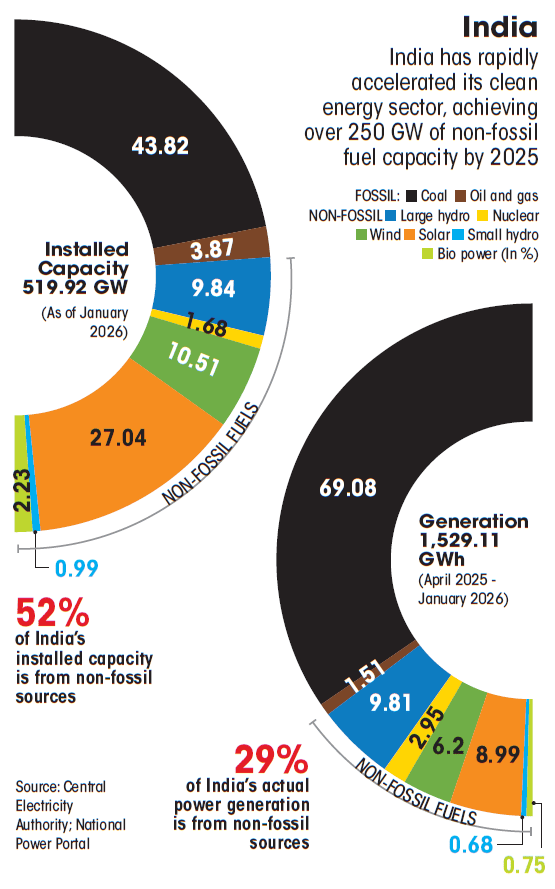
- India crossed 250 GW of non-fossil fuel capacity by 2025, with a target of 500 GW by 2030.
- The country ranks 3rd in solar and 4th in wind globally.
- The power sector recorded a decline in emissions in 2025, driven by renewable expansion rather than economic slowdown.
- However, a capacity–generation gap persists due to intermittency and grid constraints.
- Renewable expansion alone is insufficient; grid integration, storage, and policy design are equally critical for meaningful decarbonisation.
Key Challenges in India's RE Transition
- Capacity vs Generation Gap: High installed capacity does not translate into equivalent generation due to intermittency of solar and wind.
- Grid Integration Issues: Transmission bottlenecks and variability management remain critical constraints.
- Storage Deficit: Limited battery and pumped storage infrastructure affects reliability.
- Financial Stress: DISCOM losses hinder renewable energy procurement and payments.
- Regional Imbalances: RE growth concentrated in a few states (e.g., Karnataka, Tamil Nadu, Gujarat).
- System flexibility, storage, and regional balancing are essential for scaling renewables effectively.
Lessons for India
- Policy and Governance: Stable policies and regulatory certainty are crucial.
- Technology Adoption: Early investment in emerging technologies (e.g., offshore wind, storage).
- Grid Modernisation: Smart grids and transmission expansion to integrate variable RE.
- Decentralised Energy Systems: Rooftop solar and localised generation to reduce grid pressure.
- Cooperative Federalism: State-level innovations must be scaled nationally.
Way Forward
- Energy Storage Mission: Scale battery and pumped hydro storage.
- Green Hydrogen Integration: Use excess RE for hydrogen production.
- Market Reforms: Strengthen power markets and pricing mechanisms.
- Just Transition: Address socio-economic impacts of coal phase-down.
Universities in Crisis
Context
- India's higher education system indicates a structural mismatch between policy intent and innovation outcomes. While patent filings have increased significantly, studies consistently show that quantity does not translate into quality innovation.
'Robodog' Episode: A Symptom, Not an Exception
- The controversy surrounding a private university presenting a foreign-made robotic dog as indigenous innovation highlights a deeper malaise.
- It reflects a culture of exaggerated claims driven by pressure to demonstrate innovation.
- In a globally connected academic environment, such misrepresentation undermines credibility and trust.
- The incident is not isolated but symptomatic of metric-driven academic behaviour.
Patent Boom vs Real Innovation
- Rising Numbers: India has witnessed a sharp rise in patent filings, reaching global top ranks.
- Universities have contributed significantly to this surge.
- Core Problem: Academic literature distinguishes between patents filed (inputs); and patents granted (validated outputs).
- Many Indian universities file patents without substantive innovation, resulting in low grant rates (Sattiraju et al., 2023).
- Evidence from Academia: Private universities: High filings, extremely low grant rates
- IITs/NITs: Fewer filings, higher approval ratios
- It suggests a shift from knowledge creation to metric accumulation.
Policy Distortions: Incentivising Quantity Over Quality
- Ranking Systems and Perverse Incentives: Frameworks like NIRF and NAAC reward patent filings, not outcomes. It creates incentives for mass filing of low-quality patents; and financial investment in paperwork rather than research.
- Such policies distort academic priorities and weaken genuine innovation ecosystems.
- NEP 2020 and Structural Challenges: Research indicates implementation gaps i.e. weak faculty capacity, insufficient research funding, and administrative centralisation.
- Political and Ideological Interference: Increasing control over appointments, and curriculum design.
- Introduction of Indian Knowledge Systems (IKS) raises concerns when scientific rigour is diluted; and pseudoscientific ideas enter formal curricula
Declining Research Ecosystem
- Key Issues Identified in Literature: Weak research culture in universities; limited industry-academia collaboration; and overemphasis on outputs like patents and rankings.
- Only a small fraction of Indian universities actively engage in meaningful research and patenting.
- Innovation Without Foundations: Reforms without ecosystem strengthening may not yield meaningful innovation outcomes.
Way Forward
- Institutional Reforms: Shift focus from patents filed → patents granted and impact. Reform ranking systems to include research quality, citations and real-world applications.
- Strengthening Academic Ecosystem: Enhance faculty quality and autonomy, and increase research funding and infrastructure.
- Safeguarding Scientific Temper: Ensure clear distinction between traditional knowledge and scientific validation, and prevent politicisation of curriculum.
- Promoting Genuine Innovation: Foster industry-academia collaboration, and encourage problem-solving research over symbolic outputs.
RBI’s DLGS Reset: Boosting Credit for Last-Mile Electric Mobility
Context
- The Reserve Bank of India (RBI) has restored the recognition of Default Loss Guarantees (DLGs) for NBFCs, reversing earlier restrictions. It is expected to revive credit flow, especially in financing electric two and three wheelers.
Understanding Default Loss Guarantee (DLG)
- DLG is a risk-sharing mechanism between NBFCs and fintech companies:
- Fintechs source borrowers (often underserved)
- NBFCs provide loans
- Fintechs absorb up to 5% of loan losses in case of default
- It enables lending to borrowers with thin credit histories, such as gig workers, delivery agents, small fleet operators, and micro-entrepreneurs.
- Fintech-NBFC collaborations have significantly improved financial inclusion and credit access for informal sectors.
Importance for Electric Mobility
- Electric two- and three-wheelers dominate last-mile transport;
- Buyers often lack formal credit histories;
- DLG reduces perceived lending risk;
- Digital microfinance and fintech-led credit models are critical for EV adoption in emerging markets.
- Thus, DLGs play a hidden but crucial role in India's EV transition.
RBI's Earlier Restrictions
- DLG cap fixed at 5% (2023) & DLGs excluded from provisioning calculations (2025)
- Rationale:
- Prevent misuse of DLGs to understate credit risk
- Ensure NBFCs retain 'skin in the game'
- Address rising unsecured lending risks via fintech channels
- Concerns over regulatory arbitrage and excessive risk transfer to fintechs.
RBI's 2026 Recalibration
- What Changed? RBI restored DLG recognition with safeguards:
- DLG needs to be integral to loan structure;
- Cannot overstate risk protection;
- NBFCs must update loss estimates dynamically;
- 5% cap retained;
Expected Outcomes
- Improved Credit Flow: Reduced capital burden on NBFCs; increased lending capacity.
- Boost to EV Financing: Easier loans for last-mile mobility users, and supports India's clean energy transition.
- Strengthened Fintech-NBFC Partnerships: Greater regulatory clarity, and focus on better underwriting and compliance.
- Balanced Regulation: Combines risk control & innovation support.
- Well-regulated credit guarantees enhance financial stability without stifling inclusion.
Conclusion
- RBI's evolving stance, from permitting to restricting and now recalibrating DLGs, reflects a maturing regulatory framework.
- The central bank strikes a balance between financial stability and inclusion, by restoring DLG recognition with safeguards.
- For India's electric mobility transition, this decision is significant.
- Credit access determines adoption, especially for underserved users powering last-mile connectivity, while technology (battery, charging) drives innovation.
Great Fragmentation: A New Era of Global Disorder
Context
- The global order is undergoing a structural transformation marked by rising conflicts, weakening multilateralism, and shifting power dynamics. The Institute for Economics and Peace (IEP) terms this phase as 'The Great Fragmentation.'
Rising Conflicts and Declining Peace
- Around 35 countries are currently experiencing conflict, with violence surpassing natural disasters in causing deaths and displacement.
- The world has seen a decline in peacefulness in 13 of the last 17 years.
- The term 'World War' trending in global searches reflects growing public anxiety.
- Conflicts today are more prolonged and internationalised, with a 175% rise in external involvement in civil wars since 2010.
- It signals a shift from localized wars to complex, multi-actor conflicts.
From Globalisation to Fragmentation
- Post-Cold War Phase (1991–2008): Characterised by globalisation, free trade, and liberalisation.
- Expansion of multilateral institutions (WTO, UN frameworks).
- Post-2008 Financial Crisis Phase: Beginning of economic nationalism and protectionism.
- Rise in tariffs, export bans, and capital controls.
- 'The Great Fragmentation' (Current Phase): Decline of multilateralism; emergence of 'minilateral' groupings (QUAD, AUKUS, I2U2); and increasing geopolitical risk surpassing Cold War levels.
Changing Power Dynamics
- Decline of US and China's unilateral influence since 2015.
- Rise of middle powers (India, Turkey, Brazil, Saudi Arabia).
- Increased competition in the Global South through aid, investments, and security partnerships.
- It has intensified proxy conflicts and strategic rivalries.
Militarisation and Decline of Peace Mechanisms
- Peace agreements have sharply declined:
- 1970s: ~23% conflicts ended in agreements
- 2010s: ~4%
- Military expenditure rising continuously since 1991: Sharp increase post Russia–Ukraine war (2022)
- Indicates preference for military solutions over diplomacy.
Developmental Consequences
- Resource Diversion: Increased military spending to reduce funding for education, healthcare, and climate action.
- Impact on SDGs: Conflict-affected countries show poor SDG progress; and development setbacks can last decades or generations.
- Disproportionate Impact on Developing Nations: Wars impose higher economic and social costs on poorer countries.
- These lead to poverty traps, institutional weakening, and migration crises.
Way Forward
- Revitalising multilateral institutions (UN reforms, WTO strengthening)
- Promoting diplomacy over militarisation
- Strengthening Global South cooperation
- Balancing security with development priorities
- Investing in conflict prevention and peacebuilding
Great Nicobar Project: Development vs Constitutional Environmentalism
Context
- The National Green Tribunal's (NGT) recent decision to uphold environmental clearances for the Great Nicobar Island project marks a critical juncture in India's development trajectory.
- It raises a deeper constitutional question: can development in fragile ecosystems proceed without establishing ecological and anthropological limits?
Ecological Significance of Great Nicobar
- Great Nicobar is among India's most ecologically unique and sensitive regions, characterized by high endemism and fragile island ecology.
- Key Biodiversity Features:
- Critical nesting ground for leatherback sea turtles
- Habitat for endemic species like Nicobar megapode, Nicobar long-tailed macaque, presence of apex predator: saltwater crocodile, and rich mangrove, coastal, and rainforest ecosystems.
- Island ecosystems have limited resilience and dispersal capacity, making them highly vulnerable to disturbances.
Indigenous Communities and Cultural Fragility
- Home to Shompen (PVTG) and Nicobarese communities;
- Deep dependence on forests and coastal ecosystems;
- Small population size & high demographic vulnerability;
- Rapid external contact often leads to disease, displacement, and cultural erosion in isolated tribes.
Limitations of the NGT's Approach
- Procedural vs Substantive Scrutiny: The NGT primarily focused on regulatory compliance, environmental clearances, and expert consultations.
- However, Indian environmental jurisprudence requires substantive evaluation, not mere procedural adequacy.
Constitutional and Legal Principles Involved
- Precautionary Principle: Burden of proof lies on the developer in case of potential harm (Vellore Citizens' Welfare Forum v. Union of India, 1996)
- Sustainable Development: Balance between development and environment (Narmada Bachao Andolan v. Union of India, 2000)
- Intergenerational Equity: Protect resources for future generations (Goa Foundation v. Union of India, 2014)
- Article 21 (Right to Life): Includes right to a healthy environment and dignified life.
- Public Trust Doctrine: State acts as trustee of natural resources.
Ecological Risks of the Project
- Impact on Marine Life: Artificial lighting disrupts turtle nesting; and shipping and dredging affect marine ecosystems.
- Habitat Fragmentation: Threat to Nicobar megapode breeding patterns; and disturbance to forest-dependent species.
- Mangrove Degradation: Impacts coastal stability and crocodile habitats, and increases vulnerability to natural disasters.
- Seismic Vulnerability: Located in a high seismic zone; 2004 tsunami altered island geomorphology.
Cumulative Impact Concerns
- Environmental Impact Assessments (EIAs) often assess projects in isolation and ignore cumulative ecological footprint.
- However, research stresses that integrated assessments are essential in island ecosystems, where multiple stressors can trigger irreversible damage.
Socio-Anthropological Risks
- Demographic Pressures: Influx of population for economic activity; and risk of marginalizing indigenous communities.
- Indirect Impacts: Road construction, labour camps, resource extraction; and cultural disruption without formal displacement
- Consent and Rights: Questions over Free, Prior, and Informed Consent (FPIC); and tribal reserves overlap with project areas.
Need for a Holistic Approach
- Cumulative Impact Assessment: Integrate ecology, seismic risks, hydrology, and anthropology.
- Survival Safeguards for PVTGs: Beyond mitigation, ensure cultural continuity.
- Redesigning Development: Infrastructure must align with ecological thresholds.
Sabai Grass (Eulaliopsis Binata)
Context
- Research across eastern India consistently highlights that weak market linkages and poor institutional support limit its full economic potential of Sabai grass.
About Sabai Grass (Eulaliopsis Binata)
- Non-Timber Forest Produce (NTFP)-based livelihoods
- Climate-resilient agriculture in drylands
- Inclusive rural development (tribal economy focus)
- Value chain inefficiencies and market reforms
Ecological Advantage
- Sabai grass thrives in the lateritic uplands of western West Bengal, regions marked by poor soil fertility, erratic rainfall, and limited irrigation.
- It requires minimal inputs and labour, is drought-resistant and long-lasting (productive up to 15–17 years), and grows well on degraded and marginal lands.
- These grasses are ideal for climate-resilient agriculture and land restoration, particularly in fragile ecosystems.
Green Heating Law: Germany
Context
- Recently, Germany announced to scrap the 'green heating law' introduced in 2024, to decarbonise the building sector.
About Green Heating Law
- The law mandated that all new heating systems must run on at least 65% renewable energy.
- It was embedded within Germany's Building Energy Act (GEG) aimed at reducing fossil fuel dependence.
- The policy aligned with EU climate targets and Germany's goal of achieving carbon neutrality by 2045.
- Germany is a key player in the EU's energy transition (Energiewende).
Why Was the Law Criticised?
- High Financial Burden: Households faced high upfront costs for installing renewable heating systems.
- Transition disproportionately affected low- and middle-income groups.
- Implementation Challenges: Lack of infrastructure such as district heating networks and skilled workforce.
- Policy uncertainty created hesitation among homeowners.
- Political Opposition: The law became politically contentious, with debates focusing on social justice and energy affordability.
Implications for Germany and the EU
- Risk of Climate Commitment: The building sector is crucial for emission reduction.
- Weakening regulations may slow down decarbonisation efforts.
- Shift Towards Flexible Policy: Germany may adopt incentive-based approaches instead of strict mandates.
- Could include subsidies, carbon pricing, and phased targets.
- Political Economy of Energy Transition: Highlights the tension between environmental goals, economic feasibility, and public acceptance.
Oleum Gas Leak in Palghar
Context
- Recently, a hazardous oleum gas leak occurred at a chemical unit in Palghar district, Maharashtra, affected population was located within a 3–4 km radius of the site.
About Oleum
- Chemical Nature: Oleum is a solution of sulfur trioxide (SO₃) in sulfuric acid (H₂SO₄); Fuming sulfuric acid
- Uses: Widely used in chemical manufacturing, especially in dyes, explosives, and petroleum refining.
- Risks: Highly reactive with water, releasing heat and toxic fumes.
Health and Environmental Impact
- Eye irritation; Breathing difficulties; General discomfort due to toxic fumes
- Highly corrosive and toxic substance, and its release into the atmosphere can
- React with moisture to form sulfuric acid mist
- Cause respiratory distress and skin damage
- Lead to localized environmental contamination
Relevant Legal & Institutional Frameworks
- Environment (Protection) Act, 1986
- Manufacture, Storage and Import of Hazardous Chemicals Rules, 1989
- National Disaster Management Authority (NDMA) guidelines
Fishing Cats (Prionailurus Viverrinus)
Context
- The first scientific assessment of fishing cats (Prionailurus viverrinus) in Assam's Kaziranga National Park and Tiger Reserve revealed at least 57 individuals across 450 sq km of wetlands.
About Fishing Cat (Prionailurus Viverrinus)
- Family: Felidae (small wild cats)
- Distribution: South and Southeast Asia, especially India, Nepal, Bangladesh, Sri Lanka
- Obligate wetland species: strongly dependent on marshes, swamps, mangroves, and floodplains
- Found in riverine ecosystems like Brahmaputra floodplains (Kaziranga)
- Presence indicates healthy wetland ecosystems
Conservation Status
- IUCN Red List: Vulnerable (VU)
- Wildlife Protection Act, 1972: Schedule I (Highest level of legal protection; Same category as tiger and elephant)
Subjective Questions
- Human–wildlife conflict in India is increasingly becoming an agrarian crisis rather than merely an ecological issue. Discuss the causes, consequences, and suggest a balanced policy framework to address both conservation and livelihood concerns.
- Examine the relationship between environmental sustainability and economic development. How can policy frameworks reconcile the apparent conflict between 'bad environment' and 'good economics'?
- Discuss the factors driving increased pesticide toxicity in India. Examine its impacts on biodiversity and public health, and suggest sustainable alternatives for pest management.
QUICK LINKS

 Call
Call