 Residential Course
Down To Earth (16-30 September, 2025)
The following topics are covered in the Down To Earth (16-30 September, 2025):
Extremely Heavy Rains in North India
Context
- According to the India Meteorological Department (IMD), rainfall in North India, from Punjab to Himachal Pradesh, and deep into the valleys of Jammu and Kashmir, crossed the threshold of ‘extremely heavy’.
Unprecedented Rainfall Patterns
- According to the India Meteorological Department (IMD), August saw 24 out of 31 days of heavy to extremely heavy rainfall in Punjab alone.
- Heavy rainfall: more than 115 mm in 24 hours;
- Extremely heavy rainfall: more than 204 mm in 24 hours;
- Himachal Pradesh endured record-breaking rain for more than 90% of the days in the past three months, while Jammu and Kashmir also faced relentless downpours.
- Between June and August, Punjab, Himachal Pradesh, and Jammu and Kashmir saw nearly 50% excess rainfall.
- At times, weekly rainfall exceeded normal averages by 300–400%, leaving no time for recovery between disasters.
IMD Rainfall Classification
- IMD classifies rainfall (mm/day) based on its intensity over a 24-hour period.
- Light Rain: 0.1 mm to 2.4 mm
- Moderate Rain: 2.5 mm to 64.4 mm
- Heavy Rain: 64.5 mm to 115.5 mm
- Very Heavy Rain: 115.6 mm to 204.4 mm
- Extremely Heavy Rain: More than 204.4 mm
Climate Change at the Core
- These extreme events are a stark reminder of the climate emergency. Rising global temperatures are disrupting weather systems:
- Rainfall is becoming intense and concentrated, with an entire season’s rain falling in just hours.
- Western disturbances, normally limited during monsoon, surged to 19 occurrences by early September—colliding with monsoon winds and amplifying rainfall.
- Shifting wind patterns from the Arabian Sea and Bay of Bengal, influenced by warming oceans and Arctic disruptions, have created unstable atmospheric conditions.
Development and Recklessness
- While climate change fuels the crisis, human actions amplify its impact. Reckless development practices include:
- Construction in floodplains without adequate drainage systems;
- Encroachment on fragile mountain slopes prone to landslides;
- Rapid expansion of roads, housing, and hydropower projects in seismically active regions;
- The Himalayas are young, unstable mountain ranges. Ignoring their geological fragility has only magnified the devastation.
Punjab Flood
Context
- Punjab has witnessed its worst floods since 1988, triggered by relentless rains across the state and upstream regions, swollen rivers, and back-toback extreme weather spells; the devastation has been severe—lives lost, crops destroyed, and villages submerged.
History of Floods in Punjab
- Punjab’s current disaster is not isolated; it is part of a recurring pattern:
- 1955: Overflowing Ghaggar and Sutlej rivers devastated Malwa.
- 1988: The worst flood before 2025, killing 600 and affecting 3.4 million.
- 2008: Flash floods caused by dam releases destroyed rural infrastructure.
- 2019: Bhakra Dam discharges submerged 300 villages.
- 2023: A decade’s worst flood submerged 1,432 villages.
- 2025: Now surpasses all past floods, showing how drainage failures and reckless development magnify natural hazards.
Scale of Devastation by Recent Flood
- Punjab: The state faced its worst floods since 1988, recording a 54% seasonal rainfall surplus.
- In the last two weeks of August alone, it was battered by 388% to 454% surplus rainfall, submerging 1.39 million hectares of crops, impacting 1,247 villages, and claiming 48 lives.
- Himachal Pradesh: Three extreme rain spells between June and August led to landslides, swollen rivers, and record-breaking surpluses.
- Some districts received over 400% abovenormal rainfall during peak spells.
- Jammu & Kashmir: After starting the season with a deficit, the Union Territory received a sudden surge, culminating in 260% and 241% surplus rainfall in successive weeks.
- This swelled the Ravi river and contributed to Punjab’s flooding.
- Ladakh: The cold desert recorded an astonishing 434% surplus rainfall, raising fears of glacial lake outburst floods.
A Nationwide Crisis
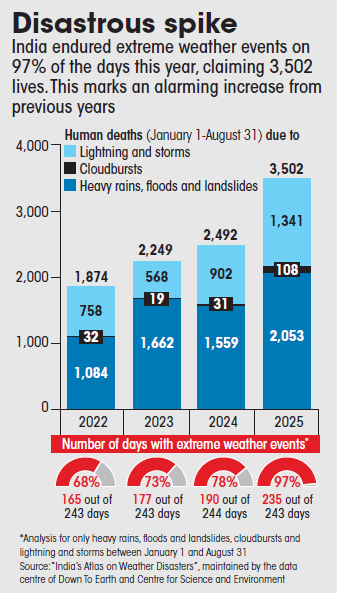
- India has faced extreme weather on all 92 days between June and August 2025, according to India’s Atlas on Weather Disasters.
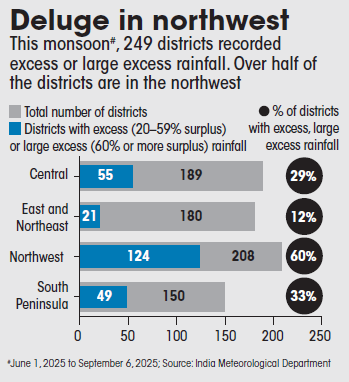
- One-third of districts across India received excess or large excess rainfall.
- 13 states and UTs recorded extreme weather events every second day.
- Himachal Pradesh was hit on 76 of 92 days, while Jharkhand saw the highest human toll with 470 deaths, mostly from lightning.
- By August, 3,502 lives were lost nationwide—40% higher than 2024.
Reasons Behind Recent Flood
- Western Disturbances: Instead of the occasional one or two, 19 such disturbances struck by early September, colliding with monsoon winds and intensifying rainfall.
- Anomalous Arabian Sea Winds: Moisture-laden winds pushed monsoon lows northward, interacting with Bay of Bengal systems.
- Potential Vorticity Cut-Off Lows: Cold-core systems detached from the Arctic jet stream, moving southward and unleashing heavy rains.
- Global Linkages: Warming in the Arctic and Arabian Sea has disrupted the delicate balance between equatorial and polar temperature gradients, fueling instability.
Conclusion
- Punjab’s floods of 2025 were not just the result of heavy local rainfall but also the combined impact of extreme weather across the Himalayan states and Jammu & Kashmir. With rivers carrying excess water downstream and Punjab itself experiencing record-breaking rainfall, the disaster became unavoidable.
Fragile Recovery of Earth’s Ozone Layer
Context
- A recent MIT-led study reveals that healing of the ozone layer is far from complete and new threats are emerging that could stall progress.
About Ozone Layer
- It is a thin and powerful blanket of gas located in the stratosphere, roughly 10 to 50 kilometers above Earth’s surface.
- It is composed of ozone molecules (O₃), it plays a critical role in absorbing the majority of the Sun’s harmful ultraviolet (UV) radiation — especially UV-B rays that can cause skin cancer, cataracts, and damage to crops and marine ecosystems.
Global Action
- The world first woke up to the threat of ozone depletion in the 1970s, when scientists discovered that human-made chemicals — especially chlorofluorocarbons (CFCs) — were breaking down ozone molecules in the stratosphere.
- It led to the formation of the ‘ozone hole’ over Antarctica, which was first documented in 1985.
- In response, nations came together under the Vienna Convention (1985) and the Montreal Protocol (1987) — landmark international agreements that phased out nearly 100 ozonedepleting substances (ODS).
- India has been a proactive participant, implementing measures like the India Cooling Action Plan and reducing hydrofluorocarbon (HFC) emissions significantly.
- India celebrates World Ozone Day every year on September 16, with the 2025 theme being ‘From Science to Global Action’.
Signs of Healing
- According to the World Meteorological Organization (WMO), the ozone hole in 2024 was smaller than in recent years, and the layer is on track to return to 1980 levels by mid-century.
- It is largely credited to the success of the Montreal Protocol, which has phased out 99% of ozone-depleting substances globally.
New Threats: Chlorinated very-short-lived substances (CL-VSLS)
- These are used in industrial chlorine-containing gases (solvents), lifetimes of about six months, are not regulated under the Montreal Protocol and are slowing the pace of recovery.
- A fraction reaches the stratosphere via tropical convection and the Asian monsoon, where it contributes to ozone depletion, although short-lived.
- Stratospheric chlorine levels measured by satellites are declining more slowly than expected from CFC reductions alone, due to rising Cl-VSL emissions.
Scientific Warnings
- Health of the ozone hole: The impact of Cl-VSLs remains smaller than CFCs, but rising emissions risk delaying full recovery to pre-1980 levels.
- Future risks: Greenhouse gases, particularly nitrous oxide (N₂O), pose a growing threat by altering stratospheric circulation and directly destroying ozone.
- Need for monitoring: Long-term satellite and ground-based measurements are at risk due to aging instruments and uncertain funding.
- Without these, tracking how new factors— such as wildfires and volcanic eruptions— affect the atmosphere becomes impossible.
What Next?
- Research shows that controlling Cl-VSL emissions could prevent up to 25% of projected tropical stratospheric ozone loss by 2100. Scientists are calling for:
- Expanding the Montreal Protocol to address Cl-VSLs.
- Stronger climate action to curb greenhouse gas emissions.
- Global investment in new atmospheric monitoring satellites.
Subjective Questions for Practise
Q1. Discuss the socio-economic and environmental impacts of the extremely heavy rains in North India during the recent monsoon season.
Q2. Evaluate the factors contributing to the fragile recovery of Earth’s ozone layer. How do emerging chemical threats and climate interactions complicate global efforts to restore atmospheric balance?
QUICK LINKS

 Call
Call