 Residential Course
Down To Earth (01-15 November, 2025)
The following topics are covered in the Down To Earth (01-15 November, 2025)
India Sets Legally Binding Emission-Cut Rules for Four Key Sectors
Context
- Recently, India took a significant step toward meeting its Paris Agreement commitments by notifying the Greenhouse Gas Emission Intensity (GEI) Target Rules, 2025.
- These rules are the country’s first legally binding emission reduction mandates for industrial sectors.
- Sectors Under Regulation: The rules apply to four high-emission industries: Aluminium, Cement, Chlor-alkali, and Pulp and Paper.
- At least 282 industrial units will be required to comply with emission intensity targets for 2025– 26 and 2026–27, focusing on reducing emissions per unit of product output.
Operationalising India’s Carbon Market
- The GEI Target Rules are designed to operationalise the Carbon Credit Trading Scheme (CCTS), 2023, which forms the backbone of India’s domestic carbon market.
- Industries achieving or exceeding targets will earn carbon credits.
- Non-compliant entities will need to purchase credits to offset their emission shortfalls.
- It ensures flexibility while driving overall emission intensity reductions across sectors.
Policy Integration and Governance
- The rules fall under the Energy Conservation Act, 2001 (as amended in 2022), empowering the Bureau of Energy Efficiency (BEE) to monitor and enforce compliance.
- According to the MoEFCC, it aligns with India’s Nationally Determined Contributions (NDCs) — specifically, to reduce the emissions intensity of GDP by 45% by 2030 compared to 2005 levels.
Sectoral Implications
- Cement & Aluminium: Both sectors are part of the Perform, Achieve, and Trade (PAT) program under BEE.
- These new rules build on the program’s experience in tracking and benchmarking industrial efficiency.
- Pulp & Paper, Chlor-Alkali: These sectors face challenges in energy efficiency and process optimization; emission caps will accelerate technological shifts toward low-carbon manufacturing.
Global Context
- The notification precedes COP30, hosted in Brazil, where India is expected to highlight it as part of its strengthened domestic climate policy, to ‘bridge the gap between voluntary pledges and enforceable emission accountability’.
Outlook
- Strengthen market-based climate governance.
- Stimulate investment in green technologies.
- Support India’s vision of achieving net-zero emissions by 2070.
- However, industry groups have called for clear monitoring guidelines and capacity-building to ensure smooth compliance.
Record Emissions & Renewable Surgesrecord Emissions & Renewable Surges
Context
- The World Meteorological Organization (WMO) has confirmed that global atmospheric carbon dioxide recorded a new high, marking extreme weather events, rising global temperatures, and unstable ecosystems.
Global Energy Shift: Renewables Rise, Fossil Fuels Resist
- According to Ember’s ‘Global Electricity Mid-Year Insights 2025, the first half of 2025 witnessed renewable energy surpassing coal as the world’s leading source of electricity.
- Solar power has doubled in the past three years, driven largely by China, which contributed over half the global increase, and India, where government programs such as the National Solar Mission have rapidly expanded installed capacity to over 90 GW (MNRE, 2025).
- However, natural gas-based generation has risen by 1.6%, as countries turn to fossil fuels to meet soaring AI data center energy needs and to counter the effects of intensifying heatwaves.
China and India: Double-Edged Progress
- China is simultaneously leading solar deployment and constructing 95 GW of new coal capacity (CarbonBrief, 2025).
- India, while advancing in solar and green hydrogen initiatives, continues to expand coal capacity to ensure grid stability and energy security.
Electric Vehicles (EV) Revolution
- The International Energy Agency (IEA) reports that 20% of global new car sales in 2024 were electric, with China leading (almost half of its new cars are EVs).
- India is emerging as a strong regional player, with over 3 million EVs registered (Vahan Portal, 2025) and new policies such as the FAME II and National Electric Mobility Mission Plan driving adoption.
- However, geopolitical frictions are reshaping the landscape:
- China’s dominance over rare earth minerals and battery supply chains has caused Western nations to rethink EV subsidies and delay ICE phase-out timelines.
- Export restrictions on lithium and graphite are intensifying supply chain vulnerabilities, potentially slowing the pace of global electrification.
Financing Gap: Real Barrier to Transition
- The IMF’s World Economic Outlook (2025) underscores the economic imbalance haunting the climate transition: for the first time since 2000, the poorest countries now spend more on debt servicing than they receive in official development assistance.
- It means that nations most vulnerable to climate impacts lack the fiscal space to invest in green technologies, trapping them in a cycle of energy poverty and dependence.
- According to MoEFCC, international climate finance remains well below pledged levels, impeding efforts to meet Paris Agreement targets.
Conclusion
- The world stands at a crossroads between technological optimism and economic hesitation.
- Renewable energy, electric mobility, and low-carbon pathways are no longer future prospects—they are the present reality.
- But without a coordinated global financing framework, equitable technology access, and political courage, the climate transition risks stalling at the halfway mark.
Alarming Rise in Global Deaths Among Young People
Context
- According to The Lancet’s Global Burden of Disease Study 2023, global life expectancy has rebounded to 76.3 years for women and 71.5 years for men, nearly returning to pre-pandemic levels.
- However, a worrying trend has emerged — rising deaths among young people aged 10–29 years, particularly women.
Rising Mortality Among Young Women
- The study reports that death rates for young women (15–29 years) are 61% higher than earlier estimates. Key causes include:
- Pregnancy and childbirth complications;
- Road accidents, particularly in developing nations;
- Lack of access to reproductive healthcare, as noted by UNFPA and MoHFW.
- India’s National Health Mission (NHM) data also show that maternal mortality among adolescents remains high due to early marriages and limited prenatal care access.
Shift to Non-Communicable Diseases (NCDs)
- Globally, NCDs account for nearly two-thirds of all deaths, surpassing infectious diseases, highlighted an alarming rise in heart disease, diabetes, and stroke among youth due to:
- Sedentary lifestyles
- Ultra-processed food consumption
- Tobacco and alcohol use
- In India, NITI Aayog’s Health Index shows a 30% rise in NCD-related deaths in the 15–35 age group since 2015.
Mental Health
- Mental health disorders surged sharply, anxiety disorders increased by 63%, and depressive disorders by 26%.
- It links to social media addiction, unemployment, and post-pandemic isolation.
- India’s National Mental Health Survey (2023) also reported a sharp rise in depressive symptoms among college students and firsttime job seekers.
Environmental and Climate Risks Intensify
- The Lancet report underlined the growing impact of climate-related health risks:
- Deaths due to heat and cold exposure rose 6% annually between 2013–2023.
- India Meteorological Department (IMD) and MoEFCC reports indicate that extreme heat days have tripled since 1980, leading to more cases of dehydration, cardiac arrest, and mental fatigue among youth.
Way Forward
- Youth-focused health policies integrating mental health, reproductive care, and road safety.
- Climate-resilient healthcare systems to mitigate environmental risks.
- Education and employment reforms to address stress and mental health concerns.
IUCN World Conservation Congress 2025
Context
- Recently, the International Union for Conservation of Nature (IUCN) convened its World Conservation Congress (held once every four years) in Abu Dhabi, marking a pivotal moment for global environmental assessment and action.
Ecosystem in Crisis
- The Global Land Outlook Thematic Report on Ecological Connectivity and Land Restoration, launched jointly by the UN Convention to Combat Desertification (UNCCD) and the Convention on the Conservation of Migratory Species (CMS), revealed that nearly one-third of the Earth’s land surface has been profoundly transformed by human use.
- Land degradation affects up to 40% of the planet, placing nearly half of humanity at risk.
- Deforestation, infrastructure expansion, and agriculture-driven fragmentation are rapidly diminishing ecological connectivity — essential for biodiversity and ecosystem resilience.
Loss of Natural Habitats
- More than 60% of the world’s rivers have been dammed or diverted, while road networks are expected to expand by 60% by 2050, intensifying habitat fragmentation.
- These pressures are eroding the capacity of ecosystems to regenerate.
- MoEFCC notes that habitat fragmentation and urban encroachment are key threats to over 680 native species listed under the Wildlife Protection Act (1972).
Species on the Edge: IUCN Red List Update
- 1,256 of 11,185 bird species (11.5%) are globally threatened. Of 1,360 reassessed bird species, 61% now show declining trends, a sharp rise from 44% in 2016.
- Six species have been officially moved to the Extinct category, including the Christmas Island shrew (Crocidura trichura) and slender-billed curlew (Numenius tenuirostris).
Warming Intensifies Arctic Threats
- The hooded seal (Cystophora cristata) has been uplisted to Endangered.
- The bearded and harp seals are now considered Near Threatened, primarily due to melting ice and declining prey populations.
- Climate-linked habitat loss has made these species sentinels of the planet’s warming trajectory.
India’s Red List Updates: Signs of Distress
- Four Indian bird species — key indicators of grassland health — have been uplisted:
- Indian Courser (Cursorius coromandelicus) – Least Concern → Near Threatened;
- Indian Roller (Coracias benghalensis);
- Rufous-tailed Lark (Ammomanes phoenicura);
- Long-billed Grasshopper-Warbler (Locustella major);
- According to MoEFCC’s India Biodiversity Status Report (2024), Grassland ecosystems, once widespread across India, are among the most neglected biomes.
Protected Areas Under Pressure
- The IUCN Outlook Report (2025) shows worrying trends in India’s conservation zones:
- Sundarbans National Park: Downgraded from Good with Some Concerns (2020) to Significant Concern (2025).
- Manas National Park and Western Ghats: Continue under Significant Concern.
- Kaziranga, Nanda Devi, and Keoladeo National Parks: Classified as Good with Some Concerns.
- Deforestation, tourism, and climate stress are key drivers of this deterioration.
Equal Risks Beneath the Waves
- The dugong populations in the Gulf of Kutch and Andaman and Nicobar Islands are nearing functional extinction, warns a 2025 Wildlife Institute of India (WII) report.
- In the Gulf of Mannar–Palk Bay, sightings have dropped by over 70% in a decade, largely due to trawling and seagrass bed destruction.
Green Shoots: Tiger Conservation as a Model
- The IUCN’s first Green Status Assessment for Tigers (Panthera tigris) highlights conservation-driven hope.
- Despite being critically depleted across its native range, proactive recovery in India, Bhutan, and Nepal shows that targeted conservation can restore populations.
- The Green Status complements the Red List by tracking species recovery and conservation success, providing a roadmap for future rewilding initiatives.
Policy and Global Action
- India reaffirmed its commitment to the Global Biodiversity Framework 2030 and 30x30 conservation targets — protecting 30% of terrestrial and marine ecosystems by 2030.
- The National Mission on Biodiversity and Human Well-being, spearheaded by the Office of the Principal Scientific Adviser, aims to integrate biodiversity into climate adaptation and sustainable livelihoods.
- At the global level, the Congress endorsed a UN-backed Restoration Acceleration Platform, designed to support countries in scaling up land and species recovery efforts.
Soil Security: Existential Challenge of Humanity
Context
- At the recent IUCN World Conservation Congress, a historic step was taken toward protecting the soil by the adoption of ‘Motion 007: Soil Security Law’ marked the first formal move to give soil security global legal recognition.
Defining Soil Security: Five Dimensions
- Motion 007 defines soil security as, ‘Responsible management and preservation of soil to ensure its continued ability to perform vital functions, provide essential ecosystem and biophysical services, and protect against emerging threats to support life on Earth’.
- It outlines five guiding dimensions:
- Capacity: The soil’s ability to sustain life and provide ecosystem services.
- Condition: The physical, chemical, and biological state of soil.
- Capital: The economic and social value soil contributes to human welfare.
- Connectivity: The interlinkages between soil, water, biodiversity, and climate systems.
- These principles aim to guide nations in integrating soil health into environmental frameworks, shaping a potential Global Soil Convention.
Why Soil Matters More Than Ever
- Soil is increasingly recognized as the eighth existential issue—alongside climate change, food and water security, biodiversity loss, energy transition, environmental maintenance, and human well-being.
- According to the UN Convention to Combat Desertification (UNCCD), if nations fail to act decisively, 16 million square kilometers of land could be severely degraded by 2050, with annual global economic losses exceeding US $878 billion.
- Land degradation is already undermining the planet’s capacity to sustain humanity.
- Over 33% of Earth’s soils are degraded, affecting food production for billions.
- India alone loses 5.3 billion tonnes of soil annually due to erosion and poor land management, according to the Indian Council of Agricultural Research (ICAR, 2024).
Missing Link in Global Conventions
- While the world has established international conventions for climate (UNFCCC), biodiversity (CBD), and desertification (UNCCD), soil has remained largely invisible in global governance.
- Healthy soil contributes directly to 12 of the 17 UN Sustainable Development Goals (SDGs) — from climate action (SDG 13) to ending hunger (SDG 2).
- The FAO’s Global Soil Partnership and India’s Soil Health Card Scheme focus on soil conservation is essential for sustainable food and water systems.
Building on Existing Frameworks
- Many countries, including India, already align soil conservation programmes with climate and desertification frameworks.
- The National Mission for Sustainable Agriculture (NMSA) and the Pradhan Mantri Krishi Sinchayee Yojana (PMKSY) emphasize soil and water health integration.
- India’s National Bureau of Soil Survey & Land Use Planning (NBSS&LUP) is working on soil carbon mapping to align with UNCCD Land Degradation Neutrality (LDN) goals.
- Motion 007 builds on these foundations, urging countries to re-orient policies to prioritize soil security at their core.
India’s Wild Elephant Population Falls By 18%: DNA Census
Context
- Recently, India’s first-ever DNA-based elephant census, developed by the Project Elephant Division of the MoEFCC, was released.
Key Findings of the DNA-Based Census
- It was compiled using genetic samples from over 1,100 locations across 15 elephant range states, and estimates the current wild elephant population at 22,446.
- It has revealed a sharp 18% decline in the wild elephant population since 2017.
- Karnataka continues to host the largest number of wild elephants, followed by Assam and Kerala.
- The overall population shows a decline from approximately 27,312 in 2017 to 22,446 in 2025.
- The Eastern Himalaya and Northeast regions reported the steepest drops, with severe habitat fragmentation noted in parts of Assam, Arunachal Pradesh, and West Bengal.
Causes Behind the Decline
- Habitat Fragmentation: Expanding infrastructure, rail lines, and human settlements have severely fragmented elephant corridors.
- India’s 101 identified elephant corridors are shrinking due to encroachments, agricultural expansion, and mining. It forces elephants to move through human-dominated landscapes, increasing encounters and casualties.
- Human-Elephant Conflict: Between 2018 and 2023, official records show more than 2,500 human deaths and 500 elephant deaths due to conflict incidents.
- Elephants stray into farmlands in search of food, while retaliatory killings and electrocutions have surged.
- MoEFCC data highlights Assam, Odisha, and Tamil Nadu as the worst-affected states.
- Poaching and Illegal Ivory Trade: Though large-scale ivory poaching has declined since the 1990s, there is a resurgence in small-scale poaching in parts of central and northeastern India.
- Increased demand from illegal trade networks and the use of snares for bushmeat pose a persistent threat.
Conservation Efforts and Policy Responses
- Project Elephant and Corridor Protection: Initiated in 1992, Project Elephant aims to protect elephant populations, restore habitats, and reduce humanelephant conflict. Recent policy efforts include:
- The National Elephant Action Plan (2023–2032) focusing on corridor restoration and coexistence models.
- Establishment of Elephant Reserves, such as the Agasthyamalai and Dandeli–Anshi reserves, to secure migratory routes.
- Implementation of the Gaj Yatra campaign by the Wildlife Trust of India to raise public awareness.
- Use of Technology in Conservation: The DNA-based census marks a paradigm shift. Combined with satellite telemetry, AI-powered camera traps, and GIS-based conflict mapping, authorities hope to create a more adaptive conservation framework.
Road Ahead
- Landscape-level conservation planning rather than isolated forest patches.
- Community-based conflict mitigation, including early warning systems and crop insurance schemes.
- Stronger anti-poaching surveillance and crossborder cooperation with Nepal, Bhutan, and Bangladesh.
Parbati–Kalisindh–Chambal (PKC) River Linking & Irrigation Project
Context
- The National Tiger Conservation Authority (NTCA) raised ecological concerns about the Parbati– Kalisindh–Chambal (PKC) river linking and irrigation project because of its proximity to the Kuno National Park.
About Parbati–Kalisindh–Chambal (PKC) River Linking Project
- It is a pivotal component of India’s National Perspective Plan for river interlinking, spearheaded by the Ministry of Jal Shakti and executed by the National Water Development Agency (NWDA).
- It aims to enhance water availability in droughtprone regions of Madhya Pradesh and Rajasthan by transferring surplus water from the Parbati and Kalisindh rivers to the Chambal basin.
Project Components
- Patanpur Diversion Dam on the Parbati River: Transfers 464 million cubic meters (Mm³) of water via a 55.37 km canal (including 6.61 km tunnel);
- Mohanpura Diversion Dam on the Newaj River: Transfers 403 Mm³ of water via a 73.17 km canal (with two tunnels totaling 4.39 km);
- Kundaliya Storage Dam on the Kalisindh River: Receives water from Patanpur and Mohanpura and channels it to the Chambal basin;
Irrigation & Water Supply Benefits
- Irrigate over 2.8 lakh hectares of agricultural land;
- Provide drinking water to water-scarce regions;
- Recharge groundwater and improve ecological balance;
- Support industrial and urban water needs in Rajasthan and Madhya Pradesh;
Environmental Concerns: Threats to the Cheetah Habitat
- The NTCA, which oversees tiger and other apex predator habitats, expressed concerns that largescale construction and deforestation near Kuno could disrupt the fragile grassland ecosystem vital for cheetahs’ survival.
- The Kuno National Park, spread across 748 square kilometers, has been the focal point of India’s cheetah reintroduction programme since 2022, hosting cheetahs translocated from Namibia and South Africa.
- Experts warn that habitat fragmentation due to the irrigation project could:
- Disturb prey-predator balance;
- Reduce corridor connectivity;
- Increase human-wildlife conflicts;
Himachal’s Plea for Forestland Rehabilitation
Context
- According to the Himachal Pradesh State Disaster Management Authority (HPSDMA), the state witnessed 47 cloudbursts and 148 major landslides, resulting in 468 deaths and the loss of 29,534 animals.
State Assembly’s Unanimous Resolution
- The Himachal Pradesh Legislative Assembly unanimously passed a resolution urging the Central government to declare the disaster a ‘national calamity’, and sought temporary rehabilitation permissions on forestland, citing lack of alternative land for relocation.
- Under the Forest (Conservation) Act (FCA), 1980, diversion of forestland for non-forest purposes requires Central approval.
- Therefore, the state requested a special exemption under Section 2 of the FCA to allocate small plots—1 bigha (0.08 ha)—to families who lost their land.
Land Crunch: Forests as the Only Option
- Data from the Union Ministry of Agriculture (2005) reveals that out of 4.547 million ha, only 12.21% is cultivable, while 24.06% is forested and 33.63% comprises pastures and grasslands.
- As per the India State of Forest Report 2021, 68.16% (37,948 sq km) of the state’s total area is legally classified as forestland.
Gaps in Rehabilitation Framework
- Himachal Pradesh lacks a formal rehabilitation policy, unlike neighboring Uttarakhand.
- The Right to Fair Compensation and Transparency in Land Acquisition, Rehabilitation and Resettlement Act, 2013 can be applied to disasterrelated resettlement.
- However, implementation requires forest diversion clearance—again invoking FCA restrictions.
- Further, the National Disaster Management Act (NDMA), 2005 places responsibility for post-disaster rehabilitation on the Central government, involving data-driven processes like Memorandum of Loss and Damages (MLD) and Post-Disaster Needs Assessment (PDNA).
- The comprehensive impact data for the 2025 disaster will likely be available between October and December, as per NDMA protocols.
Climate Change and Himalayan Vulnerability
- Climate change has amplified monsoon intensity in the Western Himalayas. The Indian Meteorological Department (IMD) notes that extreme rainfall events in Himachal have doubled since 2010, linked to increased moisture flux from the Arabian Sea.
- Unplanned urbanisation, road expansion, and hydropower tunnelling have weakened natural drainage and slope stability.
- According to the National Institute of Disaster Management (NIDM), over 1,500 villages in Himachal are now classified as “climate-sensitive zones” prone to landslides and flash floods.
Way Forward: Balancing Ecology and Human Need
- Experts advocate a ‘temporary-use model’ for forestland—allowing low-impact, eco-sensitive settlements with reforestation commitments. Policy reforms could include:
- Special exemption under FCA for disaster-induced rehabilitation.
- Creation of a Himalayan Disaster Rehabilitation Fund jointly managed by NDMA and states.
- Mandatory vulnerability mapping before resettlement.
- Integration of afforestation and slope stabilization measures.
Uttar Pradesh’s Faecal Sludge Crisis
Context
- Despite Uttar Pradesh (UP)’s progress under the Swachh Bharat Mission (Urban), the lack of effective containment, monitoring, and treatment has made UP’s faecal sludge management (FSM) an ‘environmental ticking bomb’.
Scale of the Problem
- According to the National Faecal Sludge and Septage Management (FSSM) Policy and CPCB’s 2023 State Pollution Report, over 75% of households in UP rely on on-site sanitation systems such as septic tanks or pit latrines.
- However, less than 30% of the faecal sludge generated is safely collected and treated.
- Cities like Kanpur, Varanasi, and Meerut, untreated faecal waste is routinely dumped in open drains, fields, and water bodies, leading to massive groundwater contamination.
Poor Containment and Infrastructure
- Most septic tanks in UP are unlined or single-chambered, violating design standards set under IS 2470 (Part I): 1985.
- Data from UP Jal Nigam (2024) show that over 60% of containment systems fail to meet safety norms. The absence of proper desludging mechanisms and sealed tanks exacerbates leakage risks, especially during floods.
Weak Monitoring and Regulation
- Despite the existence of state sanitation strategies, enforcement remains minimal. The Urban Local Bodies (ULBs) often lack:
- Technical staff for monitoring desludging activities;
- Digital tracking of vacuum trucks;
- Licensing mechanisms for private desludging operators;
- As per MoHUA’s 2023 Swachh Bharat Mission (SBMU 2.0) review, only 20 out of 75 districts in UP have begun operationalizing faecal sludge treatment plants (FSTPs).
- Even among these, many operate below capacity due to irregular sludge inflow and lack of maintenance.
Illegal Dumping
- Illegal dumping has become a lucrative shortcut for private operators avoiding tipping fees at FSTPs.
- CPCB’s 2022 Inspection Report recorded over 200 cases of unauthorised disposal along highways, canals, and agricultural land in western UP.
Environmental and Public Health Impact
- Studies from IIT Kanpur (2022) and CPCB (2023) link high faecal coliform levels in drinking water with increased diarrhoeal and vector-borne disease incidence in peri-urban areas.
- Moreover, uncontrolled methane emissions from decomposing sludge contribute to greenhouse gas accumulation, worsening the state’s climate vulnerability.
Policy Gaps and Slow Implementation
- While the National FSSM Policy (2017) and AMRUT 2.0 promote decentralized sanitation, implementation in UP has lagged due to:
- Weak institutional coordination between ULBs, Jal Nigam, and Pollution Control Boards;
- Inadequate funding for O&M of FSTPs;
- Lack of community awareness and operator training;
Way Forward
- UP needs an integrated FSM roadmap emphasizing:
- Retrofitting containment systems to meet BIS standards;
- GPS-based desludging monitoring systems for transparency;
- Enforcement of fines and licensing for private operators;
- Decentralized FSTPs and co-treatment at STPs;
- Public awareness and community participation in FSM;
- The MoHUA’s 2024 Guidelines on Faecal Sludge Management encourage cluster-based treatment and resource recovery models — an approach UP could adopt urgently.
Warm-Water Corals: First Ecosystem To Collapse in a Warming World
Context
- The Global Tipping Points Report 2025 confirms the world has crossed its first ecological tipping point — the collapse of warm-water coral reefs.
- Widespread bleaching and mortality across tropical and subtropical seas mark the irreversible decline of these vital ecosystems.
What Are Coral Tipping Points?
- According to the IPCC, a tipping point is a ‘critical threshold’ where minor changes trigger selfreinforcing, often irreversible shifts.
- Coral reefs, reliant on symbiotic algae (zooxanthellae) for nutrition and color, are acutely temperature-sensitive.
- Once ocean heat exceeds their tolerance, corals expel algae, turning white — a process known as bleaching.
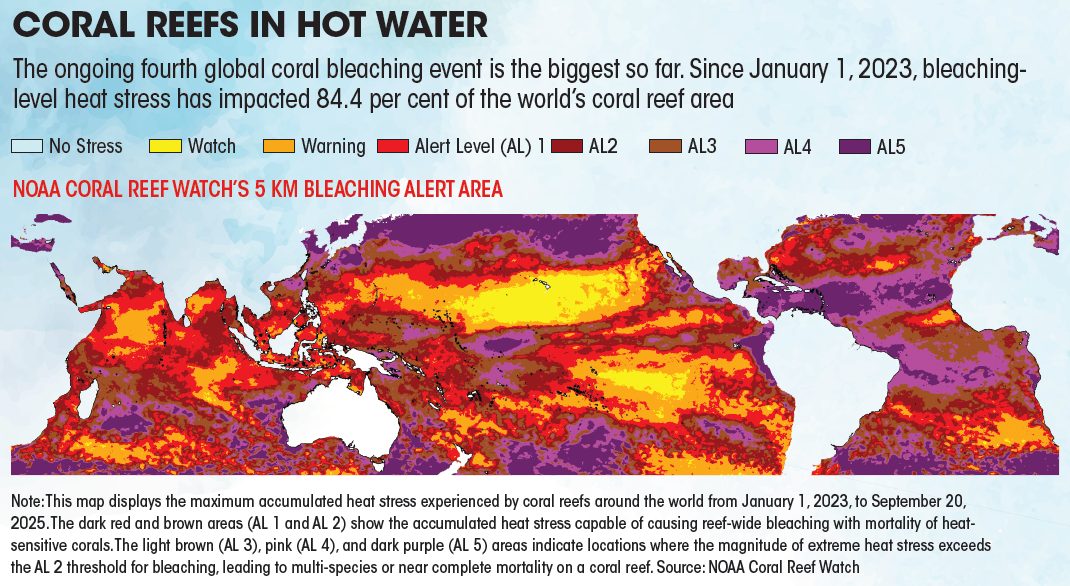
- Repeated and prolonged heatwaves since 2023 have triggered the fourth global bleaching event, affecting 85% of reefs across 80+ nations.
- Even resilient coral genera in the Great Barrier Reef (GBR) are now dying at unprecedented rates, with over 70% hard coral loss in parts of Queensland.
Other Tipping Points
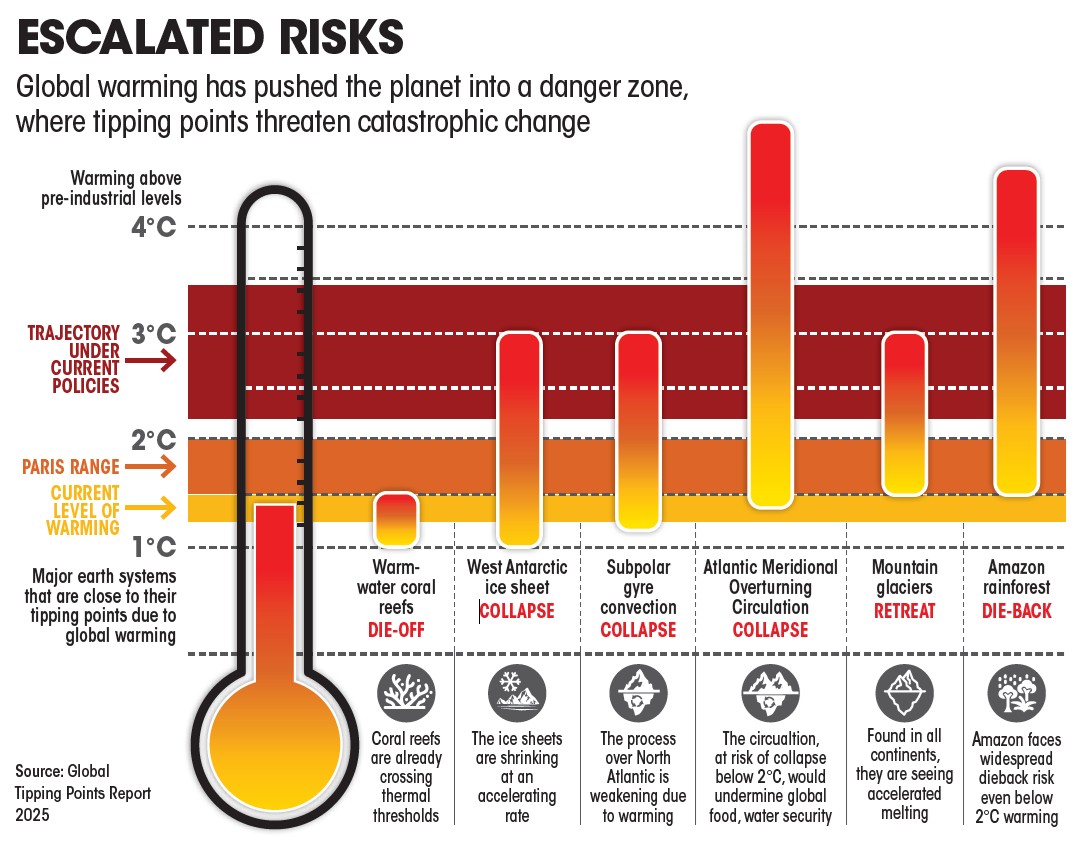
- Beyond reefs, the report warns of imminent thresholds:
- Amazon and Boreal Forest dieback;
- Collapse of Atlantic Meridional Overturning Circulation (AMOC);
- Accelerated permafrost thaw;
- Mountain glacier retreat;
Global Impacts and Local Fallout
- Warm-water coral reefs sustain nearly one billion people through fisheries, tourism, and coastal protection. Their collapse imperils livelihoods, food security, and biodiversity.
- In India, the Gulf of Mannar, Lakshadweep, and Andaman & Nicobar reefs — identified by the MoEFCC — have reported record bleaching since 2023, aligned with NOAA Coral Reef Watch alerts.
- Bleaching in Lakshadweep has become an annual event, with coral cover in Minicoy and Kavaratti falling by nearly 40% since 2018.
- The Gulf of Mannar Biosphere Reserve Trust noted rising disease incidence and coral rubble replacing live cover.
Great Barrier Reef and Beyond
- In Australia, bleaching now occurs biennially across the GBR. Ocean warming of 1.5°C has reached unprecedented depths and durations.
- Even southern protected zones — once refuges — are showing ‘reef-to-rubble’ transformation.
- Similar phenomena are reported in the Caribbean, where bleaching is now desynchronised from El Niño cycles.
Race to Save Corals
- Cryopreservation and Bio-Banking: At the Taronga CryoDiversity Bank in Sydney, scientists collect coral spawn during annual spawning events for cryopreservation.
- Even southern protected zones — once refuges — are showing ‘reef-to-rubble’ transformation.
- Partnering with the Smithsonian Conservation Biology Institute and Reef Restoration and Adaptation Program (RRAP), researchers aim to reintroduce resilient coral breeds and restore genetic diversity.
- Breeding Heat-Resilient Corals: Through assisted evolution and selective breeding, researchers cultivate coral varieties capable of tolerating higher temperatures.
- Trials in the GBR show coral recruits produced using cryopreserved sperm survive as well as — or better than — those from fresh sperm.
- Indian Coral Conservation Efforts: The National Coral Reef Research Centre (NCSCM) and Zoological Survey of India are implementing reef restoration using coral transplantation and artificial reef modules in the Gulf of Mannar and Lakshadweep.
- Under the National Adaptation Fund for Climate Change (NAFCC), India’s ‘Coral Restoration Initiative 2030’ aims to restore 500 hectares of degraded reef using microfragmentation and larval rearing techniques.
Way Forward
- Limiting global warming to below 1.5°C is imperative. Restoration can only buy time. There is a need for:
- Rapid emission reductions under COP30 pledges;
- Expanding marine protected areas (India’s 2025 MoEFCC plan targets 30% coverage by 2030);
- Investing in coral gene banking and community based reef management;
Affordable Medicines in India
Context
- Indian courts and the Patent Office have taken decisive steps to prevent multinational drug companies from unfairly extending their monopolies through evergreening—the practice of making minor changes to existing drugs to claim new patents.
Legal Backbone: Section 3(d) of the Patent Act
- At the heart of this shift lies Section 3(d) of the Indian Patents Act, 1970 — an innovative legal safeguard that bars new patents on known substances unless they show enhanced therapeutic efficacy.
- Added in 2005 to align with WTO obligations under the TRIPS Agreement, this clause ensures that incremental modifications without real clinical benefit cannot be patented.
- As the Department for Promotion of Industry and Internal Trade (DPIIT), Section 3(d) was designed to preserve the delicate balance between fostering innovation and protecting public access to affordable medicines.
- It has been repeatedly defended in domestic and international forums against lobbying from global pharmaceutical lobbies.
Judicial Endorsement of Public Health Over Monopoly
- The Delhi High Court and Supreme Court of India have repeatedly emphasized that intellectual property rights cannot override constitutional guarantees under Article 21 (Right to Life).
- In line with this, India’s National IPR Policy (2016) — explicitly commits to preventing abuse of the patent system through frivolous or repetitive filings.
India’s Role in Global Generic Leadership
- India’s generics industry supplies nearly 60% of global vaccines and 20% of the world’s generic medicines, as per Pharmaceuticals Export Promotion Council (PHARMEXCIL) data.
- By curbing evergreening, India reinforces its global image as the ‘pharmacy of the developing world’—a phrase often used by the World Health Organization (WHO).
- Such decisions echo the landmark 2013 Supreme Court ruling against Novartis’ cancer drug Glivec, where the court denied a new patent for lack of enhanced efficacy— establishing a precedent that continues to shape Indian pharmaceutical jurisprudence.
Way Forward: Strengthening Section 3(d) of the Patent Act
- Regular scrutiny of patent applications to detect disguised evergreening.
- Public transparency through mandatory disclosure of clinical data.
- Faster judicial resolution of patent disputes to prevent prolonged monopolies.
- Policy support for domestic innovation under India’s Pharma Vision 2030.
Record Turtle Breeding Season At Delhi’s Asola Bhatti Wildlife Sanctuary
Context
- The Asola Bhatti Wildlife Sanctuary in South Delhi has recorded its most successful turtle breeding season to date, marking a significant milestone in the city’s conservation efforts.
About the Asola Bhatti Wildlife Sanctuary
- Initially set up to shelter trafficked, injured, and rescued turtles, the camp now provides refuge to around 250 turtles spanning four native species:
- Indian Flapshell Turtle (Lissemys punctata);
- Indian Roofed Turtle (Pangshura tecta);
- Black Pond Turtle (Geoclemys hamiltonii);
- Yellow-Spotted Pond Turtle (Geoclemys spp.)
- Eco-Restoration Measures: To enhance the living environment for the turtles, the Forest Department has introduced several habitat-improvement measures:
- Native grasses and aquatic vegetation for natural feeding and cover;
- Basking logs and sandy sun spots for thermoregulation and nesting;
- Rock-lined pond edges to prevent erosion and provide secure resting zones;
A Model for Urban Biodiversity Conservation
- The Asola Bhatti has become a critical biodiversity hotspot within the Ridge ecosystem, offering refuge not only to turtles but also to porcupines, monitor lizards, and over 200 bird species.
- The sanctuary’s wetland restoration and antipoaching surveillance efforts have been key to reducing illegal wildlife trafficking and improving survival rates for rescued reptiles.
Global Land Outlook Report: Restoring Ecological Connectivity
Context
- The Global Land Outlook Thematic Report on Ecological Connectivity and Land Restoration, launched at the IUCN World Conservation Congress, underscores an urgent need to reconnect fragmented ecosystems worldwide.
Key Highlights
- Serengeti-Mara Crisis: In the Serengeti-Mara, a transboundary landscape between Tanzania and Kenya, wildlife migrations once spanned vast open plains.
- Today, fences and expanding farmland are constraining these ancient migration routes.
- It jeopardizes the annual wildebeest migration, a keystone event for the region’s ecological balance and one of Earth’s last great natural spectacles.
- According to IUCN scientists, these disruptions could lead to severe declines in migratory species and alter the hydrological and vegetation dynamics of the region.
Land Degradation and Policy Gaps
- Habitat fragmentation is a global pattern—not limited to Africa. India, for example, faces similar threats in:
- The Aravalli hills, where encroachments restrict wildlife corridors.
- The Western Ghats, where plantation expansion and infrastructure divide forests.
- Unplanned linear infrastructure — roads, railways, and power lines — continues to break up vital ecological corridors.
Restoration Through Connectivity
- The UNCCD-backed report stresses ecological connectivity as central to effective land restoration. Connectivity allows species to migrate, pollinate, and adapt to climate change. It suggests:
- Rewilding degraded landscapes through native vegetation.
- Community-managed buffer zones around protected areas.
- Cross-border cooperation, especially for migratory routes shared by multiple nations.
India’s Role and Commitments
- The Government of India, through its National Land Degradation Neutrality Target (2030), aims to restore 26 million hectares of degraded land.
- Initiatives under CAMPA, Green India Mission, and Eco-sensitive Zone declarations align with the report’s recommendations.
- The National Biodiversity Authority (NBA) integrating connectivity into land-use planning can help prevent biodiversity loss and sustain ecosystem services vital for rural livelihoods.
Conservation, Digitally: Karnataka’s Jala Sanjeevini Programme
Context
- Karnataka’s Jala Sanjeevini programme represents a significant stride in integrating digital tools and community participation to rejuvenate water-scarce landscapes.
About Jala Sanjeevini Programme
- Objectives and Vision: Jala Sanjeevini aims to restore degraded watersheds using a data-driven, decentralized model, launched under the Karnataka Watershed Development Department. The programme’s core goals include:
- Improving soil moisture and groundwater levels;
- Increasing agricultural resilience;
- Promoting sustainable land use;
- Empowering local communities to take ownership of natural resource management;
- Digital Backbone of the Initiative: At the heart of Jala Sanjeevini lies digital mapping, GIS tracking, and IoT-based water monitoring. The programme employs satellite imagery and real-time dashboards to:
- Identify critical watershed zones;
- Track project progress and rainfall data;
- Optimize water storage structures such as check dams, percolation tanks, and recharge pits
- The Watershed Management Information System (WMIS) provides an integrated database accessible to officials, NGOs, and communities, ensuring transparency and accountability.
Synergy with Other State Schemes
- Jala Sanjeevini aligns with the Krishna Bhagya Jala Nigam and Jal Jeevan Mission, creating synergy across rural infrastructure and drinking water initiatives.
- Through convergence funding, the scheme integrates resources from MGNREGA and the State Natural Resource Management Plan.
Impact on Ground
- Early implementation in arid regions of Koppal, Raichur, and Chitradurga has shown measurable outcomes:
- Increase in groundwater table by 0.5–1 meter;
- Higher cropping intensity and shift to less waterintensive crops;
- Reduced dependence on tanker water supply;
Lessons for Other States
- Jala Sanjeevini offers a replicable model for integrating traditional wisdom with modern technology. Its success underscores three key principles:
- Data-driven local action;
- Decentralized execution;
- Community-led ownership;
Subjective Questions for Practise
Q1.Critically evaluate whether the current pace of renewable expansion is sufficient to offset the environmental impact of rising emissions.
Q2. Discuss the concept of soil security in the context of global sustainability. Why is soil degradation considered an existential challenge for humanity?
Q3. Analyze the vulnerability of warm-water coral ecosystems in the context of global climate change. Why are they considered the first major ecosystem at risk of collapse?
QUICK LINKS

 Call
Call