

TARIFF WAR Explained
Context:
- US President Donald Trump has announced sweeping tariffs on goods imported from the rest of the world.
- Trump claims that a 10% tariff on all nations and much higher rates of up to 50% on individual countries will boost the US economy and protect jobs.
1.
What are tariffs?
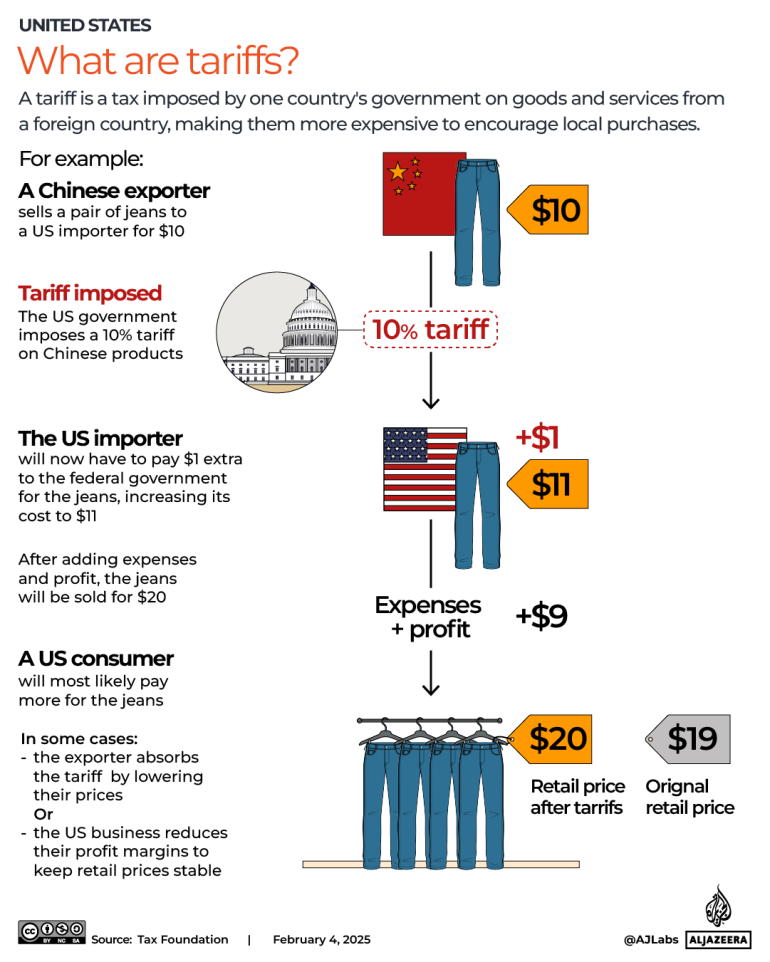
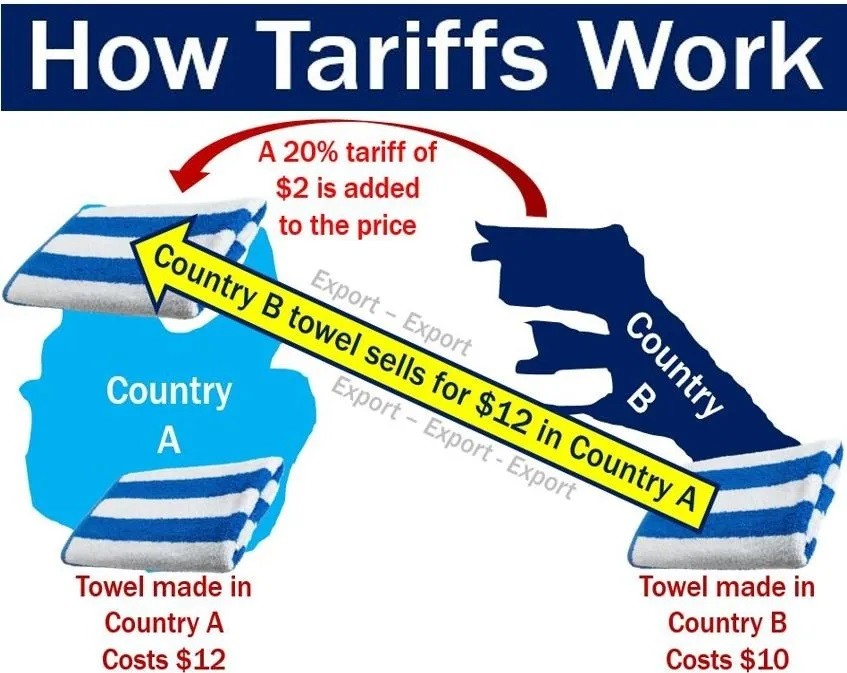
- A tariff is a duty (a tax) imposed by a national government, customs territory, or supranational union on imports (or, exceptionally, exports) of goods.
- A tariff is a type of protectionist trade policy because it increases the cost for foreign firms to sell in a country.
2.
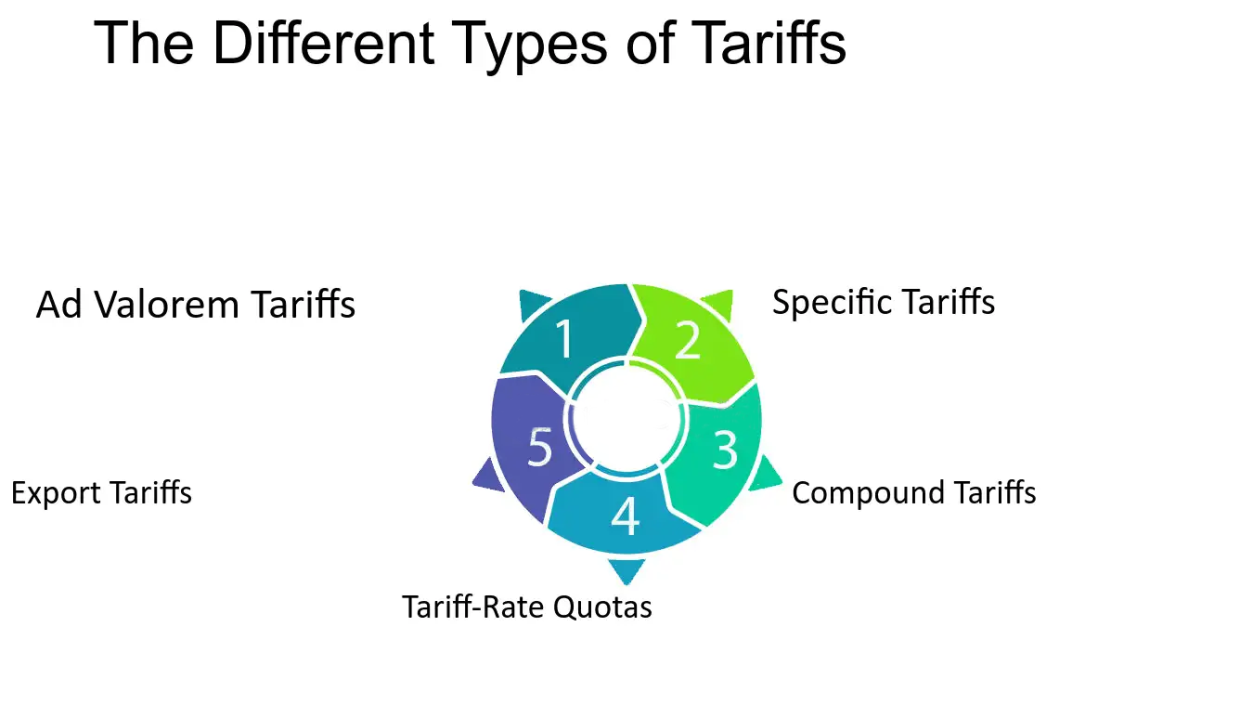
Enlist different types of tariffs?
- Tariffs are taxes imposed on goods and services that are traded internationally.
- Tariffs can be applied in different ways, and they can have different effects on international trade.
| Tariff | Description |
|---|---|
| Ad Valorem Tariffs |
|
| Specific Tariffs |
|
| Compound Tariffs |
|
| Tariff-Rate Quotas |
|
| Export Tariffs |
|
3.
Who uses tariffs?
- Almost every country imposes some tariffs.
- In general, wealthy countries maintain low tariffs compared to developing countries.
- Developing countries impose more tariffs because they have more fragile industries that they wish to protect, or they might have fewer sources of government revenue.
- The United States, for instance, maintained high tariffs for decades, until income taxes supplanted tariffs as the most important source of revenue in the 1930s.
- After World War II, tariffs continued to decline as the United States emphasized trade expansion as a central plank of its global strategy.
4.
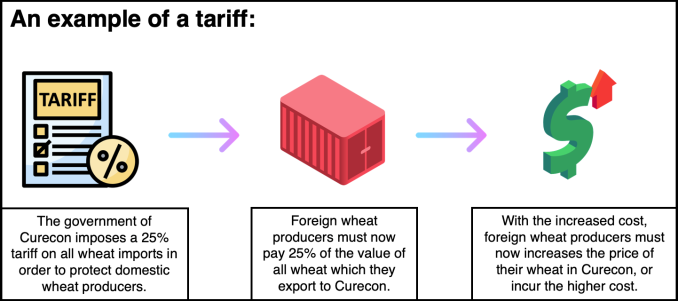
How does a tariff work?
5.
Why do governments impose tariffs?
| Reasons | Analysis |
|---|---|
| Raising Revenue |
|
| Protecting Domestic Industries |
|
| Protecting Domestic Consumers |
|
| Protecting National Interests |
|
6.
What are Tariff wars?
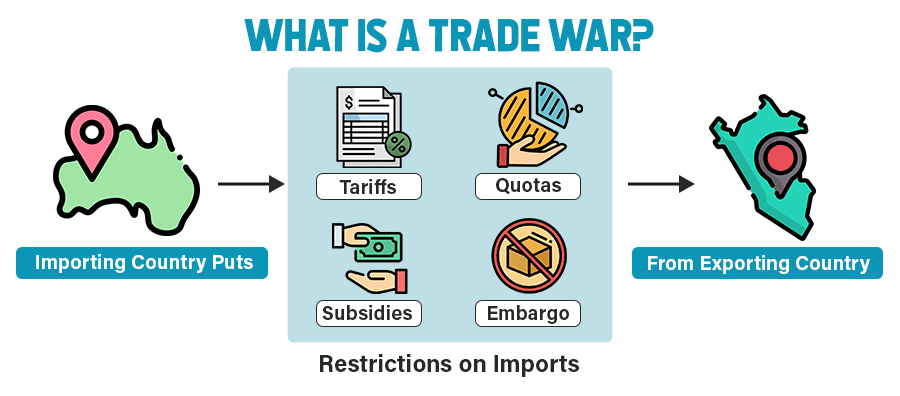
- Tariff wars refer to the imposition of tariffs or duties on imported goods by one country, leading to retaliatory measures by trading partners.
7.
Enlist the major events of tariff war?
| Events | Analysis |
|---|---|
| SmootHawley Tariff Act |
|
| US-China Trade War |
|
| European Union tariffs: |
|
| Canada and United States |
|
| India’s Tariffs on US Products |
|
8.
Why is Trump using tariffs?
- For decades, Trump has argued that the US should use tariffs to boost its economy.
- Trump wants to reduce the gap between the value of goods the US buys from other countries and the value of those it sells to them.
- He argues that America has been taken advantage of by "cheaters" and "pillaged" by foreigners.
- Trump has said tariffs will create more factory jobs, shrink the federal deficit, lower food prices and allow the government to subsidize childcare.
- "Tariffs are the greatest thing ever invented,'' Trump said at a rally in Flint, Michigan, during his presidential campaign.
9.
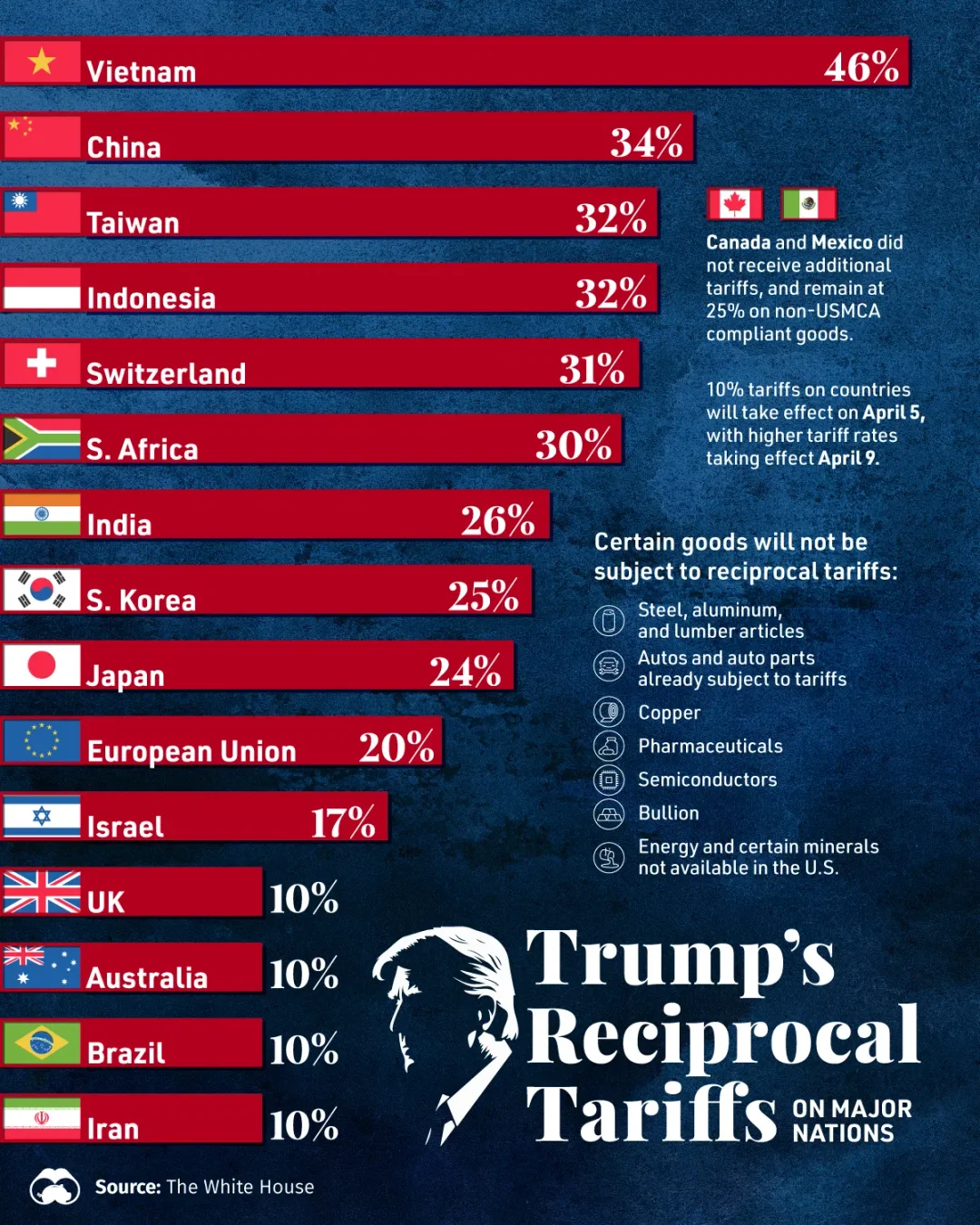
What are Trump's 'reciprocal tariffs'?
- Reciprocal tariffs are import duties imposed by a country in response to the tariffs placed on its exports by another country.
- They are designed to create a level playing field in international trade by ensuring that both trading partners impose similar tariff rates on each other’s goods.
10.
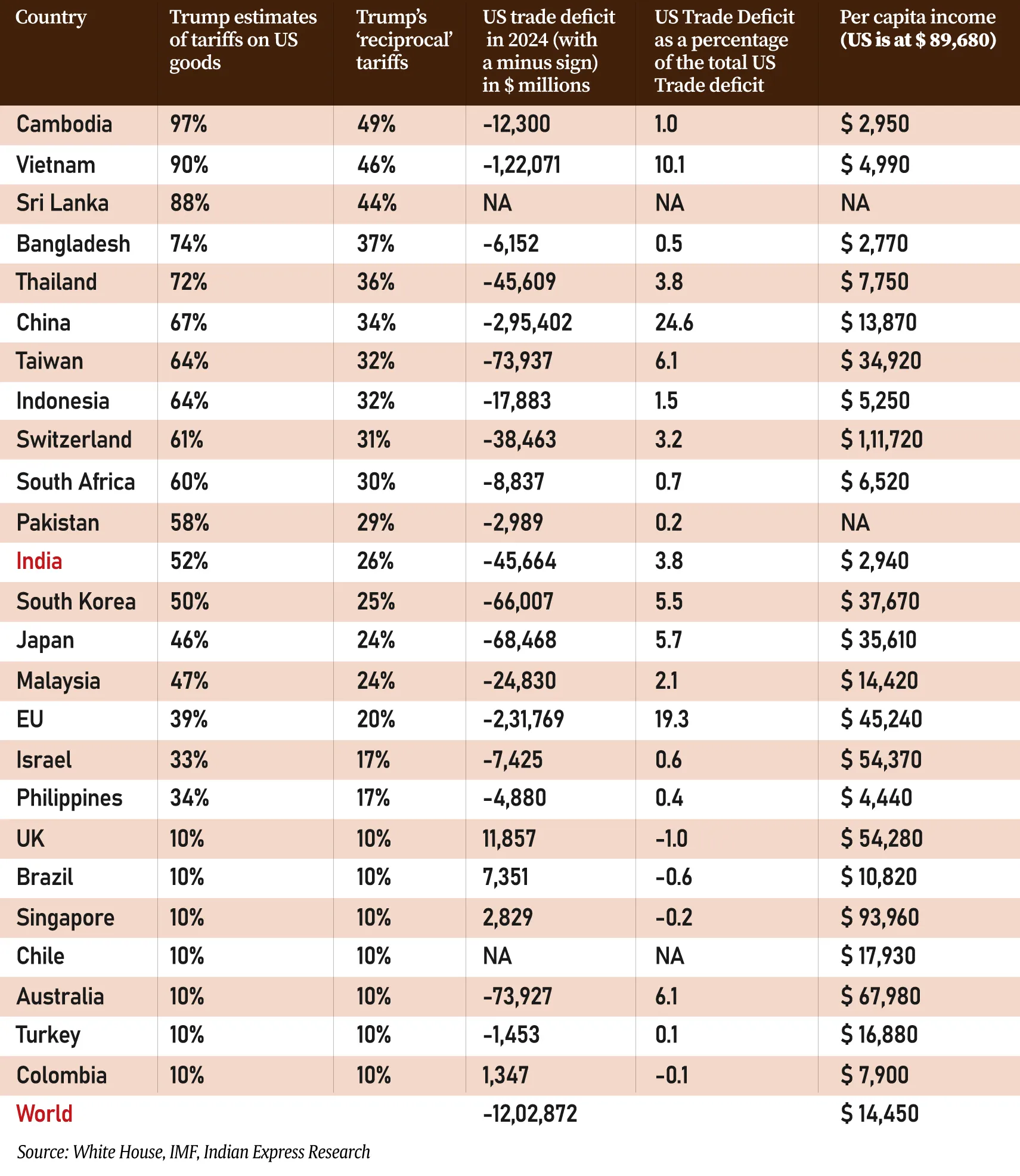
Mention about the tariff announced by Trump?
11.
How were Donald Trump's tariffs calculated?
- US President Donald Trump has imposed a 10% tariff on goods from most countries being imported into the US, with even higher rates for what he calls the "worst offenders".
- When Trump presented a giant cardboard chart detailing the tariffs in the White House Rose Garden it was initially assumed that the charges were based on a combination of existing tariffs and other trade barriers (like regulations).
- But later, the White House published what might look like a complicated mathematical formula.
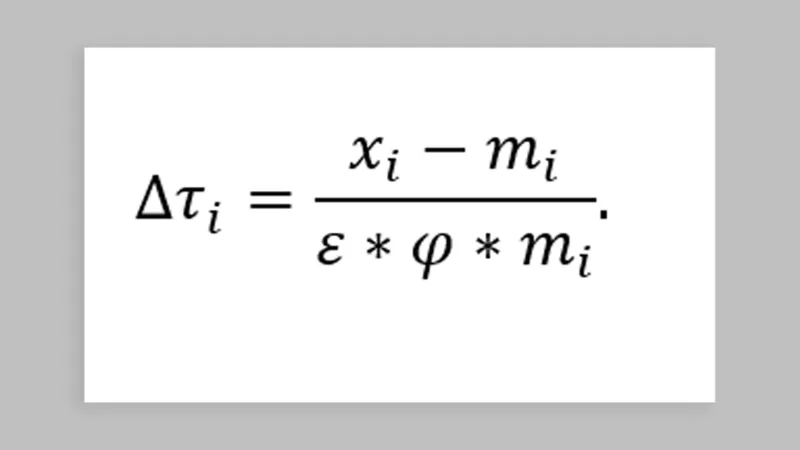
- But if we unpick the formula above it boils down to simple maths:
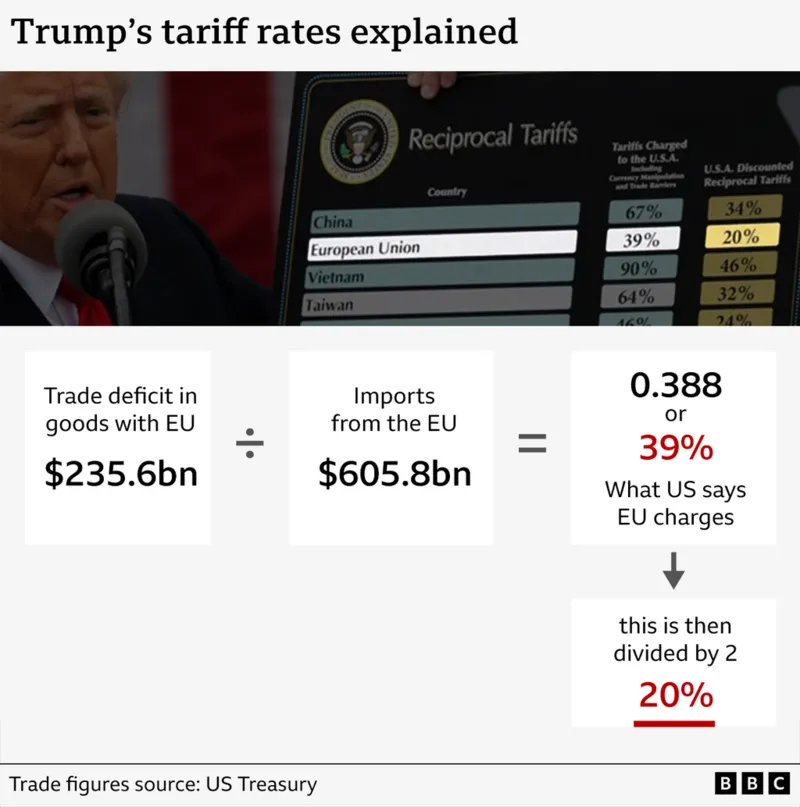
- Take the trade deficit for the US in goods with a particular country, divide that by the total goods imports from that country and then divide that number by two.
- For example, the US buys more goods from China than it sells to them - there is a goods deficit of $295bn.
- The total amount of goods it buys from China is $440bn.
- Dividing 295 by 440 gets you to 67% and you divide that by two and round up.
- Therefore the tariff imposed on China is 34%.
12.
What are the features of reciprocal tariffs?
| Features | Analysis |
|---|---|
| Balancing Trade Relationships |
|
| Negotiation Tool |
|
| Protect Domestic Industries |
|
| Countermeasures Against Unfair Practices |
|
| Trade wars |
|
13.
What is the history of reciprocal tariffs?
- The concept of reciprocal tariff policies started in the 19th century when countries began using tariffs to shield their local industries and boost economic development.
- Reciprocal tariffs, or reciprocal trade agreements, involve nations agreeing to lower or remove tariffs on goods in a mutual way.
- A notable early example is the Cobden-Chevalier Treaty of 1860 between Britain and France, which significantly cut tariffs between the two nations, enhancing trade and economic collaboration.
- In the early 20th century, reciprocal tariff policies became more prominent with the Smoot-Hawley Tariff Act in the United States in 1930.
- This act raised tariffs on many imported goods, prompting other countries to retaliate with their own tariffs, worsening the Great Depression.
- After World War II, reciprocal tariff policies played a crucial role in international trade talks.
- The General Agreement on Tariffs and Trade (GATT) was created in 1947 to lower tariffs and encourage free trade through reciprocal agreements.
- Reciprocal tariff policies have historically been a means for countries to defend their local industries, stimulate economic growth, and negotiate trade deals.
- While they can be useful for these purposes, they also risk causing trade conflicts and obstructing global economic cooperation.
14.
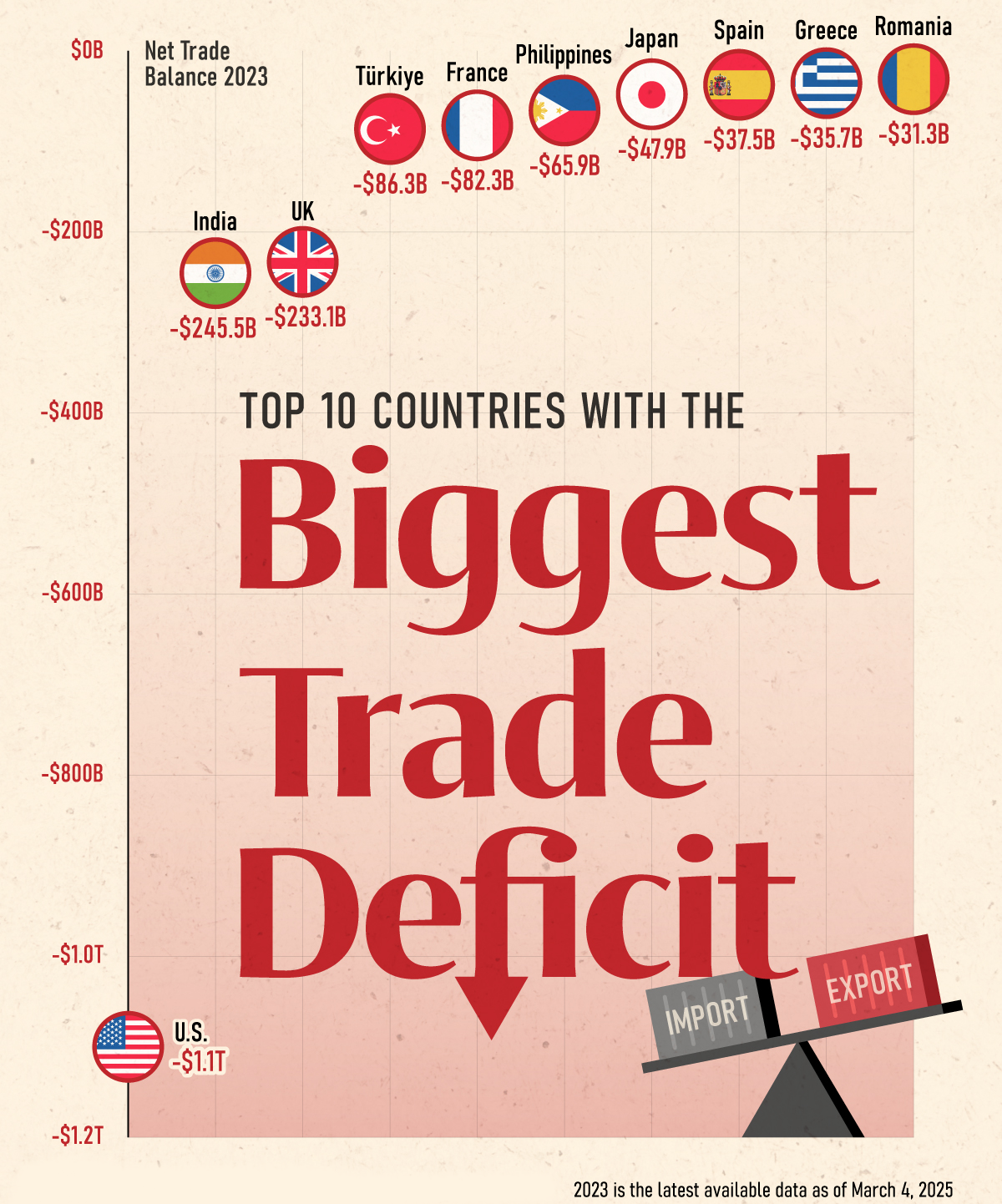
Which countries have the highest trade deficits?
- The US has the largest trade deficit in the world.
- According to data from 2023, the US imported $1.1 trillion more than it exported in that year.
- The US trade deficit has been rising continuously since 2019, and has now been at more than $1 trillion for four years in a row.
- India and the United Kingdom follow, each exceeding $230 billion in trade deficits, reflecting high import reliance.
15.
With which countries does the US have the largest trade deficit?
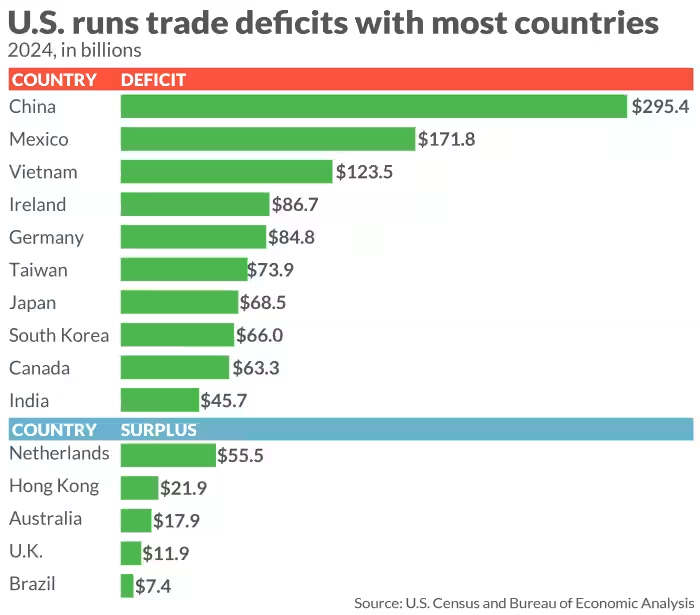
- In 2024, the US had a trade deficit with 92 countries and a trade surplus with 111 countries.
- The US’s large trade deficit is highest with three major economic partners – China, Mexico and Vietnam.
- In 2024, the US-China deficit was $295bn, the US-Mexico deficit at $172bn and the US-Vietnam deficit at $123bn.
16.
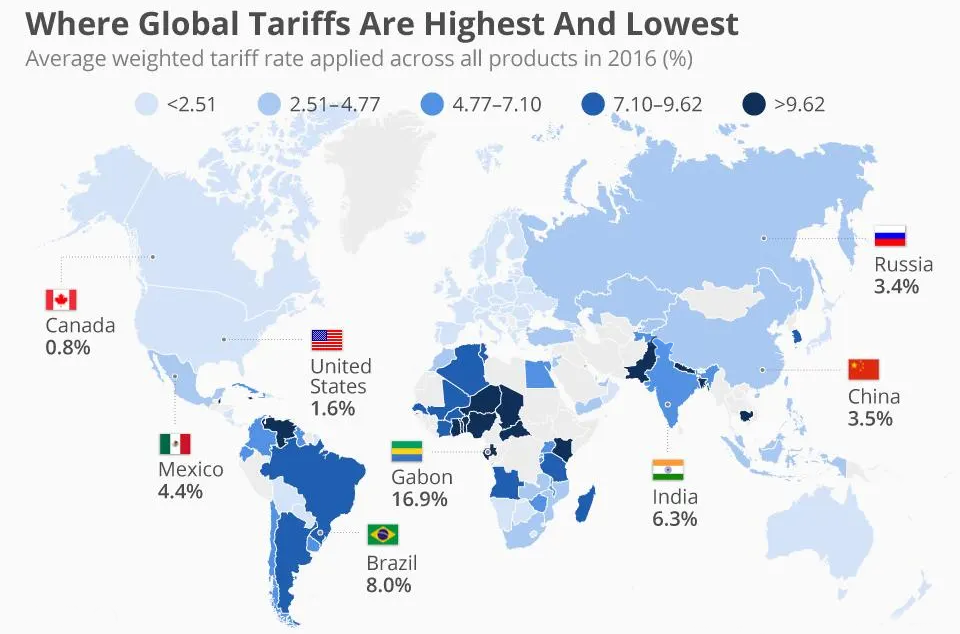
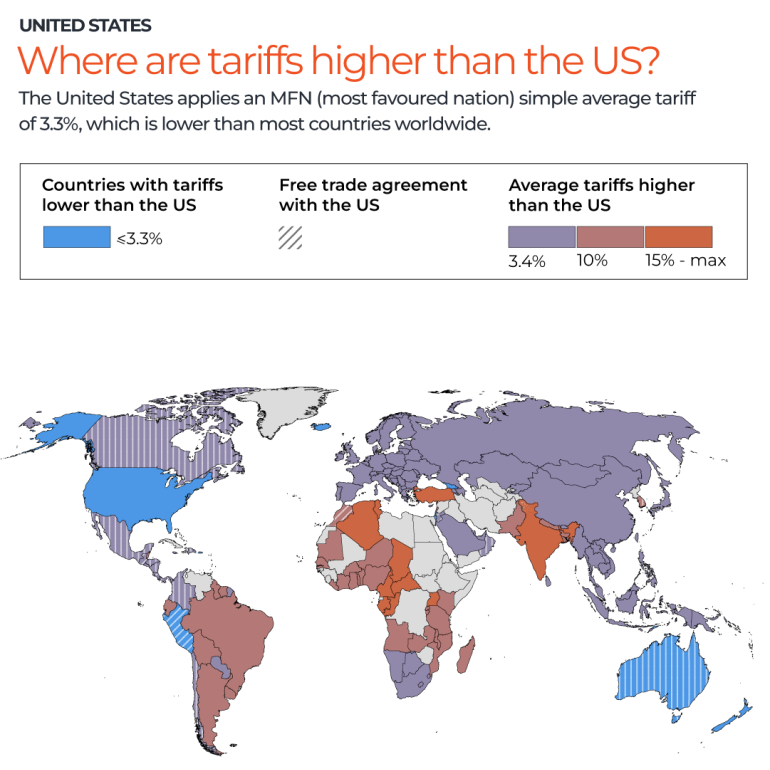
Which countries have the highest and lowest tariffs?
17.
What are the implications of tariffs?
| Implications | Analysis |
|---|---|
| Disruption of international trade flows |
|
| Increase in prices |
|
| Economic uncertainty |
|
| Retaliatory measures |
|
18.
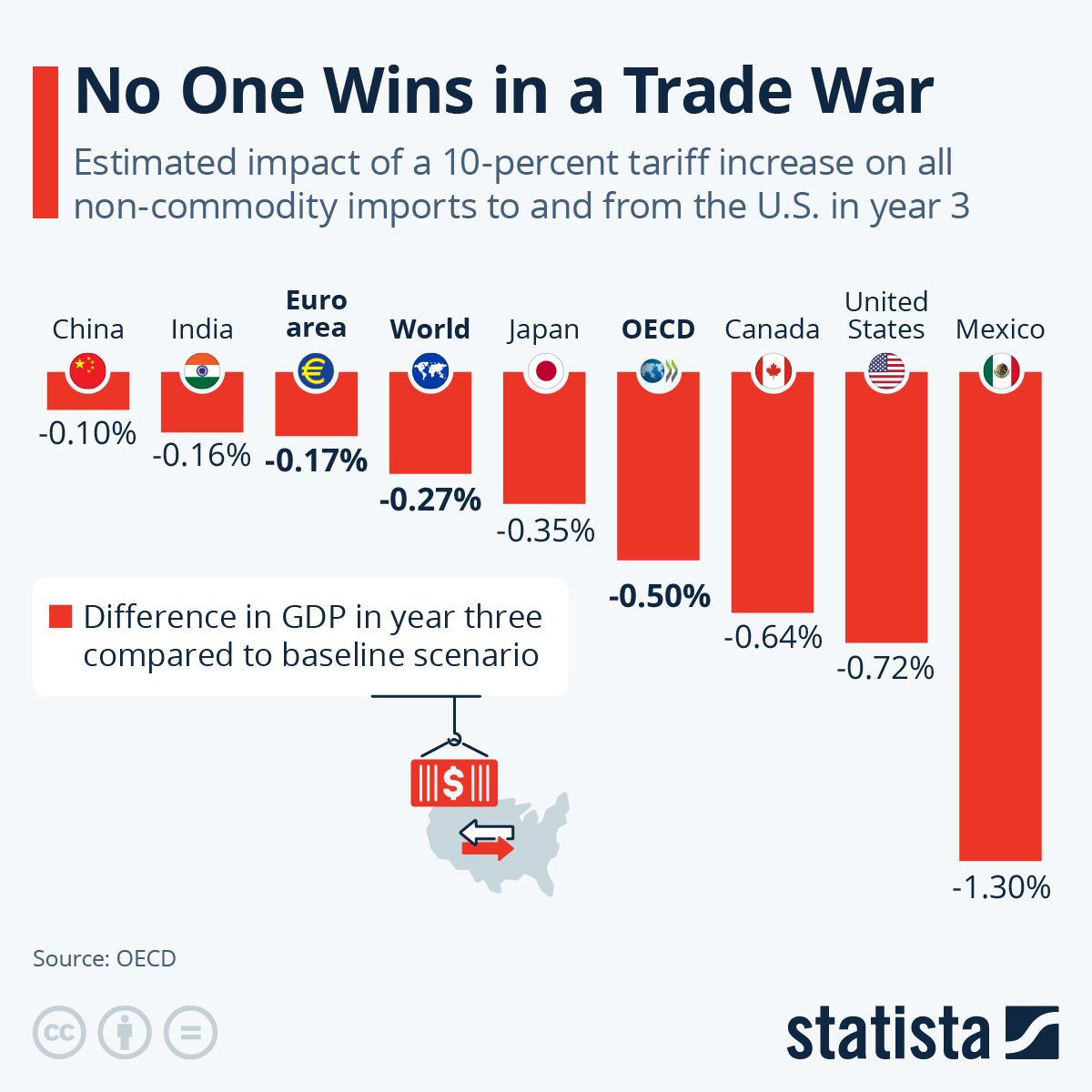
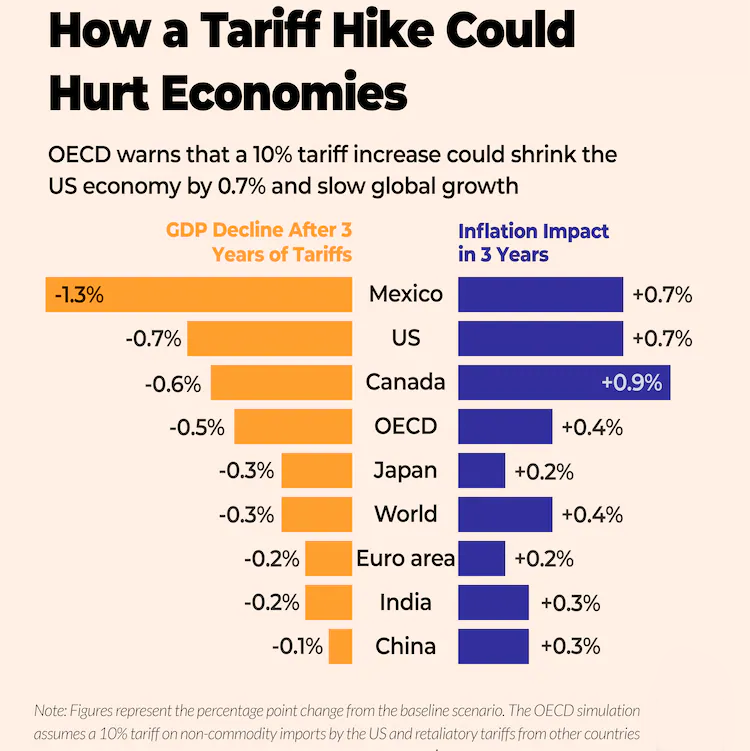
What will be the impact of tariffs on GDP?
- The OECD published its latest economic outlook, downgrading its global growth projections for 2025 and 2026 in light of various political and economic uncertainties.
- Compared to its last outlook, published in December 2024, the OECD revised its global GDP growth projection for 2025 from 3.3 percent to 3.1 percent and its 2026 estimate from 3.3 percent to 3.0 percent.
19.
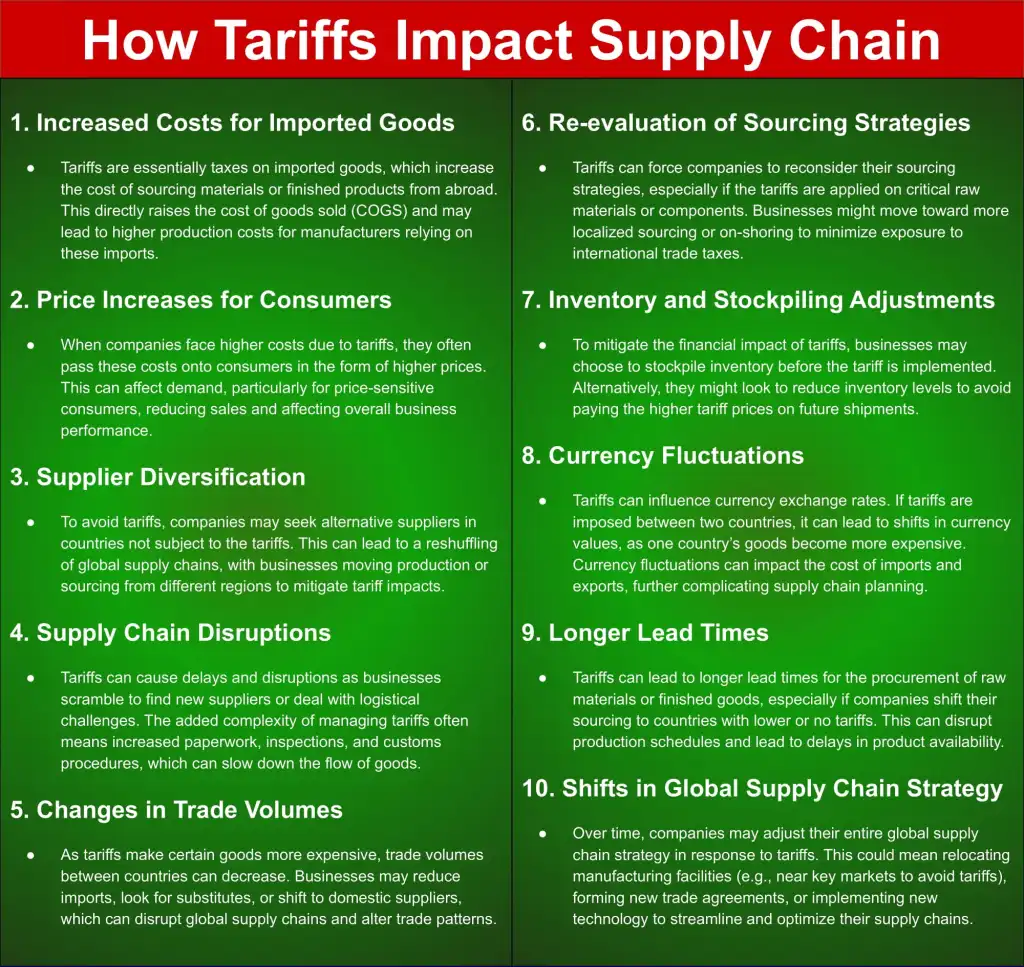
How tariff impacts the supply chain?
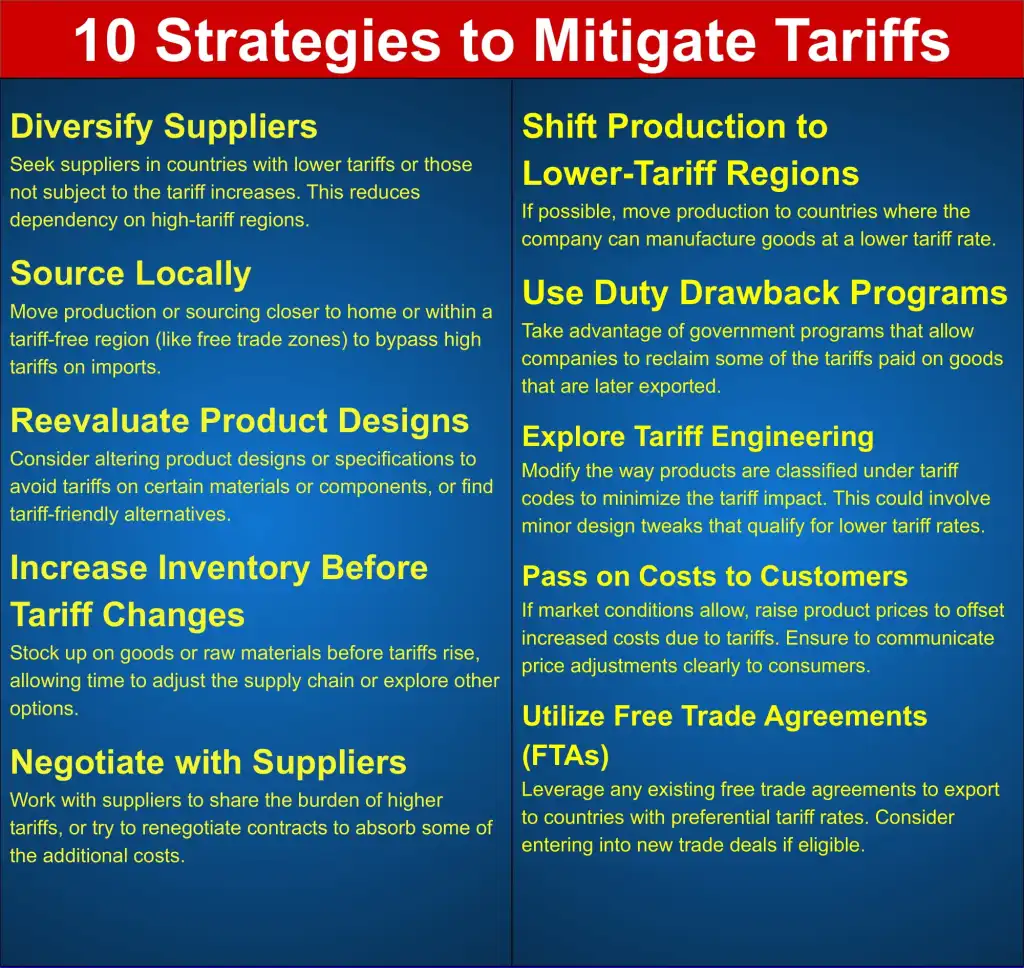
- Tariffs impact the supply chain in a multitude of ways, influencing everything from costs and pricing to sourcing and inventory strategies.
- While businesses can adapt through diversification, nearshoring, and strategic stockpiling, they must also deal with increased complexity and uncertainty.
20.
How does the Trump tariff impact the global stock market?
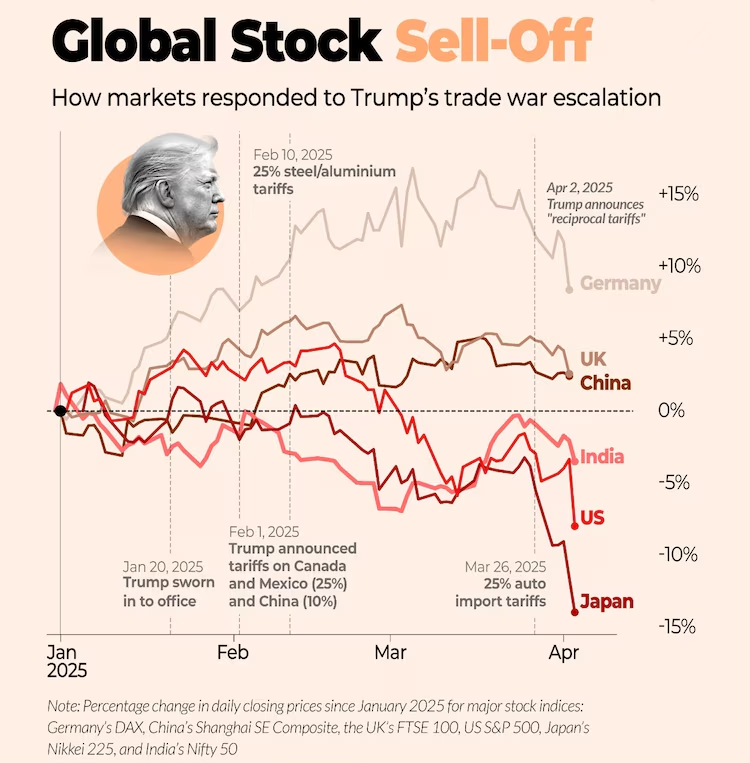
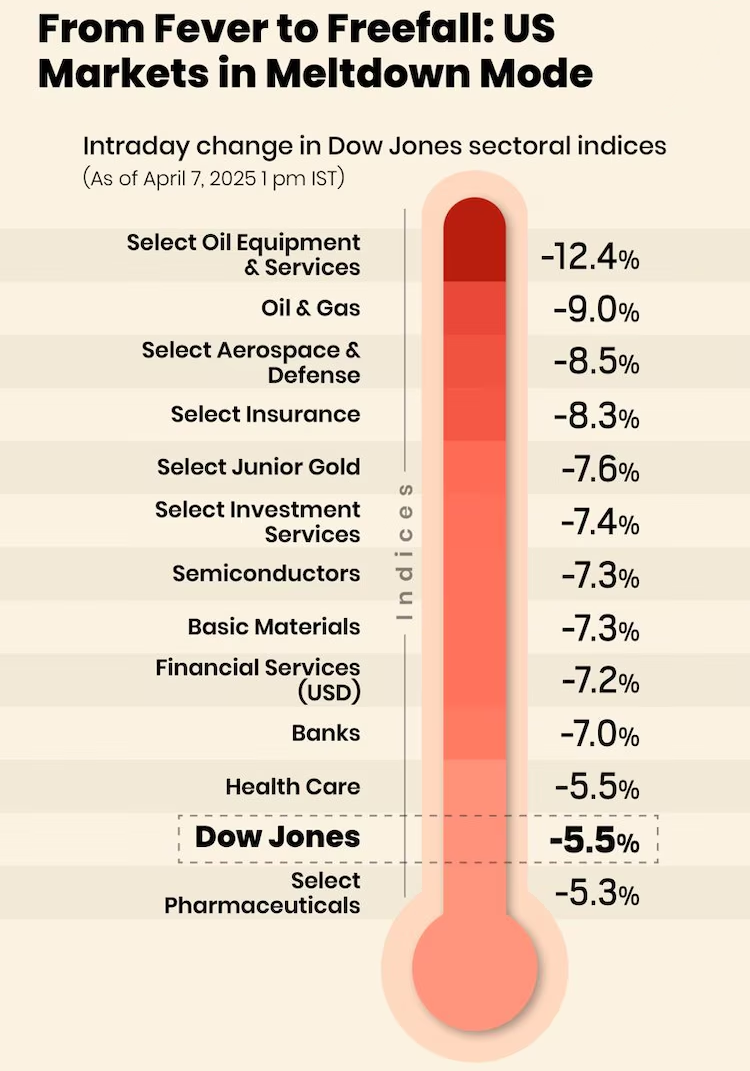
- Markets across the globe plunged into chaos on April 7,2025 (Monday) as Donald Trump's sweeping tariffs sent shockwaves from Wall Street to Asia.
- With no signs of backing down, US President Donald Trump doubled down on his aggressive trade stance, demanding that other nations "pay a lot of money" to lift duties as high as 50%.
- Asian markets have been hit particularly hard, with markets in Japan and Taiwan hitting circuit breakers for the first time since March 2020.
- In Tokyo, the Nikkei 225 nosedived to its lowest level in over 18 months, with banks shedding almost a quarter of their market cap in just three sessions.
- India's Dalal Street fared no better, with the Sensex and Nifty crashing more than 5% in pre-open trade.
21.
What happened the last time the US imposed tariffs on this scale?
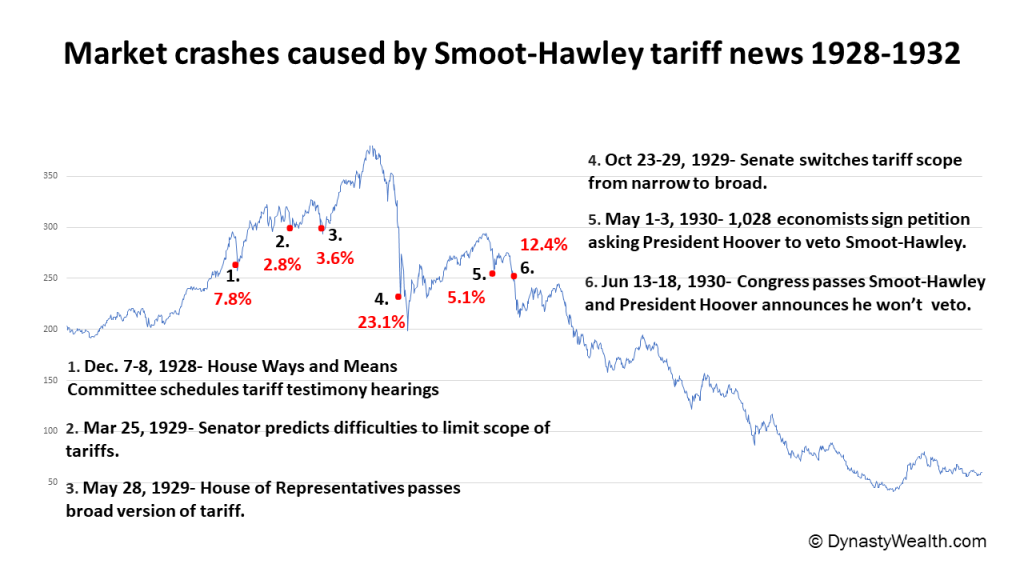
- The last time the US imposed tariffs similar to those issued by Trump was at the outset of the Great Depression.
- The Smoot-Hawley tariffs were passed in 1930 against the advice of many economists.
- They raised the average tariff by 20 percent.
- The goal was to protect American farmers and businesses that had ramped up production during World War I, only to see prices collapse when European manufacturing ramped back up thereafter.
- However, the tariffs ended up triggering retaliatory tariffs from European trading partners, causing international trade to decrease significantly.
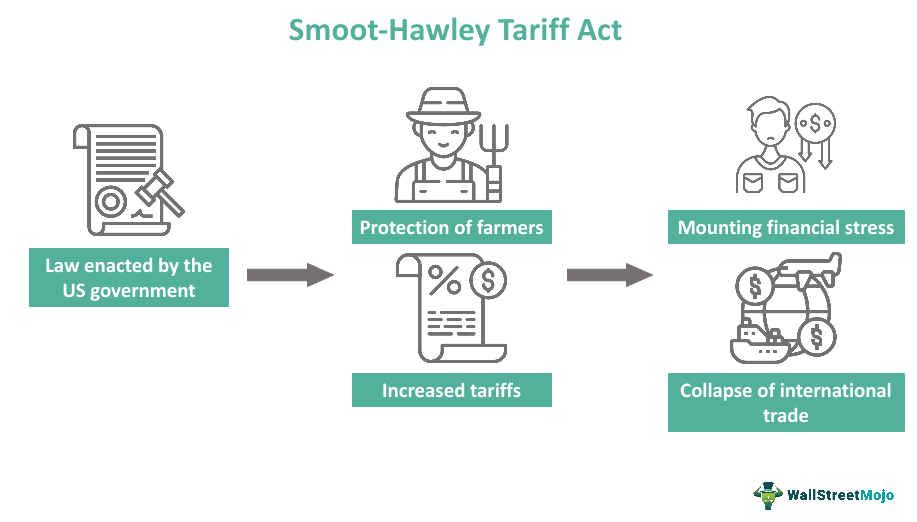
- Between the United States and Europe alone, trade fell by about two-thirds between 1929 and 1932, deepening the depression.
- The tariffs were ultimately repealed in 1934.
- But they had more lasting geopolitical impacts as some historians speculate that the resulting economic fallout globally helped contribute to the rise of Adolf Hitler in Germany.
22.
Do Americans support Trump’s tariff move?
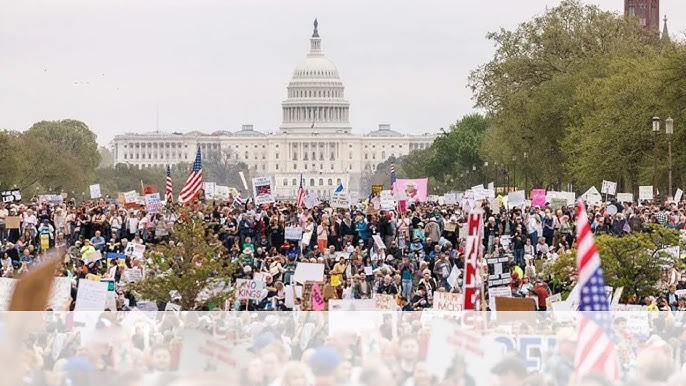
- On April 2, which Donald Trump dubbed "Liberation Day," the president announced extensive new tariffs.
- Trump's announcement sent the markets into turmoil with Wall Street recording its worst day since 2020, when COVID-19 was in full swing.
- A Wall Street Journal poll conducted by Trump’s campaign pollster, Tony Fabrizio, showed a downturn in Trump’s approval rating.
- Trump’s approval ratings have fallen to their lowest point since he assumed office amid the tariff furor.
- While Trump’s immigration policies remain relatively popular, buoying his overall approval ratings, that’s not the case when it comes to his economic policies.
- Polls conducted over the last month indicate that between 37 and 45 percent of Americans approve of Trump’s performance on the economy.
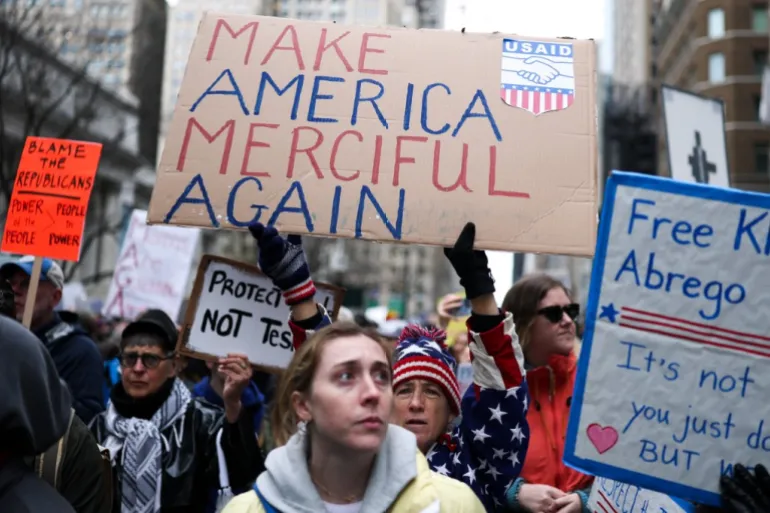
- 51 percent of Americans said they back the statement that "Republicans are crashing the American economy in real time and driving us into recession. This is not liberation day, it's recession day."
- A majority of Americans said in a March 27 CBS News/YouGov poll that Trump is focusing too much on tariffs and not enough on reducing prices.
- A separate YouGov poll conducted shortly after Trump’s tariff announcement found that a majority of Americans disapproved of the tariffs, 40 percent strongly so.
23.
Why did Donald Trump spare Russia, North Korea from massive Liberation Day tariffs?
- Russia and North Korea were also not on the list of countries facing additional tariffs, and exactly why is a bit of a mystery.
- The White House has reportedly argued that they are “already facing extremely high tariffs, and our previously imposed sanctions preclude any meaningful trade with these countries.”
- However, other countries facing significant US sanctions, including Venezuela, were hit with additional tariffs.
- Also, the US still trades significantly more with Russia than with other countries that were not spared, some of which are remote islands.
- After Russia’s 2021 invasion of Ukraine, the US imposed economic sanctions on Russia that caused trade between the two countries to fall from about $35 billion to $3.5 billion last year.
- Russia is currently in talks to lift those sanctions as part of an agreement to end the war in Ukraine.
24.
What will be the impact of tariffs on the USA?
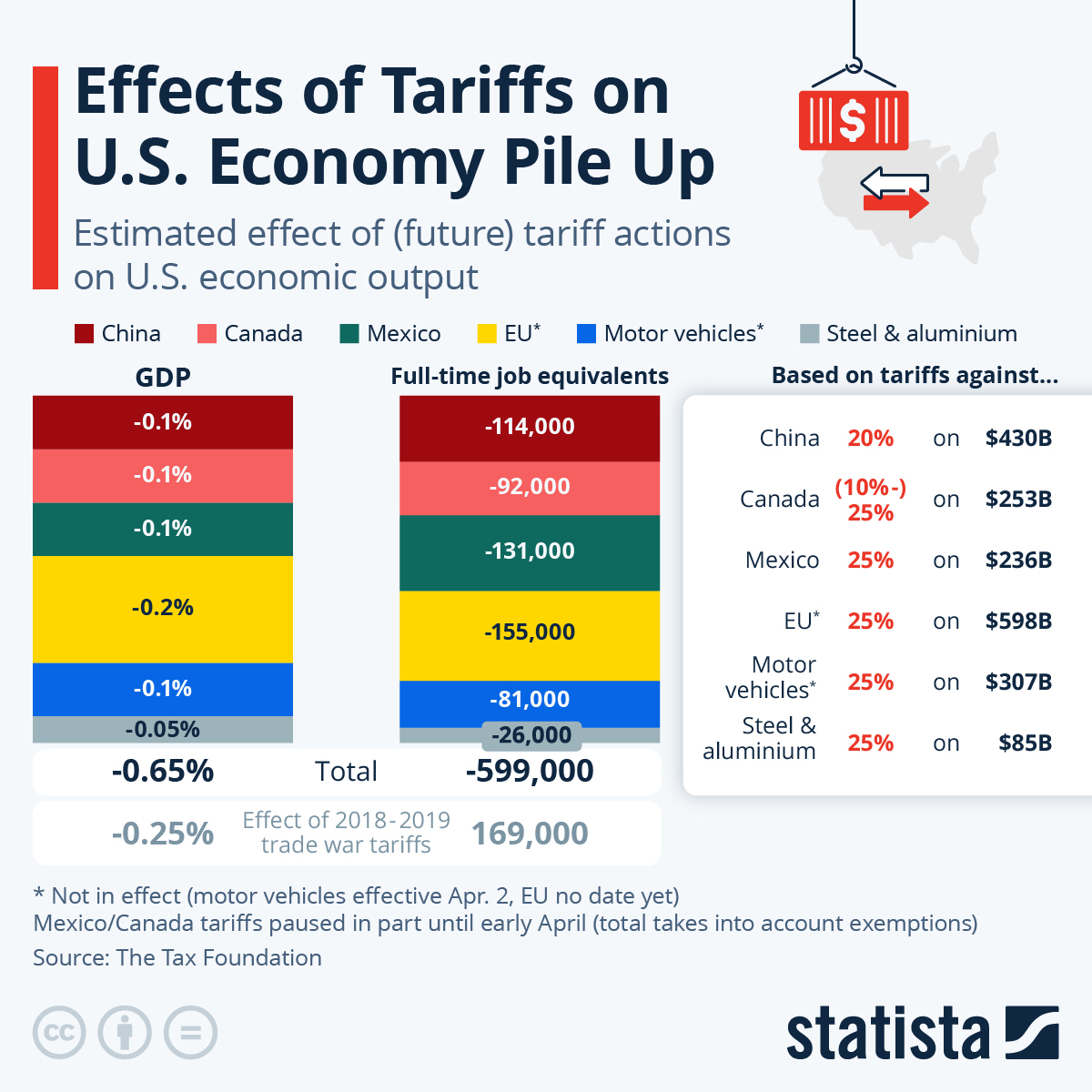
- As per a report by The Tax Foundation, tariff actions currently in effect and announced by the Trump administration could lower U.S. GDP by up to 0.65 percent.
- All these tariff actions combined could also lower U.S. full-time employment by almost 600,000.
- For comparison, The Tax Foundation estimates that 2018-2019 trade war tariffs, mostly with China, lowered U.S. GDP by just 0.25 percent and cost around 170,000 full-time jobs (including retaliatory action).
- On the other side of the equation stands an increase of government income of between $229-263 billion from tariffs in 2025 (and slightly more each year after that if they stayed in place).
- However, compared to all of government revenue, this number would still be in the single digit percent share of the budget.
25.
What can be the potential impact of Trump's Tariffs on the Indian Economy?
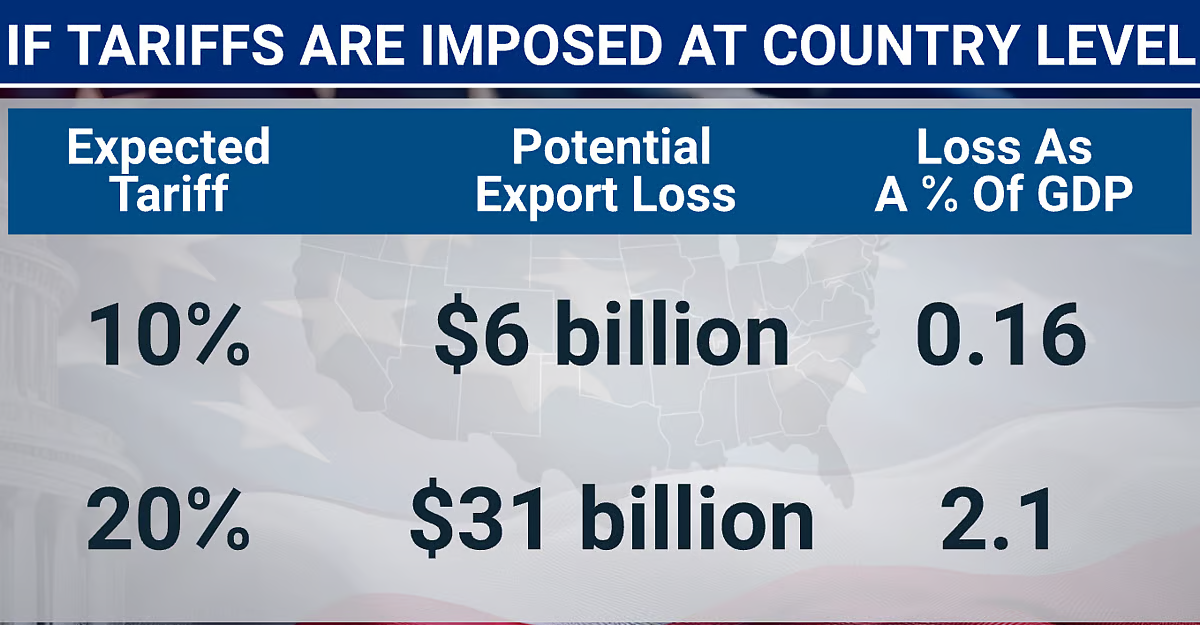
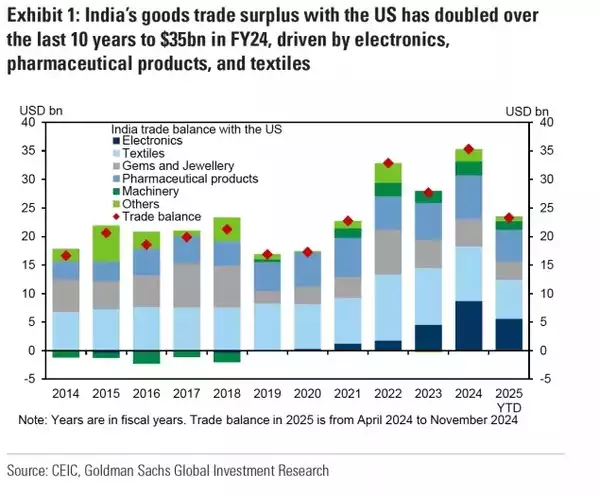
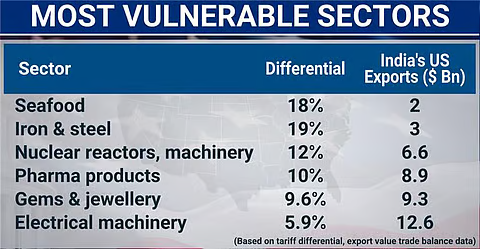
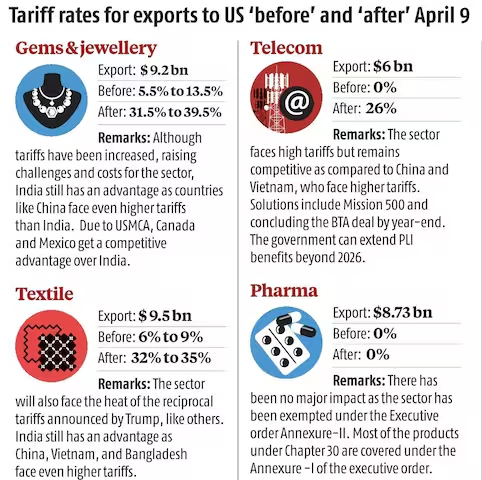
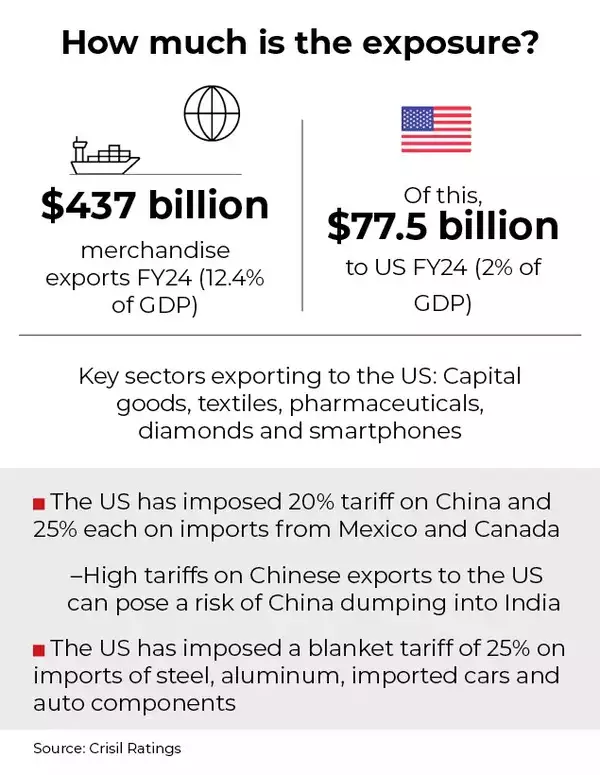
- The recent imposition of a 26% reciprocal tariff by the United States on Indian imports coupled with the ongoing US-China trade tensions, affects various sectors of the Indian Economy.
| Sectors | Analysis |
|---|---|
| Trade and Exports |
 Reduced Global Demand and Export Vulnerability:
Trade Diversion: Limited and Conditional Gains:
Export Uncertainty and Long-term Strategic Concerns:
Sector-Specific Impacts-Pharma, Textiles & Jewellery:
 |
| Supply Chain Disruptions |
Pharmaceuticals:
Auto Components:
Manufacturing Competitiveness:
|
| Financial Markets volatility |
Equity Markets: 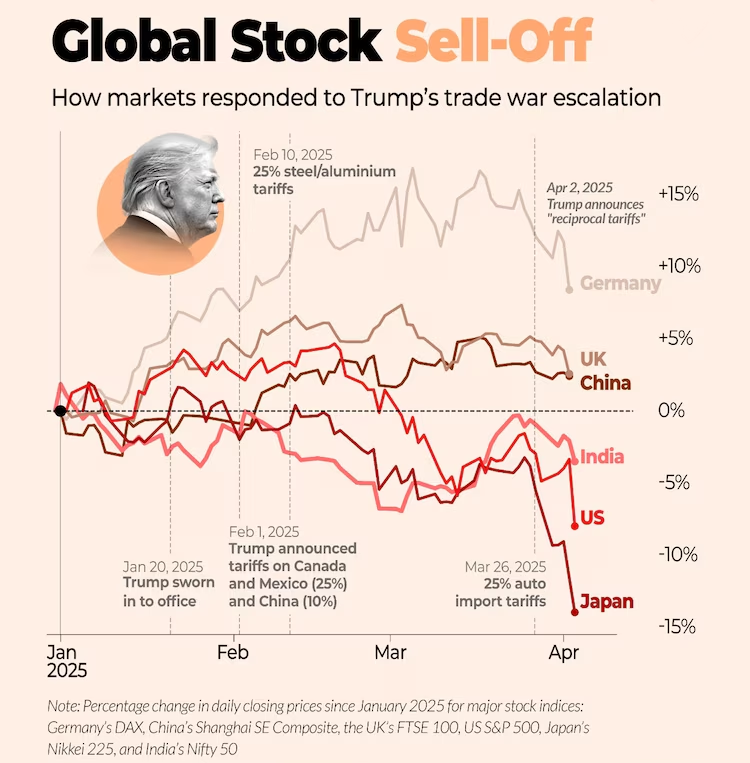
Debt Markets:
Surge in Precious Metals:
|
| Macroeconomic Implications |
GDP Growth:
Inflation:
 Currency Volatility:
|
| Employment crisis |
Export Oriented Jobs:

Manufacturing Slowdown and resulting job loss:
Informal Sector Vulnerability:
Lag in Job Creations:
|
| China dumping products in India |
 |
26.
What are the positive aspects for India?
| Sectors | Analysis |
|---|---|
| Trade Diversions |
|
| Leveraging Changed Geopolitical Dynamics |
|
| Reconfiguration of Global Value Chains |
 |
| Revamping Domestic Momentum |
|
| India-China relations |
|
27.
Why is Andhra Pradesh Chief Minister N Chandrababu Naidu concerned with US tariffs?
- Amid US President Donald Trump’s tariff announcements, Andhra Pradesh Chief Minister N Chandrababu Naidu has written to the Centre, seeking help for the state’s fish farming products.
- Naidu has requested the central government to ensure that products like shrimp are exempt from additional duty.
- Andhra Pradesh is a major exporter of shrimp and fish to the US.
- Aqua farmers and shrimp and fish exporters operate with 5 to 6 per cent profit margins, according to officials.
- The Trump administration has levied a 27 percent tariff on aqua exports from India, which will come into effect this week, apart from a 5.77% countervailing duty and a 1.38% anti-dumping duty imposed by the US Department of Commerce.
- This will drastically increase the cost of exports.
- On the other hand, countries that compete with India, especially Ecuador, face less tariffs, with the US imposing only 10 per cent tariff on the South American country.
- This will harm the interests of Indian aqua farmers.
28.
Why is Andhra Pradesh Chief Minister N Chandrababu Naidu concerned with US tariffs?
| Measures | Analysis |
|---|---|
| Diversification of Supply Chains |
|
| Utilization of Trade Finance Instruments |
|
| Cost Management and Efficiency Improvements |
|
| Governmental and Legal Support |
|
| Strategic Stockpiling |
|
29.
Enlist measures to stop trade war?
- In order to stop a trade war, it’s crucial to prioritize diplomatic engagement, open communication, and negotiation of fair trade agreements.
- Countries involved should address the root causes of the dispute, such as unfair trade practices, intellectual property concerns, or tariff imbalances, through constructive dialogue and compromise.
| Measures | Analysis |
|---|---|
| Diplomatic Engagement |
|
| Negotiating Trade Deals |
|
| Focus on Fair Trade Practices |
|
| Economic Incentives & Cooperation |
|
What is the relevance of the topic for UPSC CSE?
For Prelims: India-US Relations, LEMOA, COMCASA, BECA, Silicon Valley, International Bank for Reconstruction and Development , Exercise Malabar, NISAR mission , Digital services tax , CAATSA, US-India initiative on Critical and Emerging Technology.
For Mains: Significance of the United States for India, Key Issues in India-US Relations, Trade war, Role of WTO.
Some Previous Years Prelims Questions
Q1. What is “Terminal High Altitude Area Defense (THAAD)”, sometimes seen in the news? (2018)
(a) An Israeli radar system
(b) India’s indigenous anti-missile programme
(c) An American anti-missile system
(d) A defence collaboration between Japan and South Korea
Some Previous Years Mains Questions
Q1. ‘What introduces friction into the ties between India and the United States is that Washington is still unable to find for India a position in its global strategy, which would satisfy India’s National self-esteem and ambitions’. Explain with suitable examples.(2019- 15 Marks)
Some Questions from This Year and Previous Years Interview Transcripts
Board Dinesh Dasa sir:
- What is Reciprocal tariff and what are their impacts?
- Tell me something about globalization and De-globalisation.
Board Lt general Raj shukla sir:
- Tell me something about the Tariff war by Trump.
- What is the percentage of tariff imposed on China, Canada and Mexico?
- Why are tariffs imposed on these countries?
- Tell me something about the Auto tariff on india export and car brand exported from india
Board Sheel Vardhan Singh sir:
- You are interested in Geopolitics.
- I am a magician.
- I turn you into President Zelenskyy and those sitting beside you are Mr. Trump and Mr. Putin.
- How would you negotiate?
Board BB Swain sir:
- Why does Trump want Greenland?
- Which resources are found there?
- Why so much chaos in geopolitics?
Board Suman Sharma mam:
- Tell me something about global world order
- Differentiate early World order vs present World order?
- Tell me something about Trump's impact on World order?
Board Lt general Raj shukla sir:
- Many millionaires are coming in the Trump administration?
- Is it good?
Board Lt general Raj shukla sir:
- How is Trump good for Indian interests?
- Wouldn’t such sanctions affect Indian exports?
Some Questions for QUIZ
Q1. Consider the following Countries:
1. United States
2. India
3. France
4. Saudi Arabia
5. Italy
How many of the above countries are part of the IMEC?
(a) Only two
(b) Only three
(c) Only four
(d) All five
Some Questions for POLL
Q1. Do you think that under the Trump regime India-US relations will flourish?
(a) YES
(b) NO
(c) Can’t say
Q2. Should India fear Trump's Trade war?
(a) YES
(b) NO
(c) Can’t say
Q3. Will Trump’s tariff help strengthen India-China relations?
(a) YES
(b) NO
(c) Can’t say
 Other Topics
QUICK LINKS

 Call
Call